

Automating Legal Contract Review: Smarter, Faster, More Accurate
Legal teams handle mountains of contracts vendor agreements, NDAs, service terms, compliance documents, and more. Reviewing each one manually is slow, expensive, and prone to human error. In a business world where speed and precision matter, automation is transforming how organizations approach contract review.
Why Traditional Contract Review Falls Short
- Time consuming: Lawyers and legal staff often spend hours combing through repetitive clauses.
- High costs: Manual review requires significant billable hours or large in house teams.
- Risk of oversight: Even skilled professionals can miss hidden risks in dense legal text.
- Inconsistent results: Different reviewers may interpret terms differently, creating compliance gaps.
Automation changes this dynamic by applying advanced technologies like AI and natural language processing (NLP) to streamline the entire process.
What Contract Review Automation Delivers
Speed and efficiency
AI tools can scan hundreds of pages in minutes, flagging key terms and deviations instantly.
Consistency in interpretation
Automated systems apply the same rules across every contract, eliminating subjective differences.
Risk detection
Automation highlights unusual clauses, missing terms, and compliance risks so legal teams can focus on high-value decisions.
Cost savings
By reducing manual effort, companies cut legal expenses while still maintaining accuracy.
Better compliance
Automated workflows ensure critical legal and regulatory clauses are never overlooked.
How Automation Works in Contract Review
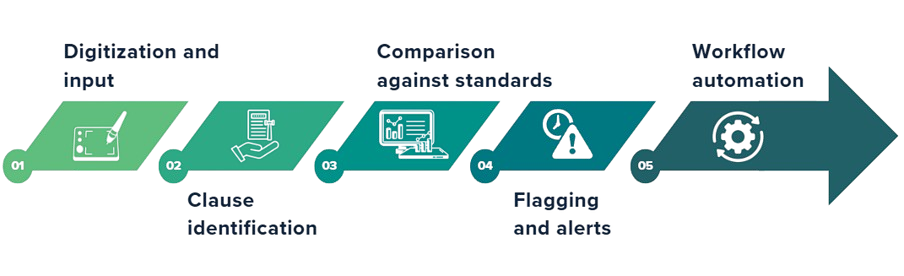
Digitization and input
- Contracts are uploaded in digital format, ready for machine analysis.
Clause identification
- AI scans documents, recognizing key clauses (confidentiality, termination, indemnity, liability limits, etc.).
Comparison against standards
- Each clause is checked against company playbooks, templates, or regulatory guidelines.
Flagging and alerts
- Deviations, risky terms, or missing clauses are highlighted for human review.
Workflow automation
- Approved contracts can be routed automatically for signatures, archiving, or further negotiations.
Tools That Enable Automated Contract Review
- AI Contract Platforms: Luminance, ThoughtRiver, Kira Systems
- Legal Tech Suites: Ironclad, ContractWorks, DocuSign CLM
- Workflow Automation Tools: Power Automate, Zapier, Make (for routing tasks and notifications)
Best Practices for Adopting Automation
- Start with standard contract types (NDAs, vendor agreements) before scaling to complex deals.
- Build a legal playbook to train AI tools on acceptable clauses and company policies.
- Balance automation with human oversight lawyers still make the final calls.
- Track performance with metrics like review time saved, error reduction, and risk mitigation.
Challenges and Considerations
While automation delivers clear benefits, organizations should also weigh certain challenges:
- Not all tools interpret complex legal language perfectly. Human oversight is still critical.
- Every business has unique policies and risk tolerance. Setting up automation to reflect these nuances takes time.
- Legal, HR, procurement, and sales teams often use different platforms. Smooth integration is essential for end-to-end automation.
- Contracts often contain sensitive business information. Vendors must comply with strict data protection standards.
- Legal teams may be hesitant to trust AI. Successful adoption requires training, clear workflows, and buy in from stakeholders.
Final Thoughts
Automating legal contract review is not about replacing lawyers it’s about freeing them from repetitive, low value tasks. With automation handling the heavy lifting, legal teams can spend more time on strategy, negotiation, and risk management.
Organizations that embrace contract automation gain a competitive edge: faster deal cycles, fewer risks, and reduced costs all while strengthening compliance.