

Pharma Commercial Analytics: KPIs Every Brand Team Should Track
Pharma commercial teams operate in a highly competitive, fast moving market where every decision from targeting the right HCPs to optimizing patient support programs depends on accurate, timely data. Yet despite having access to massive datasets, brand teams often struggle to turn that information into actionable insights.
The result? Missed opportunities, inconsistent performance, and reactive decision making.
Commercial analytics changes this. By focusing on the right KPIs, pharma companies gain clarity on what drives growth, what slows performance, and where intervention is needed. In an era defined by precision engagement and data driven execution, knowing which KPIs matter is the difference between leading the market and falling behind.
The Challenge: Too Much Data, Not Enough Actionable Insight
Brand teams rely on countless data sources HCP engagement, prescription trends, CRM activity, patient adherence, marketing performance, market access barriers, and more. Each dataset is valuable, but when viewed in isolation, the full picture remains unclear.
This leads to common challenges:
- Misaligned strategies: Field teams may focus on high volume HCPs while true influence lies elsewhere.
- Delayed visibility: Prescription drops or adherence gaps are noticed weeks after they occur.
- Unclear impact: Marketing teams cannot clearly measure what channels drive actual prescribing behavior.
- Inconsistent reporting: Each team works from its own metrics, creating fragmented narratives.
Too much data is not the problem the lack of consolidated, meaningful KPIs is.
The Importance of Tracking the Right KPIs
Every brand team needs a structured KPI framework that aligns commercial, field, medical, and patient support functions around shared goals.
Choosing the right KPIs helps:
- Reveal the real drivers of brand performance
- Enable proactive strategy adjustments
- Identify emerging risks early
- Align teams around consistent success metrics
- Improve forecasting accuracy
When KPIs are standardized and visible across the organization, everyone from the brand director to the field rep operates with the same intelligence.
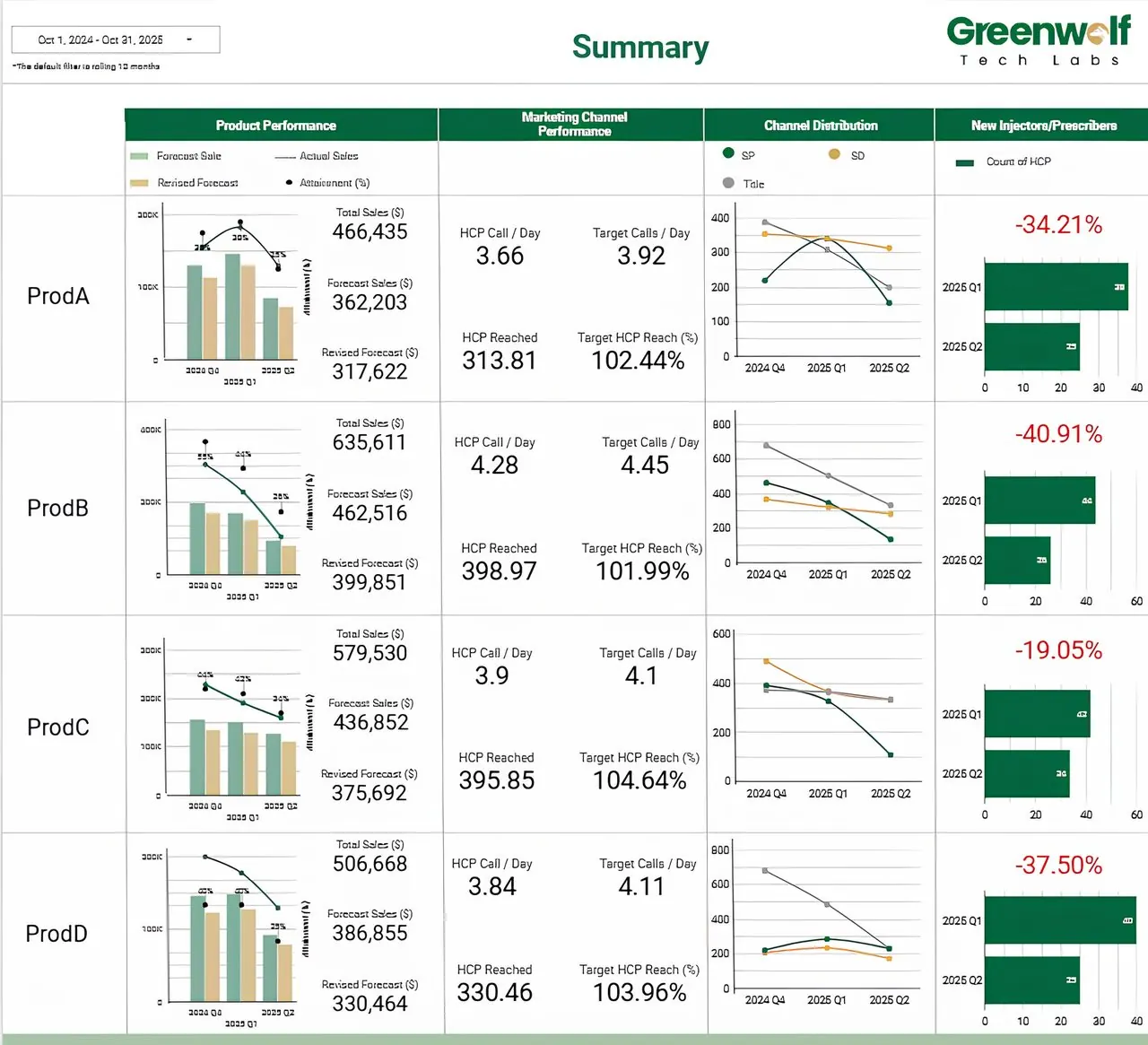
Essential KPIs Every Pharma Brand Team Should Track
HCP Engagement & Coverage KPIs
These KPIs show how effectively field and marketing teams reach and influence prescribers. These reveal whether the right physicians are being reached and whether engagement is actually driving behavioral change.
- Target HCP Coverage %
- HCP Calls / Interactions
- Call Quality & Message Delivery Score
- Digital Engagement Metrics (email opens, webinar attendance, portal usage)
Prescription & Demand KPIs
The core indicators of brand performance. When combined with geography and specialty insights, these KPIs show exactly where the brand is accelerating or losing momentum.
- New Prescriptions (NRx)
- Total Prescriptions (TRx)
- Brand Share vs Competitors
- Growth % (MoM, QoQ, YoY)
Patient Journey & Adherence KPIs
A strong script does not guarantee continuation these KPIs measure patient success. These metrics help teams identify where patients struggle and where program improvements will have the most impact.
- Adherence Rate (%)
- Refill Rate (%)
- Drop-off Rate (%)
- Time to Therapy Initiation
- Patient Support Program Enrollment %
Market Access & Reimbursement KPIs
Even high demand brands fail if access barriers are not managed. These KPIs directly affect prescription volume and patient adherence.
- Prior Authorization Approval Rate
- Payer Coverage %
- Time to Approval
- Reimbursement Denial Rate
- Out of Pocket Cost Trends
Sales Force Effectiveness KPIs
Field execution remains a critical driver of commercial success. These show how field actions translate to real commercial outcomes.
- Sales Rep Performance Score (%)
- Call Reach vs Target
- HCP Frequency & Depth
- Territory Level Attainment
Forecasting & Attainment KPIs
Brand planning depends on reliable projections. A strong forecasting framework prevents over or under investment in critical markets.
- Forecast vs Actual Sales
- % Attainment
- Revised Forecast Accuracy
- Variance Drivers (HCP behavior, access shifts, seasonality)
Why These KPIs Matter: Moving from Visibility to Strategy
Brand Teams Gain Real Time Clarity
Instead of analyzing last month’s performance, teams see what’s happening today and adjust strategies immediately.
Field Teams Focus on High Value Actions
Data highlights which HCPs need more engagement, which territories require support, and which messages are resonating.
Marketing Teams Optimize Spend
Channel level performance shows which campaigns drive actual prescriptions, not just clicks.
Patient Support Programs Improve Outcomes
Patient level insights reveal adherence gaps early, enabling proactive intervention.
Leadership Aligns Around a Shared Truth
No more debating numbers. One KPI framework ensures consistency across commercial, medical, and access functions.
Building a KPI Driven Commercial Strategy
A high performing brand team integrates KPIs across:
- CRM systems
- Prescription and claims data
- HCP engagement analytics
- Patient support program data
- Market access systems
- Marketing technology platforms
The result is a unified commercial view where every department sees how its actions influence overall performance.
Challenges and Considerations
Implementing a KPI driven analytics ecosystem requires careful planning:
- Data Integration Complexity – Linking CRM, claims, patient, and access systems requires a scalable data strategy.
- Data Quality & Governance – KPIs are only as good as the accuracy of the data behind them.
- Change Management – Teams must shift from intuition led to data led decision making.
- Technology Adoption – Modern BI tools, AI models, and automation accelerate insights but require skilled execution.
Final Thoughts
Pharma brands don’t just need data, they need the right KPIs to turn that data into commercial power. The companies that lead the next decade will be those that create a unified KPI framework that aligns every team and drives every decision.
Commercial analytics is not just reporting, it is a strategic accelerator.
With the right KPIs, brand teams move faster, collaborate better, and deliver stronger patient and business outcomes.
Pharma doesn’t need more dashboards. It needs analytics that create clarity, action, and impact.
Have a Project in Mind? Let’s Talk.
Part of our Pharma Commercial and Patient Analytics hub. Start with our specialty pharmacy analytics.