

Nuclear Supplier Identification and Qualification Support
Nuclear supply chain supplier identification: find NQA-1, 10 CFR 50 Appendix B and ASME N stamp suppliers, with qualification records kept current.
Get a free proposal
Tell us what you need. A consultant replies within one working day.
01
What is nuclear supplier identification?
Nuclear supplier identification is the work of finding companies that can make or supply a specific item or service for a nuclear facility, and nuclear supplier qualification is the work of confirming, with evidence, that each of them operates a quality programme the buyer can accept: typically ASME NQA-1 or 10 CFR 50 Appendix B in the US, an ASME Section III certificate for code items, and equivalent programmes such as RCC-M, ISO 19443 or CSA N299 elsewhere.
The first half is a search problem. The second half is an evidence problem. In most industries a sourcing team can find five capable machine shops in an afternoon. In nuclear, the same team has to find shops that are capable, hold the right quality programme for the safety classification of the item, have been audited recently by someone whose audit the buyer can rely on, accept 10 CFR Part 21 obligations, and can still deliver inside the outage or construction schedule. The list of companies that pass every test is short, it changes as certificates lapse and suppliers leave the market, and the evidence sits in a dozen places.
Greenwolf builds the data and automation behind that work: automated scouting across registries, certificate holder lists, trade directories and the open web; a supplier record that holds every qualification attribute that matters; and comparison packs that let your quality and procurement engineers make the decision faster. We do not qualify suppliers ourselves and we are not a nuclear supplier. Your QA organisation stays the authority on who goes on the approved list. We make sure they are looking at a complete, current and well-organised field when they decide.
This page is the nuclear-specific version of our general supplier identification services, written for teams buying safety-related and augmented-quality items.
02
Why finding nuclear qualified suppliers is hard
Qualification programmes and code stamps
A capable fabricator is not a usable supplier until its quality programme matches the item. Safety-related scope in the US needs an Appendix B programme, usually implemented through NQA-1, and code items need the right ASME Section III certificate for the right scope.
- Programme must match safety classification
- Certificate scope is narrower than the company name suggests
A small qualified base per commodity
For many commodities only a handful of companies worldwide hold both the capability and the qualification. Many shops left nuclear work after the build programmes of the 1970s and 1980s ended and never rebuilt their programmes.
- Few alternates when one supplier slips
- Hidden single-source exposure
Long-lead forgings and castings
Only a few facilities worldwide can produce the largest forgings to nuclear quality standards, and press capacity, not welding shops, sets the pace for reactor vessels and steam generators. Large castings, pump casings and valve bodies have long queues of their own.
- Lead times measured in years for heavy items
- Capacity booked across several projects at once
Obsolescence in operating fleets
Plants designed decades ago run on parts whose original manufacturer has closed, been acquired, stopped making the item or dropped its Appendix B programme. Each case becomes a hunt for an equivalent, an alternate source, a dedicated commercial item or a reverse-engineered replacement.
- Licence extensions lengthen the tail
- Analogue instrumentation is a common pain point
Counterfeit, fraudulent and suspect items
The NRC expects licensees to keep counterfeit, fraudulent and suspect items (CFSI) out of their supply chains. That makes traceability, distributor authorisation and supplier history part of supplier selection, not an afterthought.
- Authorised distribution matters
- Certificates of conformance must be verifiable
First-of-a-kind SMR and advanced reactor supply chains
SMR and advanced reactor designs need components that have never been bought at volume: compact vessels, new fuel forms, graphite, molten salt and liquid metal systems. The supplier base is being built at the same time as the designs are licensed.
- New commodities with no supplier history
- Several developers chasing the same shops
Localisation requirements
Governments and utilities buying new reactors increasingly expect a share of the work to go to domestic suppliers. Sourcing teams then need to find local companies that can be brought up to nuclear quality, not only established exporters.
- Local content commitments in bids
- Supplier development, not only selection
03
Nuclear supplier qualification frameworks compared
Most nuclear supplier qualification work comes down to the frameworks below. They overlap but are not interchangeable: an ISO 19443 certificate does not make a supplier acceptable for US safety-related scope, and an NQA-1 programme does not authorise a shop to apply an ASME certification mark. A supplier record has to say which frameworks a supplier holds, for which scope, and when that evidence expires.
| Framework | What it covers | Where it applies |
|---|---|---|
| ASME NQA-1, Quality Assurance Requirements for Nuclear Facility Applications | Requirements and guidance for a quality assurance programme across siting, design, construction, operation and decommissioning. Part I sets programme requirements, Part II adds requirements for specific work activities, Part III is guidance. The current edition at the time of writing is NQA-1-2024, issued in July 2024. | US nuclear facilities, including SMRs and advanced reactors, and DOE facilities. The NRC's Regulatory Guide 1.28, Revision 6 (September 2023) endorses NQA-1-2017, 2019 and 2022 Parts I and II, with exceptions, as a way to meet Appendix B. |
| 10 CFR 50 Appendix B | The NRC's 18 quality assurance criteria for structures, systems and components that prevent or mitigate the consequences of postulated accidents. Covers design, purchasing, fabrication, handling, shipping, storage, installation, inspection, testing, operation, maintenance, repair and modification. | Licensees of US nuclear power plants and fuel reprocessing plants, flowed down to their suppliers of safety-related items and services. |
| 10 CFR Part 21, Reporting of Defects and Noncompliance | Obliges directors and responsible officers of firms supplying basic components to evaluate deviations and report defects that could create a substantial safety hazard. Also defines commercial grade dedication. Procurement documents for basic components must state that Part 21 applies. | US licensees and their suppliers of basic components, including dedicating entities. |
| ASME Boiler and Pressure Vessel Code, Section III | Rules for construction of nuclear facility components. ASME certifies the quality programme of the organisation and issues Certificates of Authorization by scope: N (vessels, pumps, valves, piping systems, storage tanks, core support structures, concrete containments, transport packaging), NPT (parts, appurtenances, welded tubular products, piping subassemblies), NA (field installation and shop assembly), NS (supports), NV (pressure relief valves), N3 (transportation and storage containments), plus OWN for plant owners and G and GC for graphite or composite core components. | Code items in the US and in other countries that adopt Section III. ASME publishes a searchable list of certificate holders. |
| RCC-M (AFCEN) | Design and construction rules for mechanical components of PWR nuclear islands: pressure equipment in safety classes 1, 2 and 3 and some non-pressure items such as vessel internals, supports, storage tanks and containment penetrations. Covers design, materials and procurement, fabrication, qualification of procedures and welders, examination, acceptance criteria, documentation and quality assurance. The 2022 edition is the latest at the time of writing. | France and projects based on French PWR designs. |
| ISO 19443:2018 | Sector-specific requirements for applying ISO 9001:2015 by organisations in the nuclear supply chain that provide products and services important to nuclear safety (ITNS). | International. Used mostly in Europe as a certifiable QMS for nuclear suppliers; it does not replace a licensee's own acceptance of the supplier. |
| CSA N299 series (N299.1 to N299.4) | Quality assurance programme requirements for the supply of items and services for nuclear power plants, in four categories from Category 1 (most stringent) to Category 4. Recent editions added requirements on dedication and guidance on CFSI. | Canada. |
| CSA N285 series | Requirements for pressure-retaining systems, components and supports in CANDU nuclear power plants, referencing the applicable parts of the ASME Code, plus periodic and in-service inspection standards. | Canada, CANDU plants. |
| KTA 1401 | General requirements for quality assurance in the safety standards of the German Nuclear Safety Standards Commission (KTA). Licence holders must ensure their contractors and subcontractors meet it. | Germany. Germany shut down its last operating power reactors in April 2023, but German manufacturers still publish KTA 1401 qualification confirmations. |
| NUPIC joint audits | Not a standard but a shared audit programme. The Nuclear Procurement Issues Corporation, formed in 1989 by US and several international utilities, runs joint audits of suppliers of safety-related items, services and commercial-grade items, with NRC staff periodically observing. | Member utilities, which share audit results instead of each auditing the same supplier. |
| Commercial grade dedication (EPRI 3002002982) | The process of accepting a commercial item for a safety-related use by verifying its critical characteristics. EPRI 3002002982 replaced the 1988 and 1994 guidance (NP-5652 and TR-102260). The NRC endorsed it, with exceptions, in Regulatory Guide 1.164 in June 2017. | US licensees and dedicating entities buying items not made under an Appendix B programme. |
Editions and endorsements change. Before relying on any line above for a purchase, check the edition your licensing basis, purchase order and quality assurance programme description actually call up.
04
The nuclear supplier record: what to hold for every supplier
Search finds names. Decisions need records. The most useful thing a nuclear sourcing or supplier quality team can own is a supplier record that answers the qualification questions before anyone asks them. These are the attributes we hold for each supplier, by commodity, with a source and a date on every value.
| Attribute | What it records | Why it matters |
|---|---|---|
| Legal entity and sites | Registered name, parent group, manufacturing addresses | Qualification attaches to a site, not a brand; acquisitions change it |
| Quality programme and scope | NQA-1 edition, Appendix B, ISO 19443, CSA N299 category, RCC-M or KTA qualification, with the scope statement | A programme covering machining does not cover welding or design |
| Code certificates by commodity | ASME certificate type (N, NPT, NA, NS, NV, N3), scope, certificate number, expiry | Determines which code items the supplier may certify |
| Audit history | Audit dates, auditing organisation (own, NUPIC, third party), result, open findings | Approved supplier lists usually depend on a current audit and periodic evaluation |
| Special processes | Welding procedures, heat treatment, NDE methods and personnel certification, coatings, cleaning | Often the real constraint on what a shop can make |
| Supply history | Past nuclear supply by item, plant, design and year; Part 21 notices involving the supplier | Evidence of capability beyond a brochure |
| Capacity and equipment | Key machines, press or furnace size, cleanroom class, test rigs | Screens out suppliers who cannot physically make the part |
| Lead times | Quoted and observed lead times by commodity | Outage and construction schedules live or die on these |
| Commercial grade dedication | Whether items are supplied safety-related, as commercial grade for dedication, or both; dedicating entity used | Decides the procurement route and engineering effort |
| Single-source and obsolescence flags | Whether the supplier is the only qualified source for an item, and whether the product is end of life | Highlights where an alternate is needed before it is urgent |
| Export control | Country, applicable regimes (for US work, NRC 10 CFR Part 110 for equipment and DOE 10 CFR Part 810 for technology and assistance), licences held | Some suppliers cannot receive drawings or ship without authorisation |
| Localisation | Country of manufacture and local content share | Needed for bids with domestic content commitments |
Holding this well is a master data problem as much as a sourcing problem: one entity per supplier, one site per location, controlled values for certificate types and commodities, and a history of every change. Our master data management service and enterprise MDM work on Informatica and Reltio use the same discipline for customer and product data.
05
How Greenwolf runs nuclear supplier identification, step by step
Define the commodity and the requirement
We start with your engineering and quality people: the item or service, its safety classification, the governing code and edition, special processes, quantities, need date and any localisation or export constraint. That turns a vague brief into screening rules.
- Commodity taxonomy agreed up front
- Must-have versus preferred criteria
Search and build the long list
Automated scouting runs across public certificate holder lists such as ASME's, national registries, trade and industry directories, exhibitor lists, supplier portals and the open web, plus your own past purchase and quotation data. Every hit keeps its source.
- Wide long lists without weeks of manual searching
- Duplicates merged to one legal entity
Screen against qualification markers
Candidates are screened for evidence of NQA-1 or Appendix B programmes, ASME Section III certificates and scope, ISO 19443, CSA N299 category, RCC-M or KTA experience, and relevant special processes. Anything unverified is marked unverified, never assumed.
- Clear pass, fail and to-confirm status
- Evidence link on every marker
Enrich the supplier records
For the suppliers that pass, we fill the full record: sites, capacity, supply history, lead time signals, Part 21 history, ownership changes and export control context. Gaps become a short question list your team can send in a request for information.
- Same fields for every supplier
- Dated, sourced values
Score and shortlist
A transparent scoring model, weighted to your priorities, ranks the field. Your engineers can see why each supplier sits where it does and change the weights.
- No black-box ranking
- Alternates kept, not discarded
Hand over comparison packs
Each shortlist comes with a side-by-side comparison, the evidence behind it and the open questions, ready for supplier quality to plan audits or source verification and for procurement to issue requests for quotation.
- One pack per commodity
- Formats your QA team already uses
Keep records current
Records do not stay true. We schedule checks against certificate holder lists and your audit calendar and raise alerts when a certificate is near expiry, an audit or annual evaluation is due, a supplier changes owner or a Part 21 notice names it.
- Expiry and audit alerts
- Change history on every record
06
What a nuclear supplier intelligence view shows
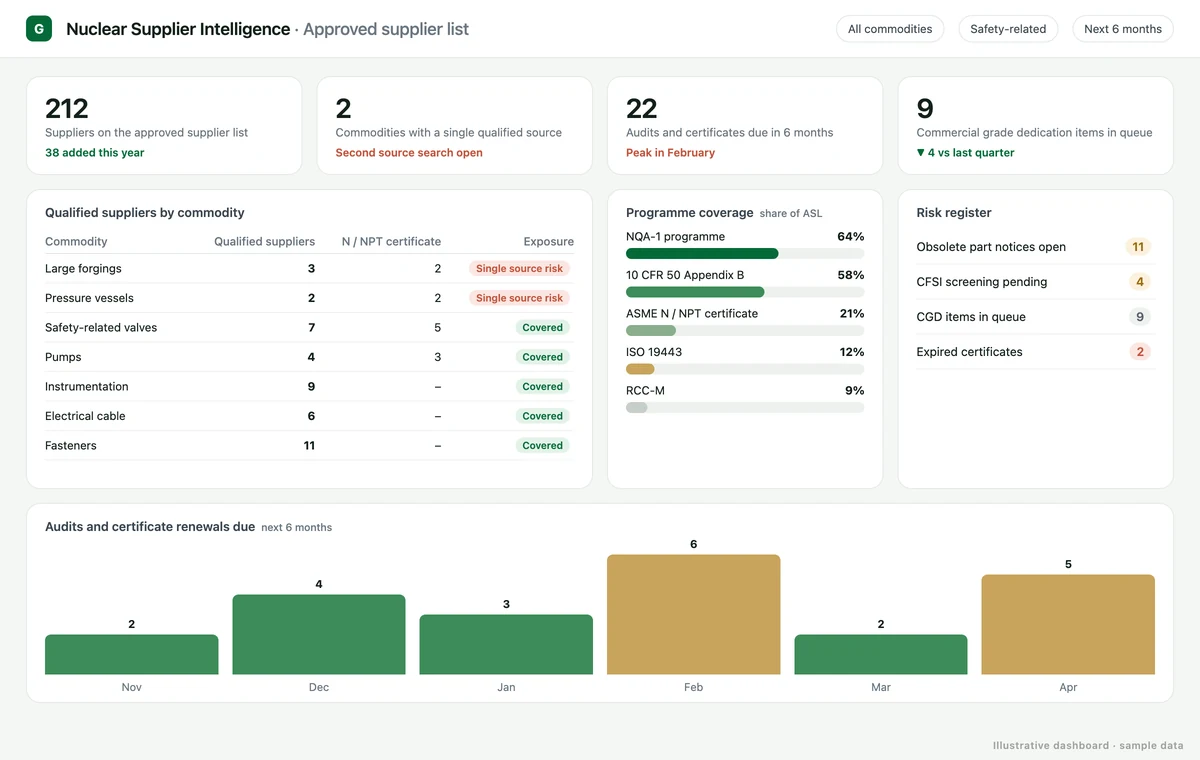
Once the records exist, the view that procurement, supplier quality and project leadership use every week is simple. It answers five questions on one screen.
- Qualified suppliers by commodity: how many suppliers are fully qualified, conditionally qualified or still being screened for each commodity, so thin categories are obvious.
- Programme and certificate coverage: which suppliers hold NQA-1, an Appendix B programme or an ASME N-type certificate, and for which scope, against what each commodity needs.
- Audits and certificates due: audits, annual evaluations and certificate renewals falling due over the next six months, by supplier and commodity, so nothing lapses in the middle of an outage.
- Single-source and obsolescence exposure: items with one qualified source, or whose product is end of life, ranked by how soon they are needed.
- Commercial grade dedication queue: items waiting for dedication, the critical characteristics still to verify and the method chosen, so engineering can plan the work.
The example below is illustrative and uses invented data.
07
Proof: four years of supplier intelligence for nuclear work
GTL has run a supplier intelligence system for four years for a France-based sourcing group serving a US nuclear OEM. The work covers automated supplier identification, supplier records with capability and qualification attributes across the procurement dataset, categorisation of procurement data, and comparison and shortlisting of suppliers.
The starting point is described in our supplier scouting case study. The client, a sourcing and supplier quality firm, had been finding suppliers by manual web searches and applying its own rules by hand to filter them. We built two tools: one that generates keywords, runs the searches and shortlists the best-fit suppliers with custom rules, and one that identifies the company name and head office from a website address. Moving from manual to automated scouting cut operating time by 85 percent and cost by 91 percent.
The parts of that system are available as separate services: supplier and spend categorisation, supplier shortlisting and wider supply chain automation.
08
Who nuclear supplier identification is for
Nuclear OEMs and SMR developers
Building a supply chain for a design that is being licensed now: new commodities, few proven suppliers, and pressure to show investors and regulators a credible path to manufacture.
Utilities and outage teams
Replacing obsolete parts, finding alternates when a supplier drops its programme, and keeping the approved supplier list current between outages.
EPC and decommissioning contractors
Sourcing many commodities at once under a client's quality requirements, often with localisation targets and tight bid deadlines.
Sourcing and supplier quality houses
Firms that find and qualify suppliers for nuclear clients and want their scouting and records automated, as our longest-running client did.
Code-qualified fabricators
Fabricators who need qualified sub-suppliers for materials, special processes and testing that their own programme must flow requirements down to.
09
How we handle your data
10
About Greenwolf
Greenwolf Tech Labs is an analytics, data and automation firm founded by Harsh Khubchandani, who has more than ten years in analytics, data and automation, including consulting at ZS. Our team is based in New Delhi and works US and European hours, and we have delivered work for clients in 18 countries.
We are not a nuclear supplier, we hold no nuclear certifications and we are not a NUPIC member. What we bring is the search automation, data modelling and record keeping that make your own supplier qualification faster and more complete.
11
Nuclear supplier identification questions
What is NQA-1?
What is the difference between NQA-1 and 10 CFR 50 Appendix B?
How do you find NQA-1 qualified suppliers?
What is commercial grade dedication?
What is an ASME N stamp?
What is NUPIC?
Why is the SMR supply chain hard to build?
Does Greenwolf qualify or certify nuclear suppliers?
Need more qualified suppliers for a hard commodity?
Tell us the commodity, the code and quality requirements and your need date. We will come back with how we would build the long list and what a first comparison pack would look like.
A reply from a consultant, usually within one working day.
Part of our Supply Chain and Procurement hub. Start with our supply chain automation.
Supply Chain and Procurement
More on supply chain automation
Supplier Identification Services
Challenges of Supplier Identification How Supplier Identification Service can Benefit Businesses Types of Supplier Identification AI-Driven Matching Utilize artificial intelligence for seamless...
Smart Supplier Identification and Selection: Enhancing Your Business with Automation
We help nuclear, aerospace, marine & defense companies discover verified, capable suppliers, fast. Sourcing for complex systems isn’t easy. You need suppliers who are technically competent,...
Supplier Shortlisting Services
Challenges of Suppliers Shortlisting How Supplier Shortlisting Services can Benefit Businesses Types of Supplier Shortlisting Strategic Fit Identifying suppliers aligned with your business goals...
Supplier Categorization Service
Challenges of Supplier Categorization How Supplier Categorization Services can Benefit Businesses Types of Supplier Categorization Strategic Relevance Categorize suppliers based on their strategic...
Purchase Order Follow Up for Manufacturers: Suppliers Chased Before Material Runs Late
Purchase order follow up for manufacturers: every open PO checked daily, suppliers asked for dates on WhatsApp and email, replies logged, delays flagged early.