


Nuclear Project Scheduling Software for New Build, SMR and Outage Work
Nuclear project scheduling software for new build, SMR and outages: CPM critical path, float, baselines, resources and earned value. Try the live NuPlan demo.
Get a free proposal
Tell us what you need. A consultant replies within one working day.
01
What is nuclear project scheduling software?
Nuclear project scheduling software plans and controls the work on a nuclear project: new build, small modular reactor (SMR) deployment, refuelling outages, major modifications and decommissioning. It links every activity to the work that must come first, calculates the critical path and float with the critical path method (CPM), and shows what a late permit, a late reactor vessel or a delayed inspection does to the finish date.
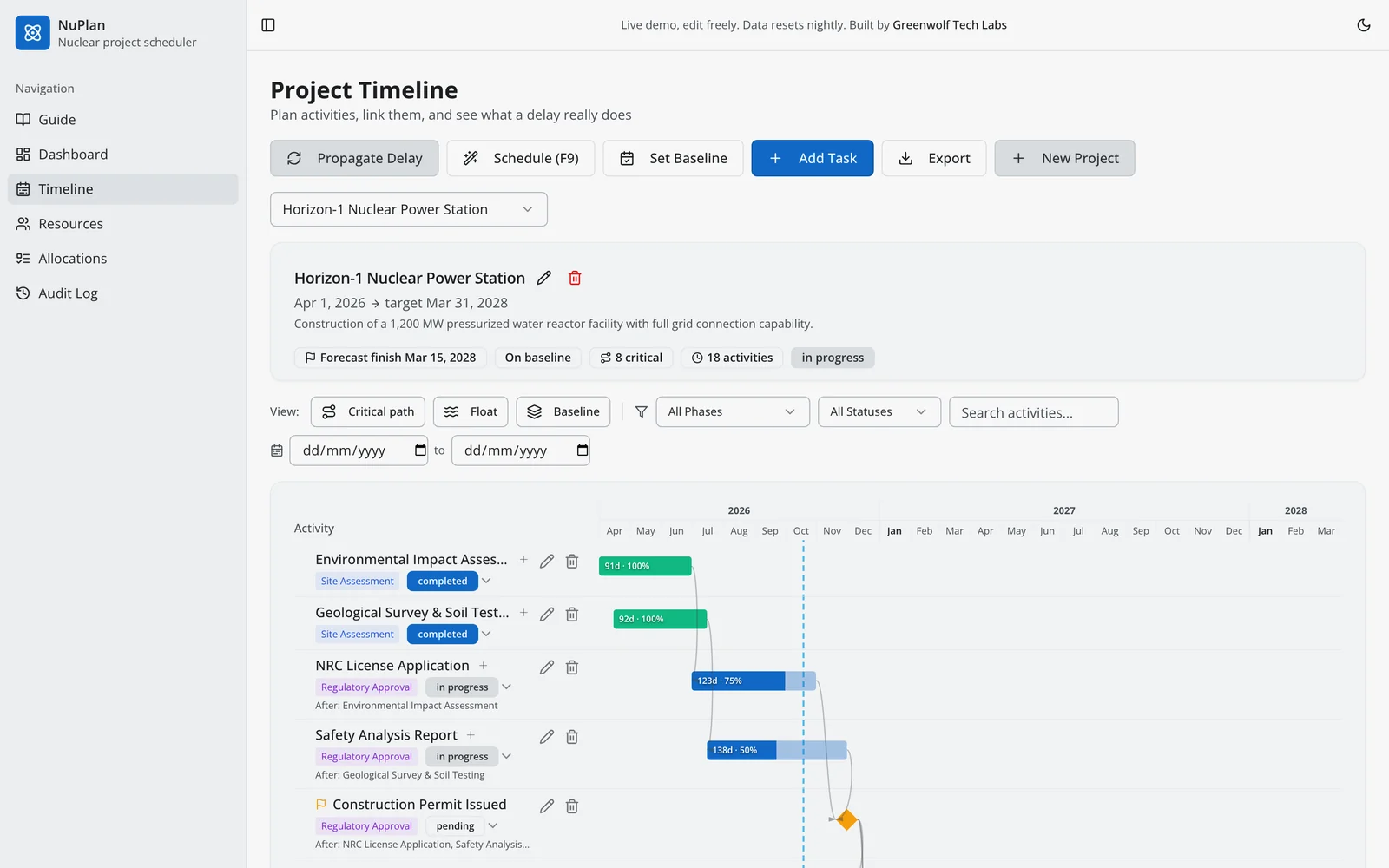
Greenwolf Tech Labs builds this kind of software for owners, EPC contractors and suppliers. Our working demonstrator, NuPlan, is loaded with a fictional 1,200 MW pressurised water reactor project: 18 linked activities from site assessment to operational readiness, two milestones and an eight-person engineering team. It runs in the browser, you can edit anything, and it resets every night.
Open the NuPlan live demo or read on for what it does, where it fits next to Primavera P6, and what certification does and does not apply to scheduling software.
02
Why nuclear schedules are harder than most
A nuclear schedule uses the same logic as any engineering project, but the cost of getting it wrong is higher and the constraints are tighter:
- Regulatory hold points. Licence applications, safety analysis reports and construction permits sit on the critical path. Work cannot start until a regulator says so, and the regulator's timeline is not yours to compress.
- Long-lead, single-source equipment. Reactor vessels, steam generators, large forgings and fuel are made by a handful of qualified suppliers. A slip at the forge moves the whole project, which is why procurement belongs in the schedule, not in a separate spreadsheet. Our nuclear supplier identification work exists for the same reason.
- Quality assurance gates. Inspections, witness points and document reviews add activities that general construction schedules leave out.
- Fixed outage windows. In a refuelling outage every day offline is lost generation. The US Energy Information Administration reported that US refuelling outages averaged 34 days in 2024 (to the end of July), down from 38 days in 2023. Shaving days depends on knowing exactly which jobs drive the finish.
- Many contractors, one finish date. Owner, EPC, vendors and specialist subcontractors each keep their own plans. The integrated schedule is the only place where their logic meets.
03
What NuPlan does
Critical path and total float
A full CPM forward and backward pass on every change. Critical activities are flagged red; everything else shows how many days it can slip.
- Finish-to-start logic links
- Milestones and percent complete
Float-aware delay impact
Delay an activity and NuPlan pushes only the successors that really move. A delay inside float is absorbed; a delay on the critical path moves the finish.
- Propagate delay in one click
- Forecast finish updates live
Schedule (F9)
Recalculates every date from the logic, the way schedulers expect from P6, so the plan stays honest after edits.
Baselines and variance
Freeze a baseline, then see every activity's variance and the forecast finish against the plan you committed to.
Resource histogram
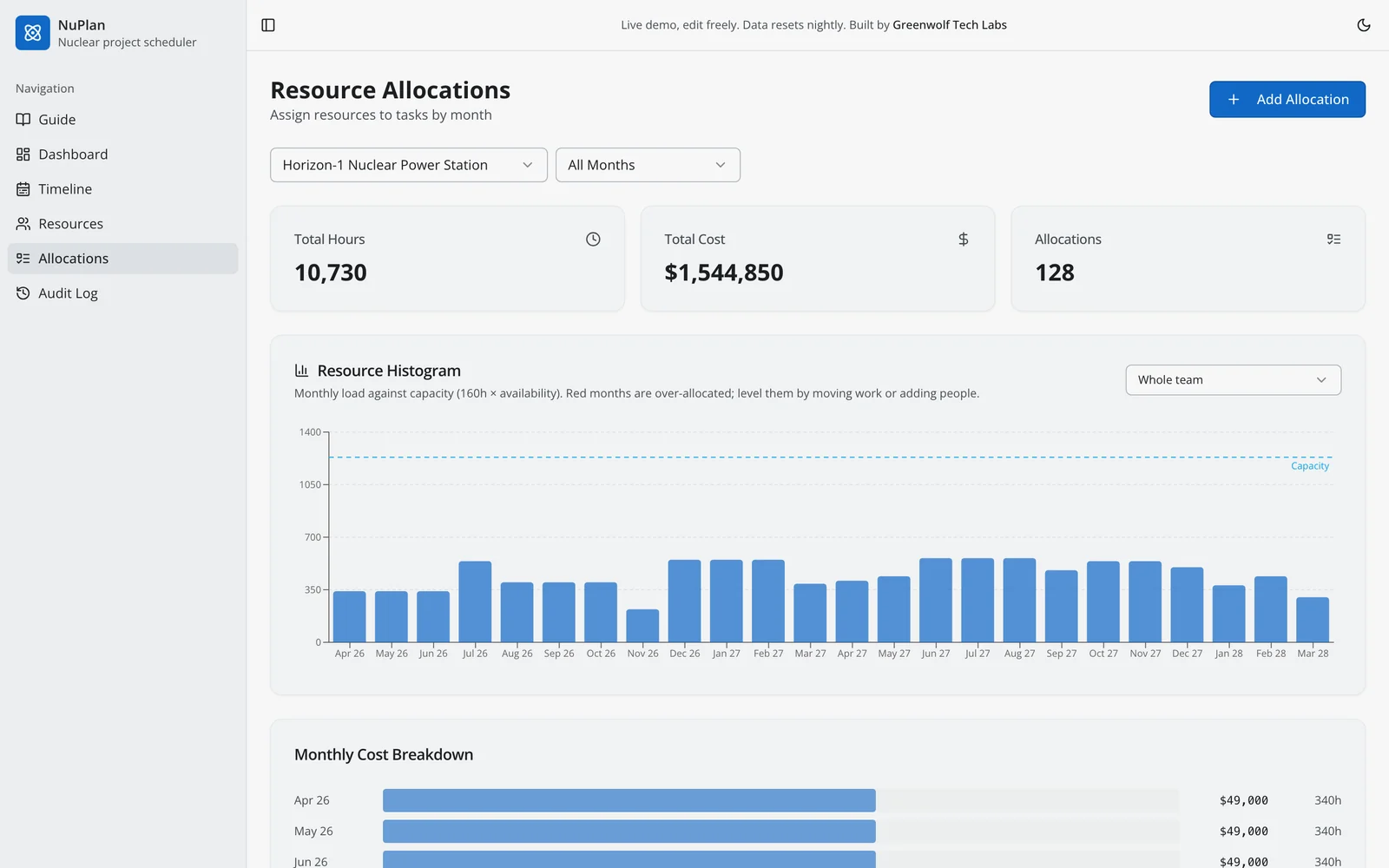
Monthly hours by person or team against capacity. Over-allocated months show up before they become overtime or late work.
- Hourly rates and cost by month
Earned value and S-curve
Schedule performance index (SPI) and a planned versus forecast S-curve on the dashboard, from the same data as the Gantt.
Exports and audit log
CSV and PNG export for reports, and an audit log of who changed what and when.
04
See the critical path, the dashboard and the resource load
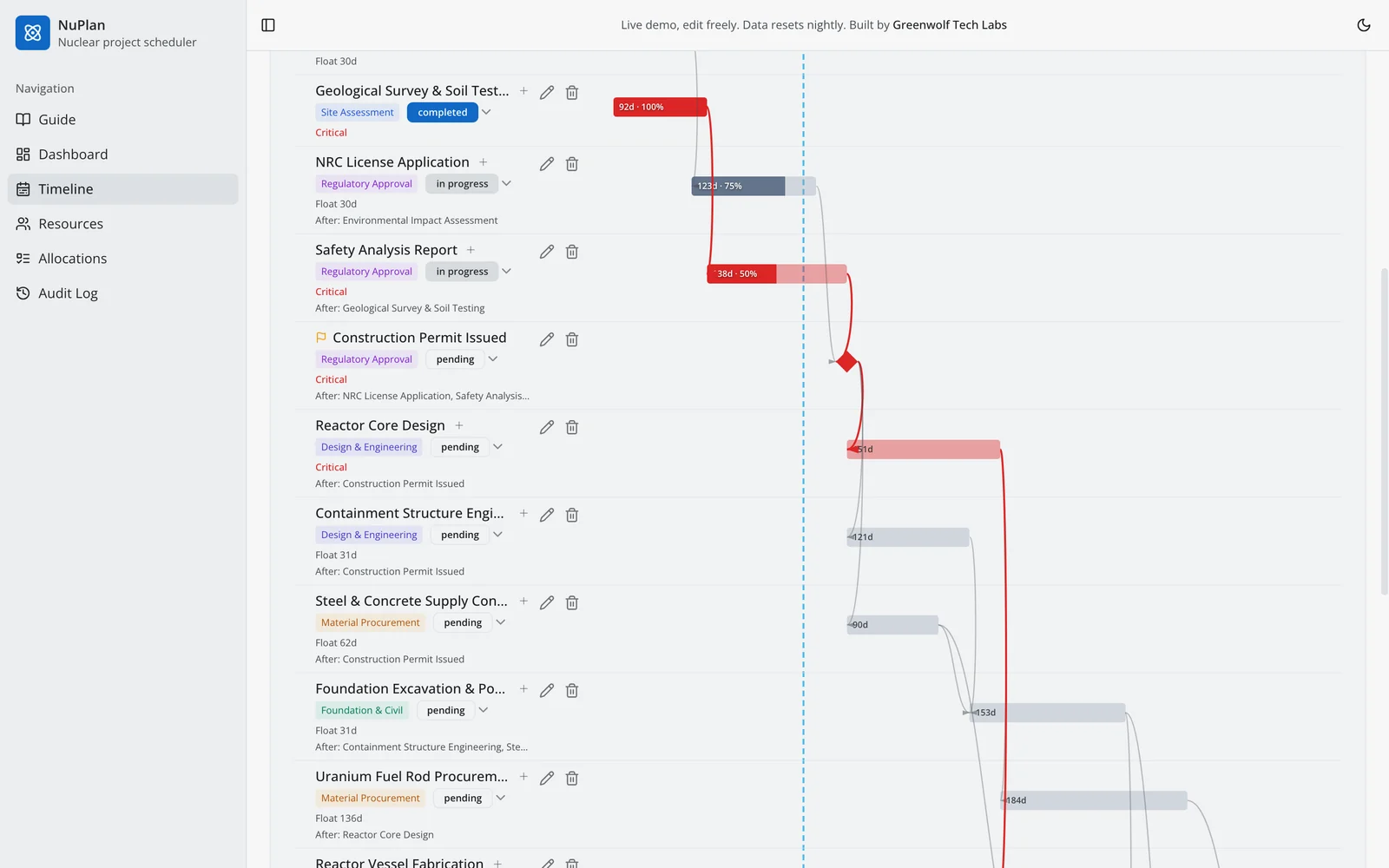
The critical path view below is the heart of any nuclear project management tool. In the demo, the geological survey, the safety analysis report and the construction permit drive reactor core design, which drives vessel fabrication. The NRC licence application runs alongside with 30 days of float, so a 20-day slip there costs nothing, while a 14-day slip in the safety analysis report moves the forecast finish by 14 days. That difference is the whole point of CPM.
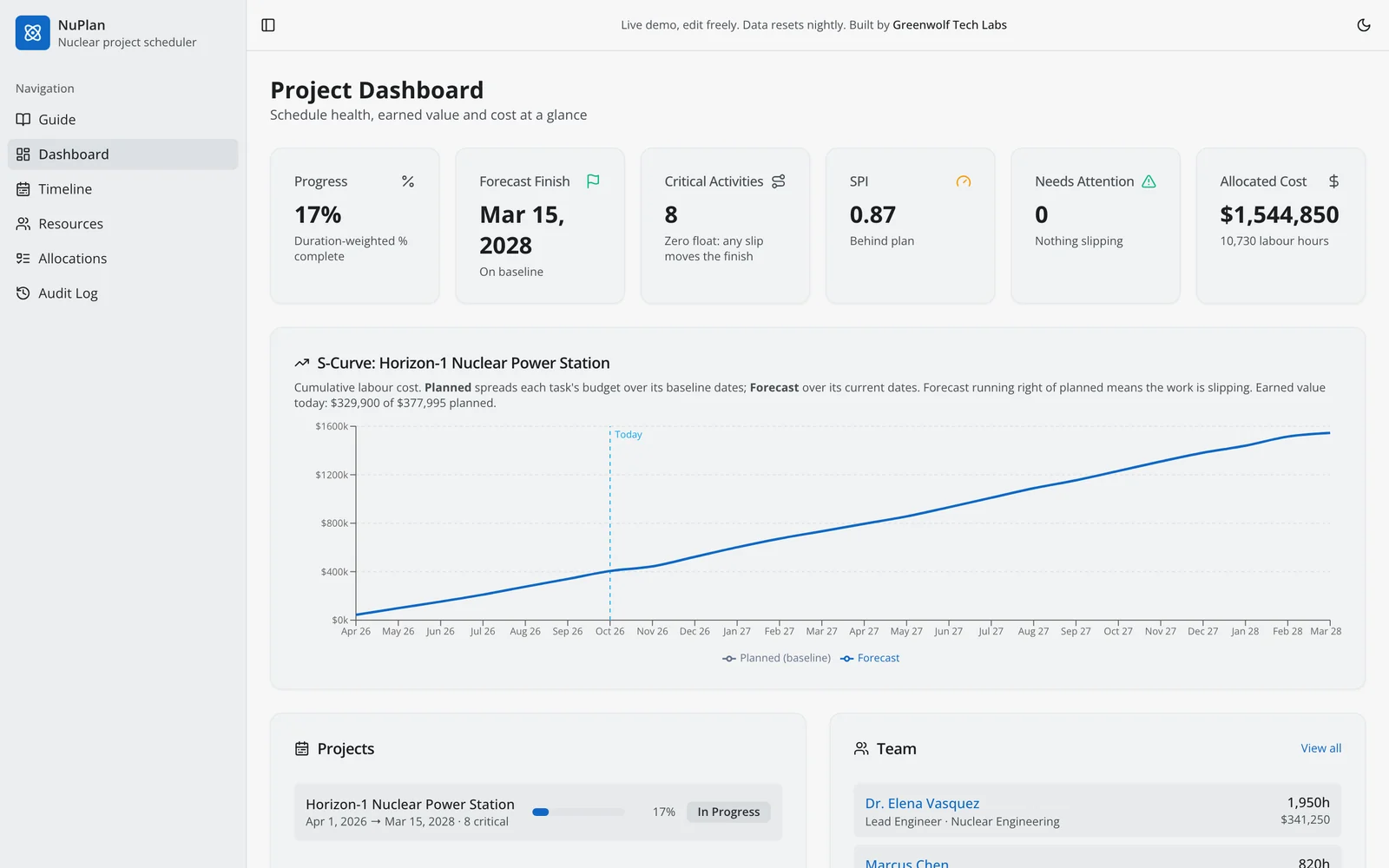
The dashboard turns the same schedule into the numbers a project director reports: duration-weighted progress, forecast finish against baseline, the count of critical activities, SPI and a cost S-curve. Nothing is typed in twice.
Resource loading closes the loop. The histogram compares monthly hours with capacity, so a schedule that looks fine on the Gantt but needs the same lead engineer in two places at once shows up in red.
05
Where nuclear project scheduling software is used
New reactors and small modular reactor programmes
From site characterisation and licensing through procurement, civil works, module installation and commissioning. SMR programmes add factory fabrication and repeat deployment, so the schedule needs templates that can be reused from one unit to the next.
- Licensing and permit milestones on the critical path
- Long-lead equipment tracked as activities
- Unit-to-unit templates for SMR fleets
Nuclear outage scheduling and outage management
Outage schedules run to the hour, with thousands of work orders and a fixed return-to-service target. The value is in seeing which jobs drive the critical path, levelling crews across shifts and updating the forecast as work closes.
- Critical path by shift
- Crew and contractor loading
- Daily forecast against the outage target
Major modifications and life extension
Steam generator replacements, digital I&C upgrades and power uprates combine engineering, procurement and outage work. The schedule has to connect the design package to the outage window it must land in.
- Engineering and procurement linked to outage dates
- Baseline and variance for each package
Decommissioning and waste programmes
Decommissioning runs for years with regulatory milestones, waste routes and funding profiles. Earned value and S-curves matter as much as the Gantt, because progress is reported against a fixed fund.
- Earned value against the funding profile
- Multi-year baselines
EPC contractors and nuclear suppliers
Suppliers and contractors need their own schedules that roll up into the owner's. A focused scheduler for fabrication, inspection and delivery is often more useful to them than a seat in the owner's enterprise system.
- Fabrication and inspection milestones
- Exports in the format the owner asks for
06
Does nuclear scheduling software need NQA-1 certification?
Usually not. There is no certificate for scheduling software. NQA-1 and 10 CFR 50 Appendix B are quality assurance requirements for safety-related work, including software used in safety-related design, analysis and control. A project or outage schedule normally does not perform a safety function, so it is controlled under the owner's own software procedures, graded to its risk.
That is also how Primavera P6 is used: it is not an NQA-1 certified product. NQA-1 applies to the organisation and its quality programme, not to a product label. Part II, Subpart 2.7 of NQA-1 sets requirements for computer software used in nuclear facility applications, and commercial software that does perform a safety function is accepted through commercial-grade dedication under the owner's programme.
What this means for you:
| Question | Typical answer for a scheduler |
|---|---|
| Is it safety-related software? | Normally no. Your QA organisation classifies it; we supply what they need to do that. |
| Do we need NQA-1 dedication? | Only if your classification says it performs a safety function, which is rare for scheduling. |
| What QA evidence do we get? | Requirements, test records, release notes and configuration control, scaled to your procedure. |
| Plant cyber security rules? | Rules for critical digital assets (10 CFR 73.54 in the US) apply to plant systems. A project scheduler normally sits on the business network; confirm with your cyber team. |
| Where is the data hosted? | Your choice: your own cloud tenant, a US or EU region, or your servers. Check export control rules for technical data with your compliance team. |
To be clear about NuPlan itself: it is a public demonstrator with fictional data, not a qualified or certified product. When we build a scheduler for a client, we deliver it under the client's software QA procedure and host it where their policies require.
07
NuPlan vs Primavera P6
Primavera P6 is the standard for large nuclear and energy programmes, and for good reason. A custom scheduler is not a replacement for P6 across a whole enterprise. It is a better fit when a team needs something focused, fast to use and connected to its own data. See our Primavera P6 pricing guide for what P6 costs.
| Primavera P6 | Custom scheduler (NuPlan approach) | |
|---|---|---|
| Best for | Enterprise programmes with tens of thousands of activities and trained planners | A project, outage team, supplier or programme office that needs a focused tool |
| CPM, float, baselines | Yes, very deep | Yes, the core set |
| Licensing | Per user licence or cloud subscription | You own the code; no per-seat fee |
| Ease of use | Powerful, steep learning curve | Built around your team's workflow |
| Dashboards and integration | Through add-ons, analytics and APIs | Built in, connected to your ERP, CMMS or document system |
| Hosting | Oracle cloud or your servers | Your cloud tenant, region or servers |
Many teams run both: P6 holds the master schedule, and a lighter tool or dashboard serves the people who update and read it. We can build that connection through P6's export files or its web services.
08
How we deliver a nuclear scheduling tool
Discovery and classification
We map your schedule, users and reports, and agree with your QA organisation how the software is classified and what evidence it needs.
Configure on your data
NuPlan is loaded with your WBS, activity codes, resources and calendars, or imported from an existing schedule export.
Pilot one project or outage
Your planners use it on real work for a few weeks, and we change what does not fit.
QA package and handover
Requirements, test records, user guide and configuration control, delivered to your procedure. You own the code.
Hosting and support
Deployed in your environment or a region you choose, with support and changes as your programme grows.
09
Not nuclear? The same scheduler for construction
The engine behind NuPlan also runs BuildPlan, a construction edition loaded with a 22-storey concrete tower: excavation, mat pour, slab cycles, facade, MEP and handover. Try the BuildPlan demo, or read how the critical path method works step by step.
10
Nuclear project scheduling software questions
What is nuclear project scheduling software?
Is NuPlan NQA-1 certified?
Does scheduling software need NQA-1 or commercial-grade dedication?
Can it replace Primavera P6?
What is nuclear outage scheduling?
How does the software calculate the critical path?
Can it be hosted in the US or on our own servers?
Does it work for SMR projects?
How long does a pilot take?
Want NuPlan on your project?
Tell us about your project, outage or programme. We will show NuPlan on a call and outline what a pilot on your data would involve.
A reply from the engineer who built it, not a sales sequence.
Part of our Supply Chain and Procurement hub. Start with our supply chain automation.
Supply Chain and Procurement
More on supply chain automation
Critical Path Method Software: How CPM Scheduling Works and What to Use
What critical path method software does, a worked CPM example with forward pass, backward pass and float, schedule quality checks and how to choose a CPM tool.
Nuclear Supplier Identification and Qualification Support
Nuclear supply chain supplier identification: find NQA-1, 10 CFR 50 Appendix B and ASME N stamp suppliers, with qualification records kept current.
Primavera P6 Pricing in 2026: Licence, Cloud and Real Costs
Primavera P6 pricing from Oracle's own price lists: Professional, EPPM and cloud per-user costs, support, term licences, worked totals and cheaper alternatives.
Proof of Delivery Automation: Every Signed Slip Filed and Every Trip Billed the Same Day
Proof of delivery automation for transporters: drivers send the signed slip on WhatsApp, AI reads it, it is filed and the trip is invoiced the same day.
Purchase Order Follow Up for Manufacturers: Suppliers Chased Before Material Runs Late
Purchase order follow up for manufacturers: every open PO checked daily, suppliers asked for dates on WhatsApp and email, replies logged, delays flagged early.