

What is critical path method software?
Critical path method (CPM) software builds a project schedule as a network of linked activities and calculates, for each one, the earliest and latest dates it can start and finish. Activities with no room to slip form the critical path: the longest chain of work, which sets the project's finish date. Everything else has float, the number of days it can slip without moving the finish.
That calculation is what separates CPM scheduling software from a to-do list with bars. When an activity is delayed, CPM software can say whether the delay is absorbed by float or moves the finish date, and by how much. Construction, engineering, energy and nuclear projects are planned this way, and many contracts require a CPM schedule.
CPM was developed in 1956 and 1957 by Morgan Walker of DuPont and James Kelley of Remington Rand to plan plant shutdowns and construction. The US Navy's PERT method, built for the Polaris programme at about the same time, uses the same network idea with uncertain durations.
How the critical path method works: a worked example
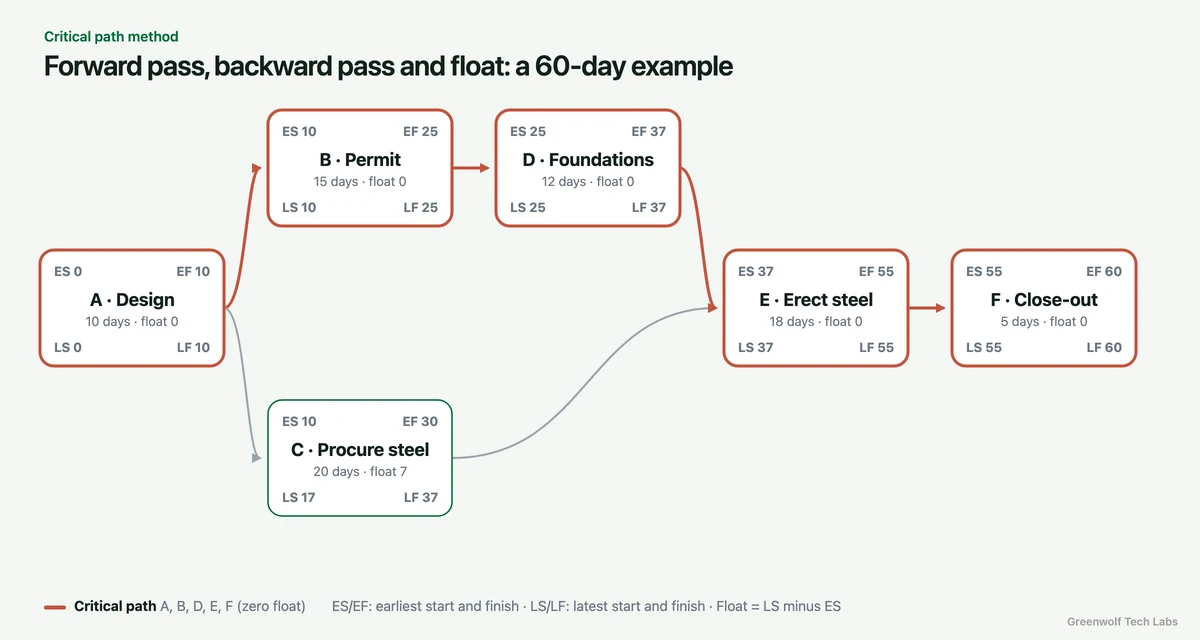
Take a small project with six activities. Each has a duration and one or more predecessors that must finish first.
| Activity | Duration (days) | Predecessors | Earliest start / finish | Latest start / finish | Total float |
|---|---|---|---|---|---|
| A: Design | 10 | None | 0 / 10 | 0 / 10 | 0 |
| B: Permit | 15 | A | 10 / 25 | 10 / 25 | 0 |
| C: Procure steel | 20 | A | 10 / 30 | 17 / 37 | 7 |
| D: Foundations | 12 | B | 25 / 37 | 25 / 37 | 0 |
| E: Erect steel | 18 | C, D | 37 / 55 | 37 / 55 | 0 |
| F: Close-out | 5 | E | 55 / 60 | 55 / 60 | 0 |
- Forward pass. Start at day 0 and work left to right. Each activity's earliest start is the latest earliest finish among its predecessors. Steel erection (E) cannot start until both the steel (day 30) and the foundations (day 37) are done, so it starts on day 37. The project finishes on day 60.
- Backward pass. Start from day 60 and work right to left. Each activity's latest finish is the earliest latest start among its successors. Steel procurement (C) must finish by day 37, so it can start as late as day 17.
- Float. Total float is latest start minus earliest start. Procurement has 7 days; every other activity has zero.
- Critical path. The zero-float chain A, B, D, E, F adds up to 60 days. It is the longest path, so it drives the finish date.
Now the useful part. If the steel arrives 5 days late, nothing happens to the finish date: the delay is inside its 7 days of float. If it arrives 10 days late, the finish moves by 3 days and procurement joins the critical path. If the permit is 5 days late, the finish moves by 5 days immediately. Good CPM software shows this the moment you enter the delay.
What to look for in CPM scheduling software
True logic-driven dates
Dates come from relationships and durations, not from typed-in dates. A Schedule (F9) command recalculates everything after edits.
- Finish-to-start, start-to-start and finish-to-finish links
- Lags, calendars and milestones
Critical path and float on screen
Critical activities highlighted and total float shown for every activity, so planners and managers see the same story.
Delay and what-if analysis
Enter a delay and see which successors move and whether the finish slips. Float-aware propagation is the test of a real CPM engine.
Baselines and variance
Freeze the plan you committed to and measure every update against it.
Resource loading
Hours and cost by person or crew per period, with a histogram against capacity to catch over-allocation.
Progress and earned value
Percent complete, schedule performance index (SPI) and an S-curve, so progress reports come from the schedule itself.
Exports people can use
CSV and image exports, and the file format your client or contract asks for, such as P6 XER.
CPM in practice: what it looks like in software
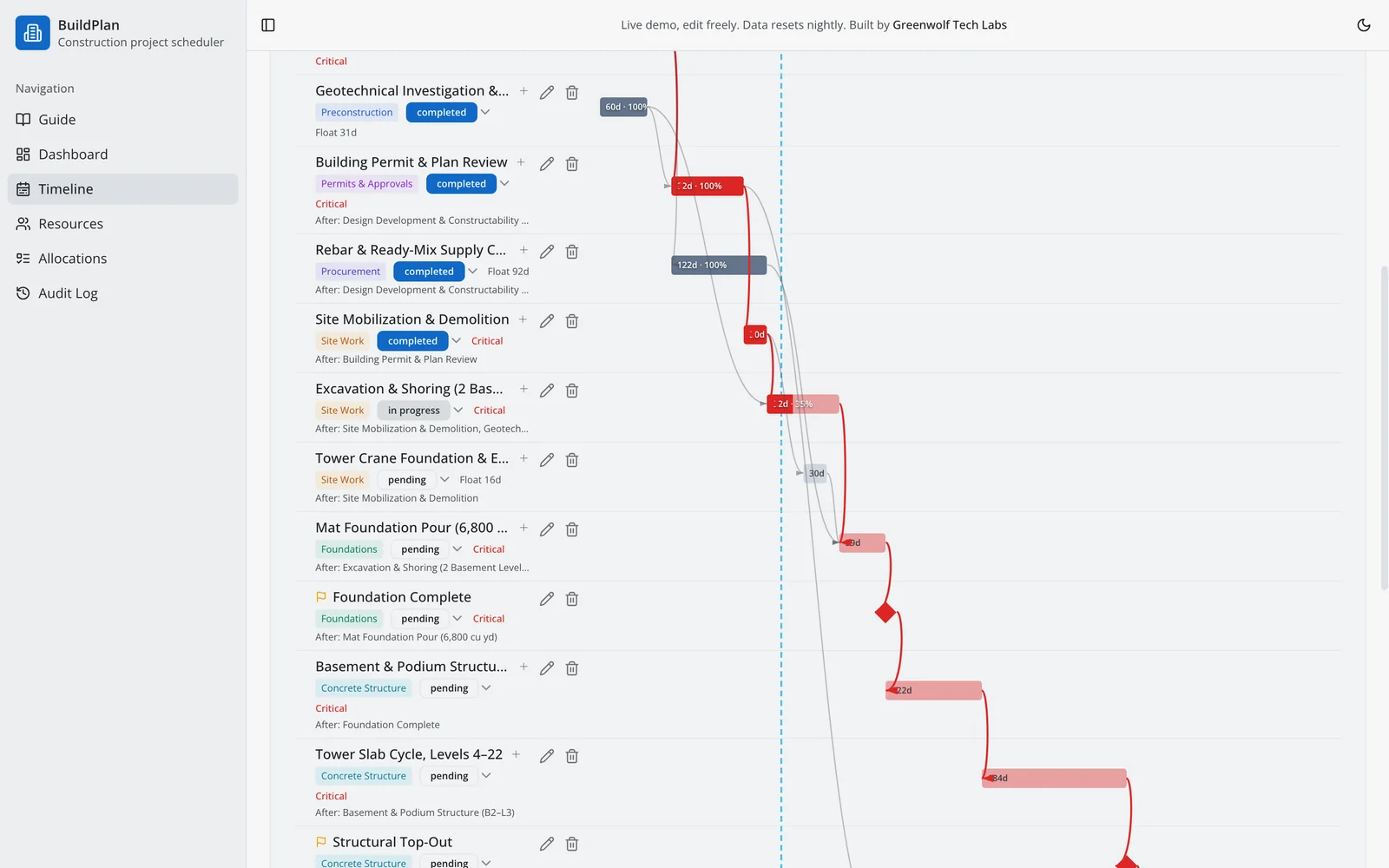
The screenshot below is BuildPlan, our CPM scheduling demo for construction, on a 22-storey concrete tower. The critical path runs in red from permits through excavation, the mat foundation pour and the slab cycle. The facade procurement off to the side carries 31 days of float, so a 20-day delay there changes nothing, while a 14-day delay to excavation moves the handover date. You can try exactly that in the BuildPlan live demo.
The same engine runs NuPlan, a nuclear edition with licensing hold points and long-lead reactor equipment. See nuclear project scheduling software for how it handles outages and new build.
CPM vs PERT vs Gantt charts vs Last Planner
| Method | What it is | When to use it |
|---|---|---|
| Critical path method (CPM) | A logic network with fixed durations; calculates float and the critical path | Construction, engineering, energy, any project with a contractual finish date |
| PERT | The same network, with optimistic, most likely and pessimistic durations | Research and first-of-a-kind work where durations are uncertain |
| Gantt chart | A way of drawing a schedule as bars on a timeline | Communicating any schedule; on its own it does not calculate anything |
| Last Planner System | Collaborative short-term planning with the crews who do the work | Site-level weekly planning, often alongside a CPM master schedule |
| Schedule risk analysis | Monte Carlo simulation on a CPM schedule | Setting a realistic finish date and contingency on large projects |
A Gantt chart drawn in a spreadsheet looks like a schedule but is not CPM: change one bar and nothing else moves. That is the most common reason project dates turn out to be fiction.
Schedule quality checks every CPM schedule should pass
Which CPM software should you use?
- Primavera P6 is the standard for large programmes and for contracts that require P6 files. It is the deepest option and the most expensive; see our Primavera P6 pricing breakdown.
- Microsoft Project does CPM well for organisations already on Microsoft 365, through the Planner and Project plans.
- Asta Powerproject is popular with UK and European construction planners, with line-of-balance views for repetitive work.
- A custom CPM scheduler fits a team with a specific workflow, many people who read the schedule but do not build it, or a need for dashboards connected to its own systems. That is what we build at Greenwolf Tech Labs: you own the code and pay no per-user licence.
Critical path method questions
What is critical path method software?
How do you calculate the critical path?
What is total float?
What is the difference between total float and free float?
Can a project have more than one critical path?
Is Excel good enough for CPM scheduling?
What is the best CPM scheduling software for construction?
Want CPM scheduling built around your team?
Tell us how you plan today. We will walk you through BuildPlan or NuPlan on your kind of project and say honestly whether you need P6, Microsoft Project or a custom tool.
Part of our Supply Chain and Procurement hub. Start with our supply chain automation.