

Templates and trackers
ABA Data Sheets and BCBA Trackers
Free ABA data sheets plus BCBA trackers that calculate and graph: ABC, frequency, duration, latency, token boards, fieldwork, RBT competency, FBA and BIP.
01
ABA data sheets that do the math for you
ABA data sheets are the forms behavior analysts, RBTs and teachers use to record behavior during sessions: what happened before (antecedent), the behavior itself, what followed (consequence), how often and for how long. Good data sheets turn those records into rates, percentages and graphs, so decisions come from data rather than memory.
Most free ABA data sheets stop at a blank grid. Ours are working tools built by the team that builds practice software for ABA clinics. Each one comes three ways: an Excel workbook that calculates and graphs on its own, the same file ready for Google Sheets, and a printable PDF for paper sessions. Every purchase is a one-time payment with an instant download.
Below you will find every free sample printable we offer, a table of the main types of ABA data collection with when to use each, a worked example that turns raw counts into rates and percentages, and the mistakes that make applied behavior analysis data sheets hard to graph later.
02
BCBA trackers and ABA templates
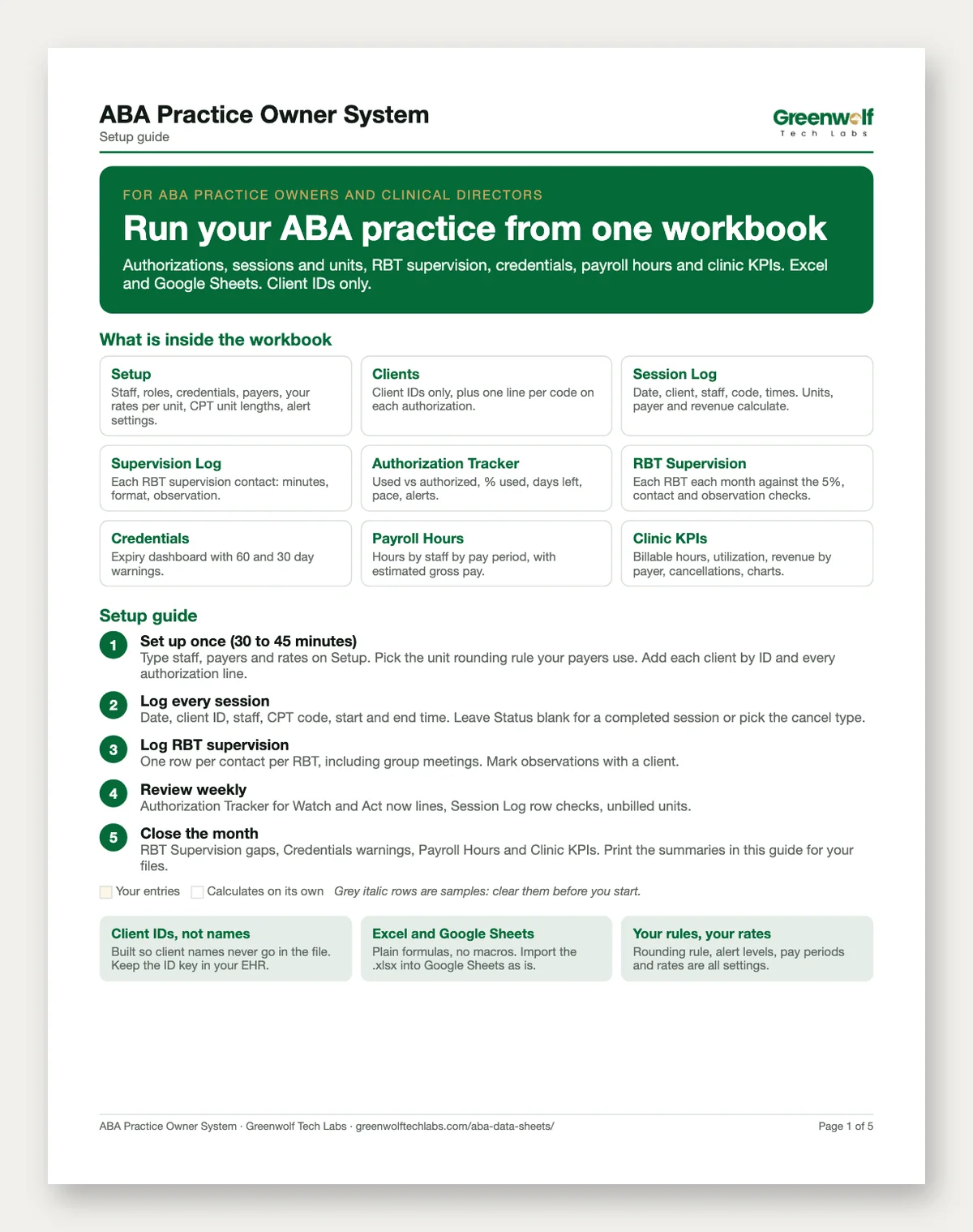
ABA Practice Owner System
For clinic owners: authorizations and units, RBT supervision %, credential expiry, payroll hours and clinic KPIs in one workbook.
$59Details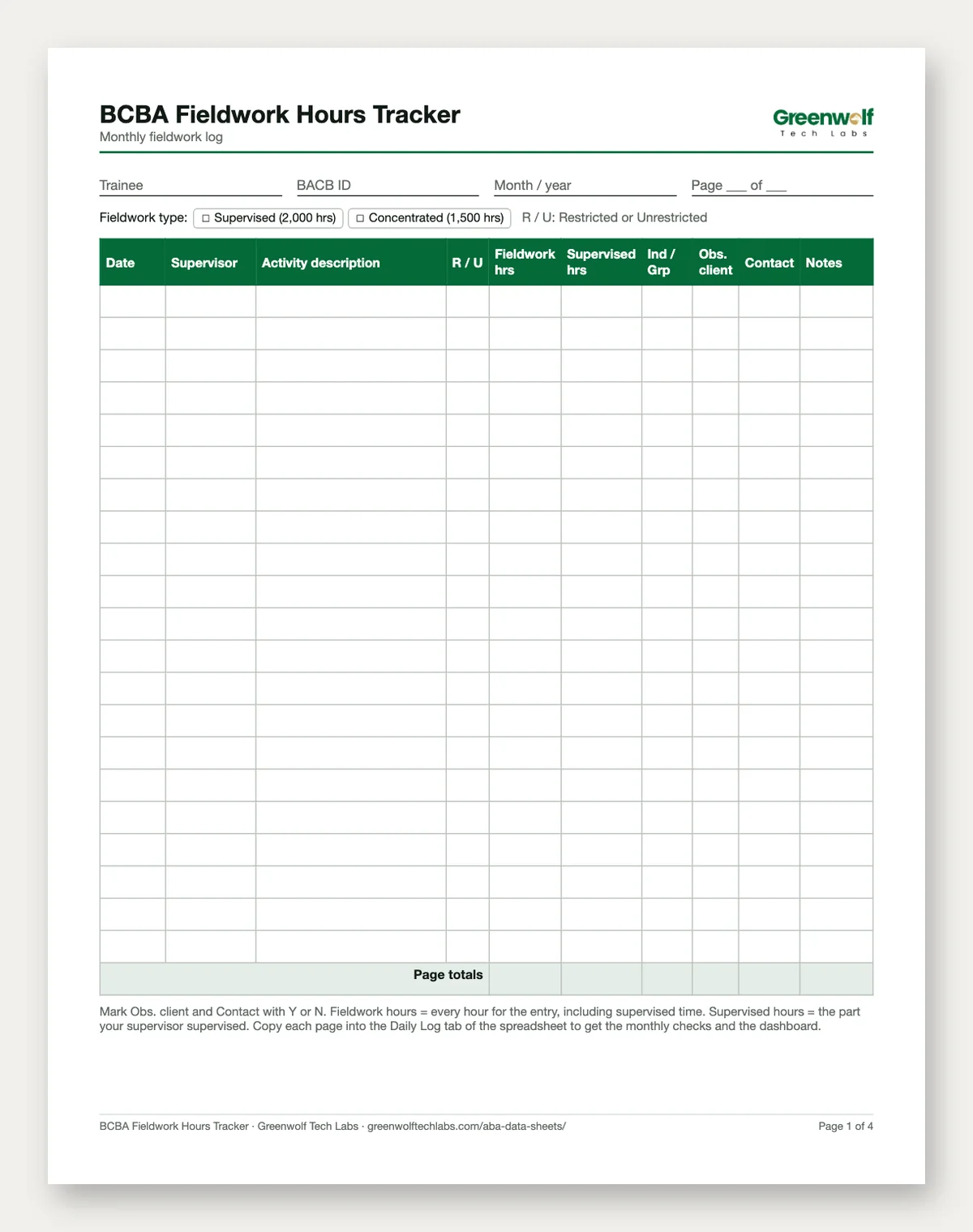
BCBA Fieldwork Hours Tracker
Log every fieldwork hour and see each month's supervision %, contacts, observations and unrestricted % checked automatically.
$29Details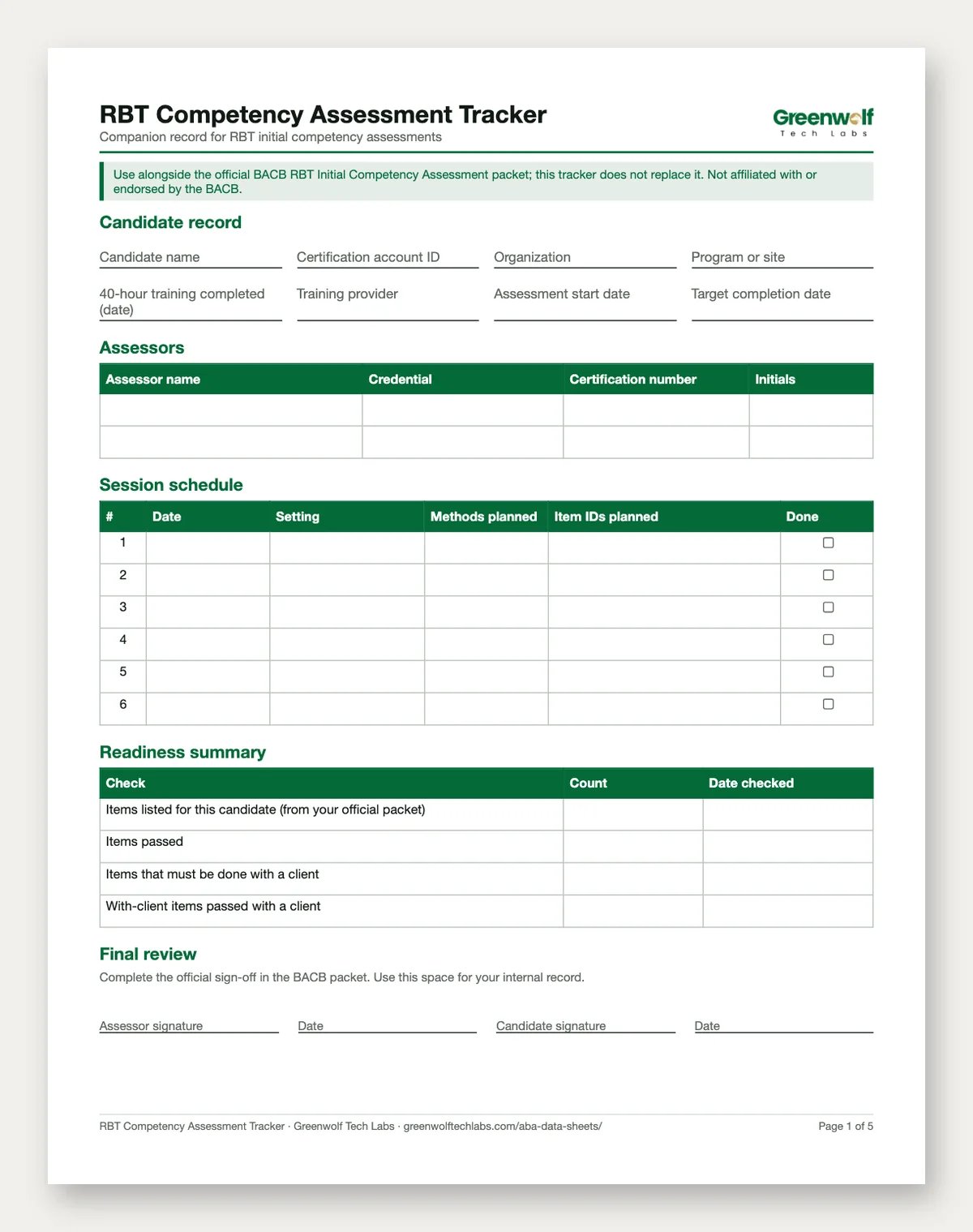
RBT Competency Assessment Tracker
Track every candidate through the initial competency assessment: items passed, with-client items, attempts and who is ready for review.
$19Details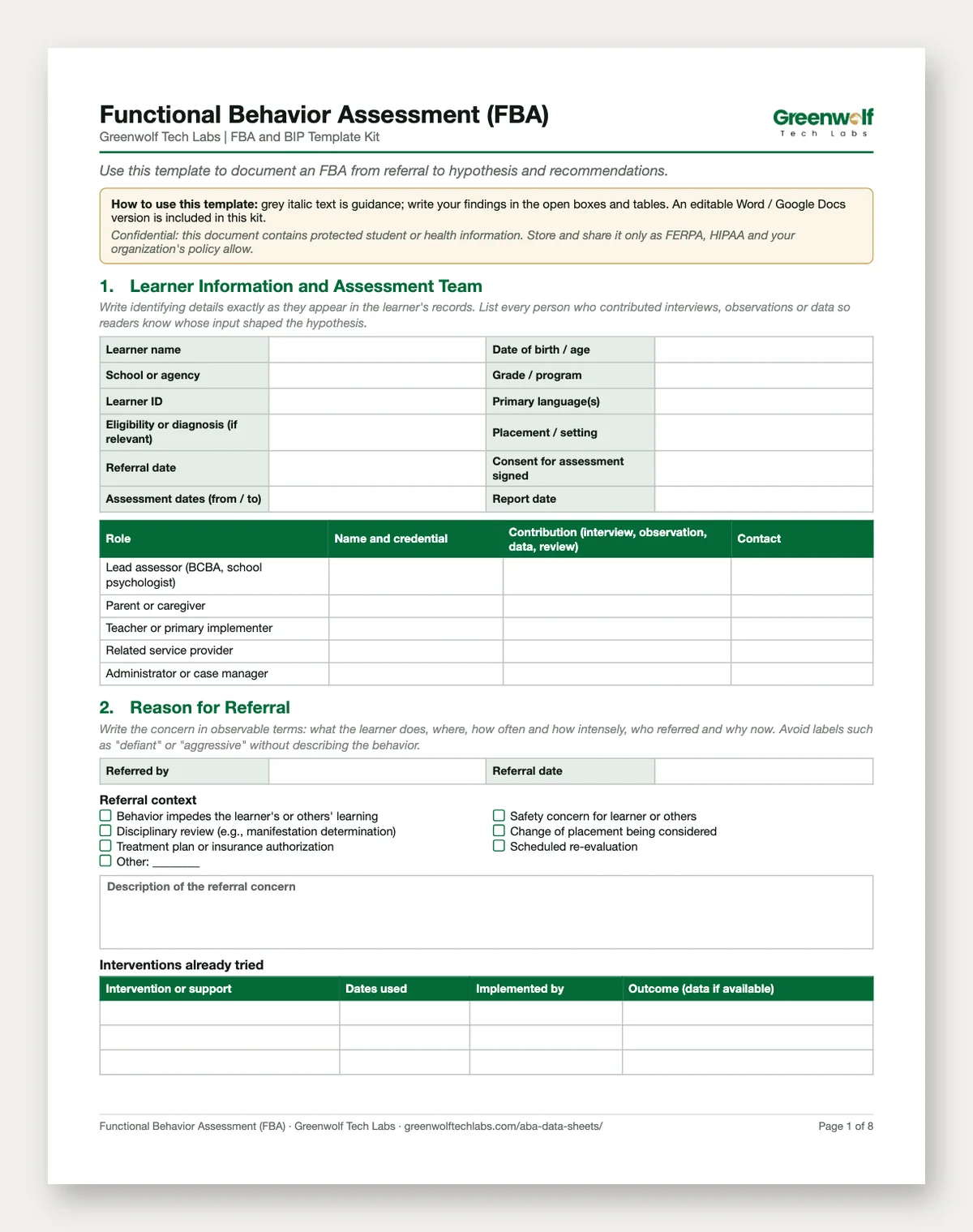
FBA and BIP Template Kit
Editable functional behavior assessment and behavior intervention plan templates, with a hypothesis matrix and fidelity checklist.
$19Details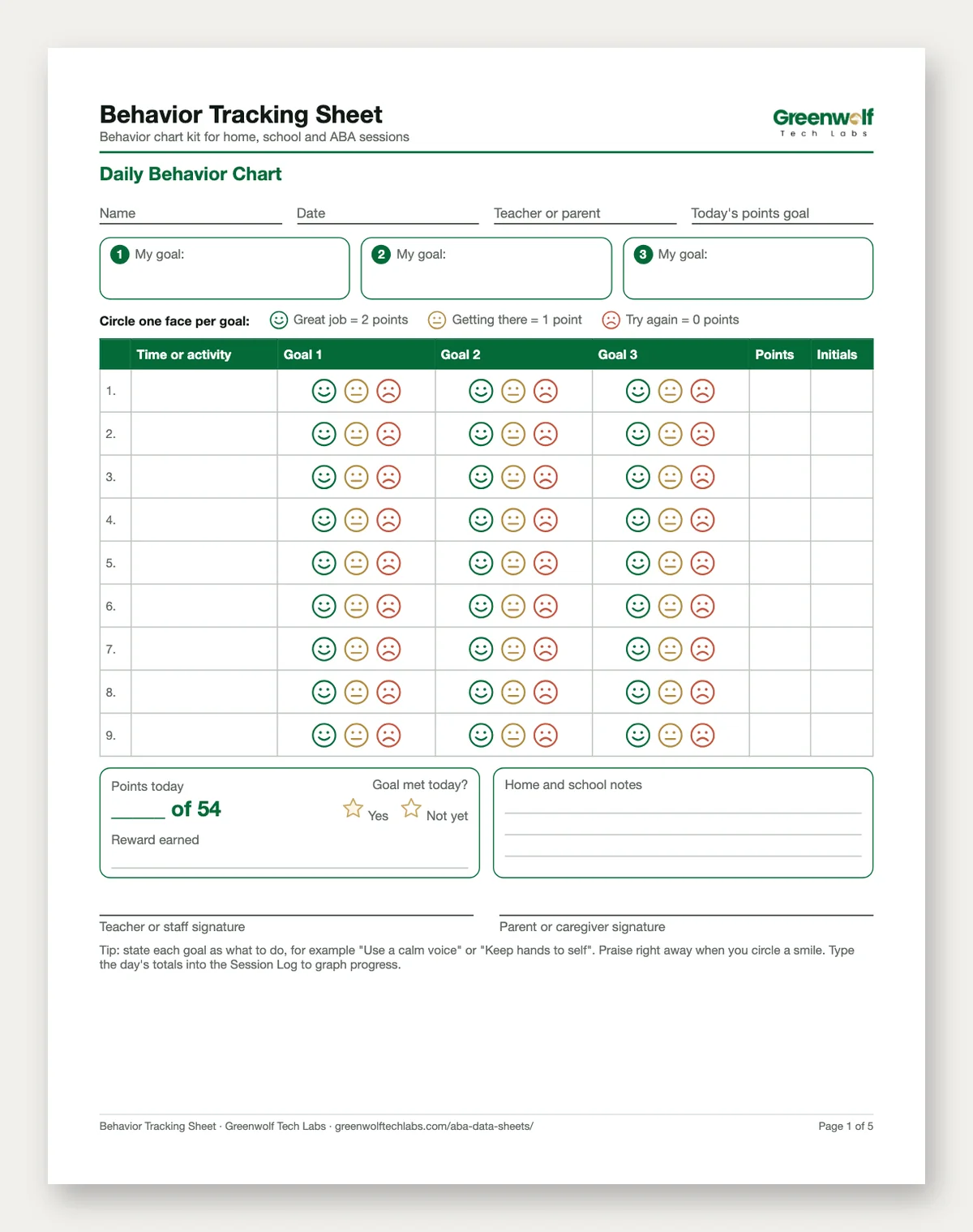
Behavior Tracking Sheet and Behavior Chart Kit
Frequency, duration and latency logging with automatic rates and graphs, plus printable behavior charts for home and school.
$12Details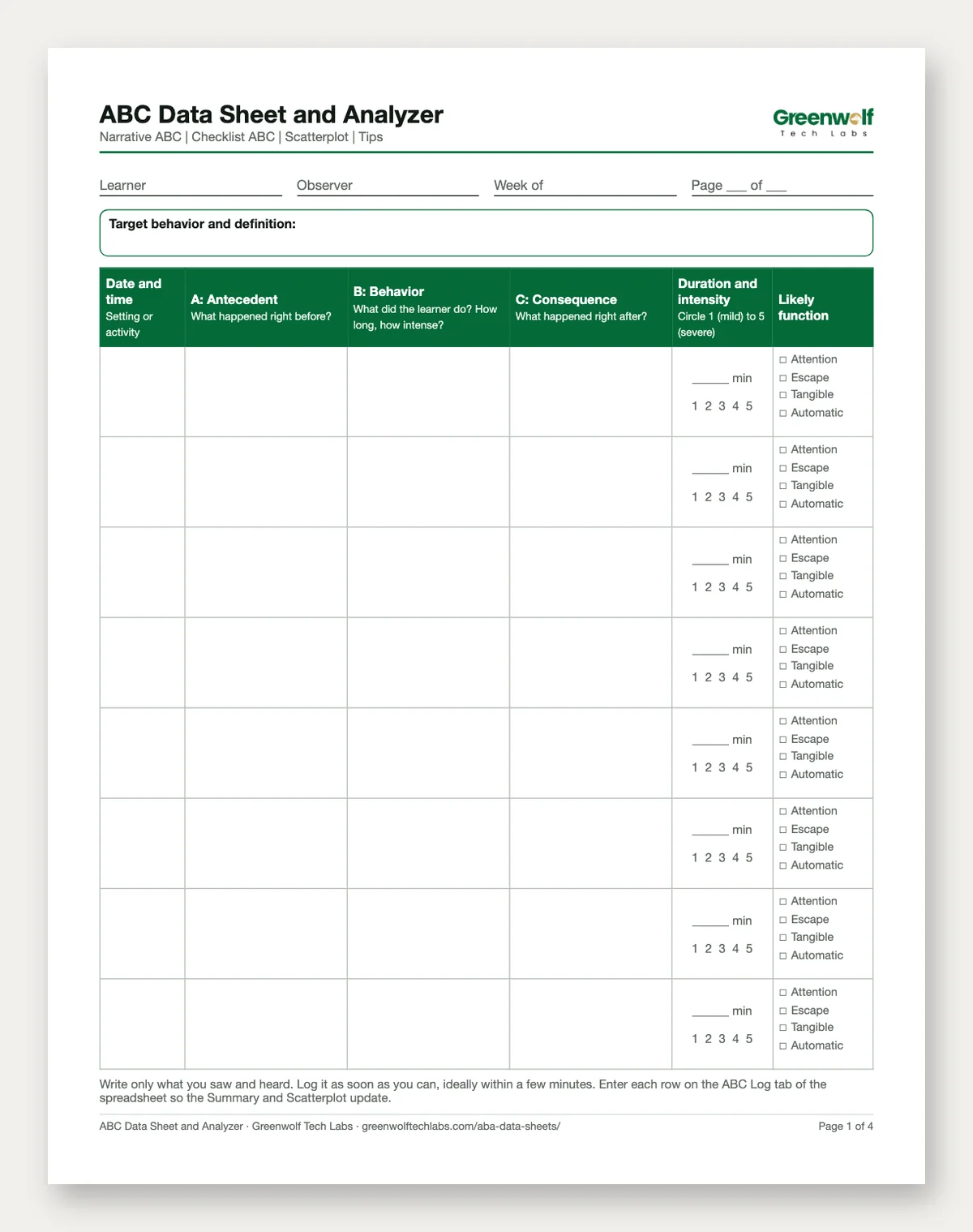
ABC Data Sheet and Analyzer
Antecedent-behavior-consequence logging that summarizes itself: top antecedents, consequences, likely function and a scatterplot.
$9Details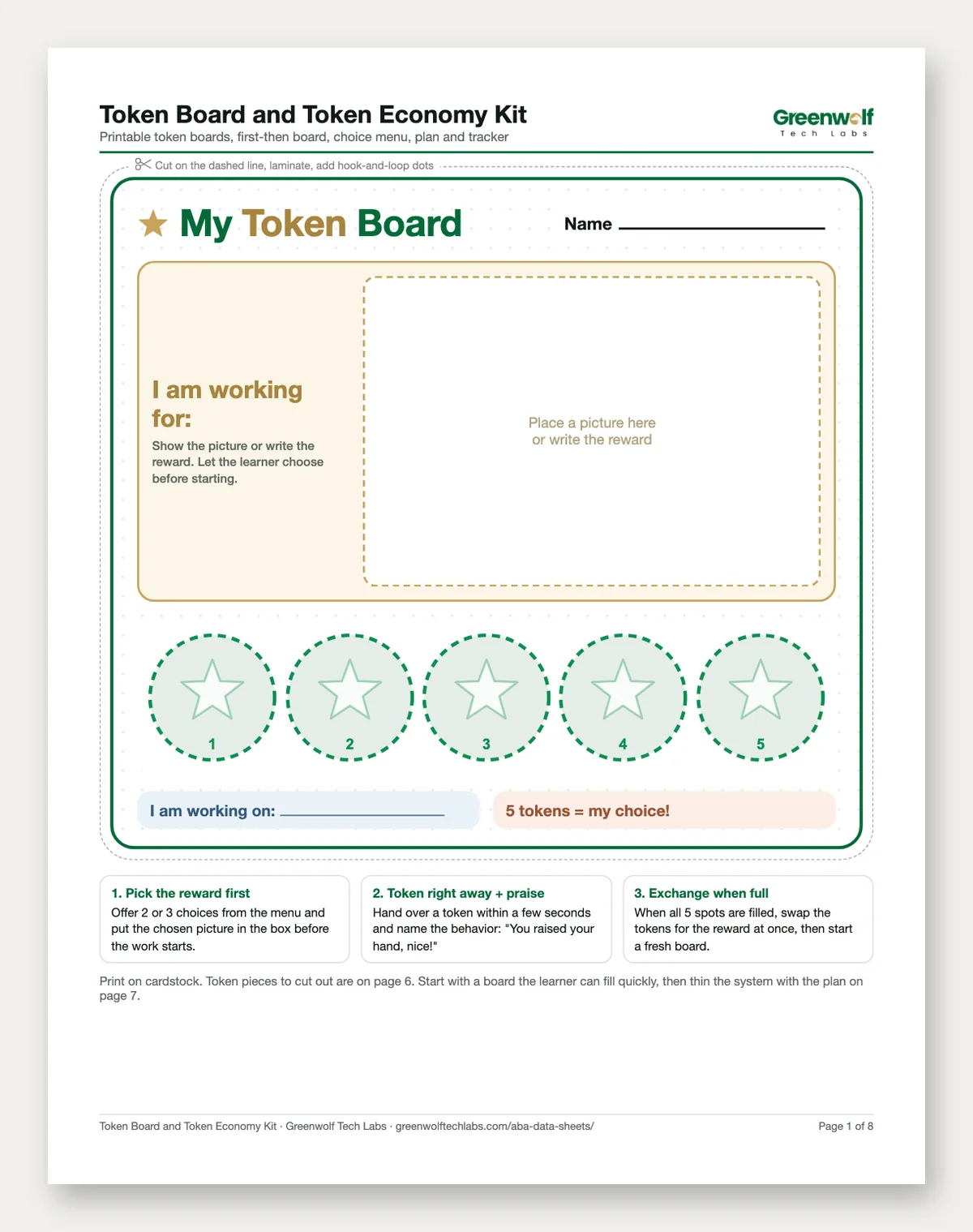
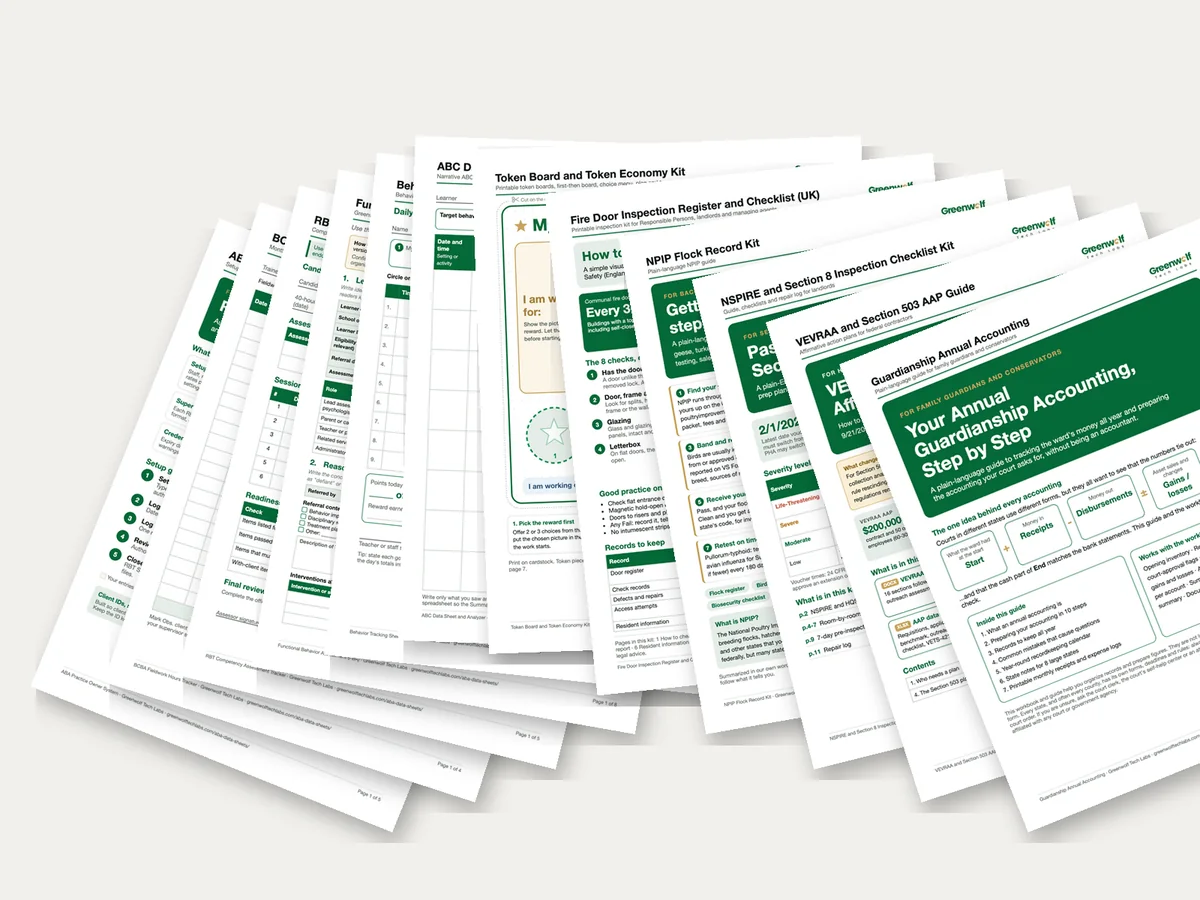
Token Board and Token Economy Kit
Printable 3, 5 and 10 token boards, first-then board and reinforcer menu, plus a tracker for tokens earned and exchanged.
$9Details
Best value
The BCBA Toolkit: all six trackers
$59$97USD · one-time purchase · instant download
Every tracker and template above in one download, for less than the price of four.
- BCBA Fieldwork Hours Tracker and RBT Competency Assessment Tracker
- FBA and BIP Template Kit (Word, Google Docs, PDF)
- Behavior Tracking Sheet, ABC Data Sheet and Token Economy Kit
- Excel, Google Sheets-ready and printable PDF versions
You get: 6 Excel workbooks · 2 Word templates · 6 printable PDFs
Secure checkout by Razorpay. Cards accepted worldwide, charged in US dollars. Files arrive on screen and by email. Refund policy
04
Free ABA data collection sheets (PDF samples)
Each product below has one free printable page you can download and use today, no email needed. They are single pages taken from the paid kits, so they match the full versions exactly.
- Free ABC data sheet (PDF): antecedent, behavior and consequence recording page. Full kit: ABC Data Sheet and Analyzer.
- Free behavior tracking sheet (PDF): a printable behavior data page. Full kit: Behavior Tracking Sheet and Behavior Chart Kit.
- Free token board (PDF): a printable token board. Full kit: Token Board and Token Economy Kit.
- Free RBT competency assessment tracker page (PDF). Full kit: RBT Competency Assessment Tracker.
- Free BCBA fieldwork tracker page (PDF). Full kit: BCBA Fieldwork Hours Tracker.
- Free FBA and BIP template page (PDF). Full kit: FBA and BIP Template Kit.
- Free RBT monthly supervision summary (PDF). Full kit: ABA Practice Owner System.
The paid versions add the Excel and Google Sheets workbooks that calculate rates, percentages and monthly requirement checks and draw the graphs, plus every other form in the kit. The BCBA Toolkit bundle above includes six of them.
05
Types of ABA data collection and which sheet to use
ABA data collection methods fall into two groups: continuous measures that capture every occurrence (ABC, frequency, duration, latency, trial-by-trial and task analysis data) and discontinuous measures that sample behavior in intervals (partial interval, whole interval and momentary time sampling). Pick the method that matches the behavior's dimension and how much a person can record during a session.
| Method | What you record | When to use it | Our product that covers it |
|---|---|---|---|
| ABC (antecedent, behavior, consequence) | What happened before, the behavior, what happened after | Finding the likely function of a behavior; the first step of an FBA | ABC Data Sheet and Analyzer (with scatterplot) |
| Frequency or event recording (rate) | Count of each occurrence, divided by observation time | Behaviors with a clear start and end that happen often enough to count, such as hitting or requests | Behavior Tracking Sheet |
| Duration | How long each episode lasts | Behaviors where length matters more than count, such as tantrums or time on task | Behavior Tracking Sheet |
| Latency | Time from an instruction or cue to the start of the behavior | Compliance and response speed, such as starting work after a direction | Behavior Tracking Sheet |
| Partial interval recording | Whether the behavior occurred at any point in each interval | High-rate behaviors you want to decrease, when counting each one is not practical (tends to overestimate) | Method and results recorded in the FBA and BIP Template Kit; no dedicated interval sheet yet |
| Whole interval recording | Whether the behavior lasted the entire interval | Behaviors you want to increase, such as on-task behavior (tends to underestimate) | Method and results recorded in the FBA and BIP kit; no dedicated interval sheet yet |
| Momentary time sampling | Whether the behavior is happening at the exact end of each interval | Group settings or when the observer is also teaching | Method and results recorded in the FBA and BIP kit; no dedicated sheet yet |
| Trial-by-trial (DTT) | Correct, incorrect or prompted response on each discrete trial | Skill acquisition programs taught in discrete trials | Not in our printable range; available in custom ABA data collection software |
| Task analysis | Independent or prompted on each step of a skill chain | Multi-step skills such as handwashing or dressing | Not in our printable range; available in custom ABA data collection software |
| Token economy data | Tokens earned and exchanged | Reinforcement systems at home, school or clinic | Token Economy Kit tracker |
Supervision and credential records are a separate family of tracking sheets: the BCBA fieldwork tracker for trainees, the RBT competency assessment tracker for new RBTs, and the ABA practice tracker for monthly RBT supervision and authorizations.
06
Which ABA data sheet do you need?
| You want to know | Use |
|---|---|
| Why a behavior is happening | ABC data sheet, then the FBA template |
| How often or how long a behavior happens, and whether it is improving | Behavior tracking sheet (frequency, duration, latency) |
| How to reinforce new skills with tokens | Token board and token economy kit |
| Whether a plan is being followed | The fidelity checklist in the FBA and BIP kit |
| Whether your fieldwork month counts toward BCBA certification | BCBA fieldwork hours tracker |
| Which RBT candidates are ready for their final competency review | RBT competency assessment tracker |
07
How to set up ABA behavior data sheets: a worked example
- Write an operational definition. Describe the behavior so two observers would agree, for example "hitting: any contact of an open or closed hand with another person's body, with force".
- Choose the dimension. Count it (frequency), time it (duration), time the start (latency) or sample it (interval). Use the table above.
- Fix the observation window. Same length and setting each session, so rates are comparable.
- Record on paper or in the sheet. Paper during the session, then enter totals in the workbook.
- Convert to a rate or percentage and graph it. Raw counts from sessions of different lengths cannot be compared.
- Review the graph with the BCBA at a set interval and decide whether to continue, change or fade the plan.
Sample session (made-up numbers), 30-minute observation:
| Measure | Raw data | Calculation | Result |
|---|---|---|---|
| Frequency (hitting) | 12 occurrences | 12 ÷ 30 minutes | 0.4 per minute (24 per hour) |
| Duration (crying) | 3 episodes: 45 s, 120 s, 90 s | 255 s total; 255 ÷ 3; 255 ÷ 1,800 s | Mean 85 s; 14.2% of the session |
| Latency (start work) | 5 instructions: 10, 25, 8, 40, 12 s | 95 ÷ 5 | Mean latency 19 s |
| Partial interval (out of seat) | Occurred in 9 of 30 one-minute intervals | 9 ÷ 30 | 30% of intervals |
The Behavior Tracking Sheet does these calculations as you type and plots each session, so the graph is ready for the next supervision meeting.
08
Paper data sheets vs spreadsheets vs ABA software
| Printable PDF | Excel or Google Sheets | ABA data collection software | |
|---|---|---|---|
| Cost | Free samples, low one-time price | One-time price | Usually a subscription |
| Calculations and graphs | By hand | Automatic | Automatic |
| Works without a device | Yes | No (paper first, then enter) | No |
| Multiple RBTs and clients | Hard to combine | Yes, with consistent dropdowns | Yes, with permissions |
| Best for | Classrooms, home programs, quick starts | BCBAs and small clinics who want graphs without software | Clinics with many clients and RBTs |
Our kits include both the printable PDF and the workbook, so paper and spreadsheet data use the same columns. When a clinic outgrows that, see ABA data collection software or ABA practice management.
09
Common mistakes with ABA data collection sheets
- Vague behavior definitions. "Aggression" means different things to different RBTs. Define it so two observers agree.
- Comparing raw counts across sessions of different lengths. Convert to rate per minute or per hour.
- Using partial interval for a behavior you want to increase. It overestimates; whole interval or duration usually fits better.
- ABC notes with opinions instead of observations. Write what was seen and heard, not "he wanted attention".
- Different sheet layouts per RBT. Data then cannot be combined or graphed. Use one template across the team.
- Data that is never graphed. Decisions should come from the trend, so graph at least weekly.
- Client names on sheets that leave the clinic. Use initials or IDs and store sheets securely.
10
Why BCBAs choose these over free templates
11
ABA data sheet questions
What are ABA data sheets?
Where can I find free ABA data collection sheets?
What are the main types of ABA data collection?
How do you calculate rate in ABA?
Do these work in Google Sheets?
Can I print them?
Can I use them with all my clients and RBTs?
Are these affiliated with the BACB?
Do you build ABA software too?
Outgrowing spreadsheets?
We build ABA data collection and practice management systems for clinics: sessions, authorizations, notes and reports in one place.
Part of our Healthcare Practice Automation hub. Start with our healthcare workflow automation.
Healthcare Practice Automation
More on healthcare workflow automation
ABA Data Collection Software, Built Around Your Clinic
Custom ABA data collection software for BCBAs and RBTs: session data on any device, automatic graphs, notes and authorizations in one system your clinic owns.
Case Study: An ABA Practice Management System for PTC
Metric Before After Submission errors High Significantly reduced Time clinicians spent entering data 10-15 mins/day < 3 mins/day Admin review effort Heavy Lightweight & structured...
Link EMR/EHR Data with Insurance Claims Through Automation
Link EMR/EHR Data with Insurance Claims Through Automation Healthcare providers and insurers often face the challenge of fragmented data. While Electronic Medical Records (EMR) and Electronic...
ABA Practice Management, Built Around Your Clinic
Custom ABA practice management software: session notes against authorized hours, BSPs, quarterly reports and billing cycles, built around your clinic.
ABA Practice Tracker for Authorizations, RBT Supervision and KPIs
RBT supervision tracker and ABA practice tracker for Excel and Google Sheets: monthly 5% supervision checks, authorization units, burn rate and clinic KPIs.