

Templates and trackers
RBT Initial Competency Assessment Tracker and Checklist
How the RBT competency assessment works under the 2026 BACB rules: who can assess, steps, timing and re-assessment, plus a free printable progress checklist.
For BCBAs, assessors and training coordinators
RBT Competency Assessment Tracker
$19USD · one-time purchase · instant download
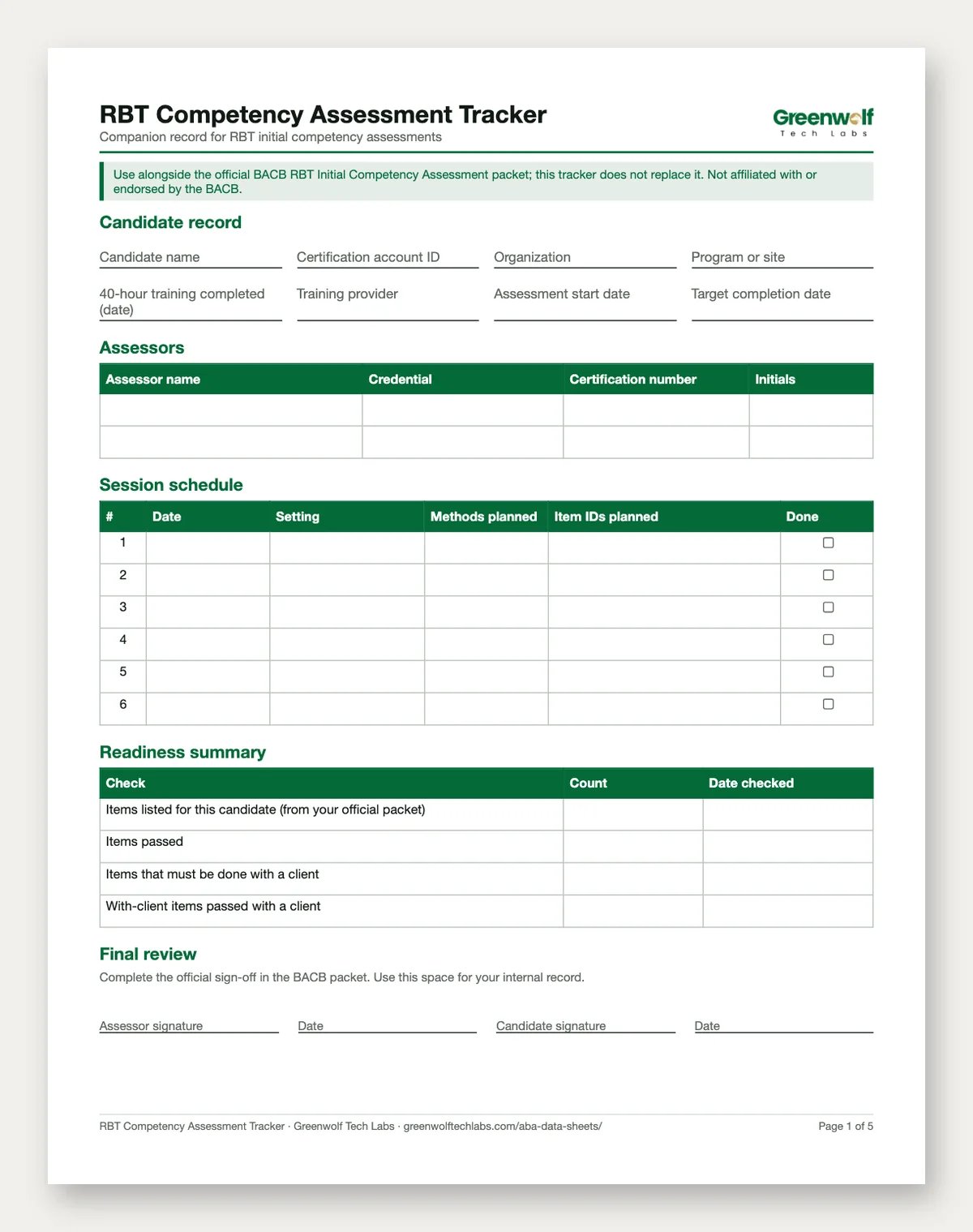
Run competency assessments for one candidate or thirty. Log each observation, and the tracker shows every candidate's progress, which items still need practice and who is ready for final review.
- Candidate list with training dates, assessor and target completion date
- Assessment log with dropdowns: item, method (with client, role-play, interview), result
- Progress grid: every candidate against every item, with-client items counted separately
- Dashboard: candidates in progress, completed, average completion and the items most often needing practice
- Printable candidate record, session notes, role-play planner and checklist
You get: Excel workbook · Google Sheets-ready · 5-page printable PDF
Secure checkout by Razorpay. Cards accepted worldwide, charged in US dollars. Files arrive on screen and by email. Refund policy
02
What is the RBT competency assessment?
The RBT competency assessment is the hands-on skills check every Registered Behavior Technician applicant must pass. After the 40-hour training, a qualified assessor watches the applicant perform each listed task, with a client, in role-play or by interview, and the signed form is uploaded with the certification application.
The Behavior Analyst Certification Board (BACB) calls it the RBT Initial Competency Assessment. The current version is the 2026 RBT Initial Competency Assessment Packet, effective January 1, 2026, and the rules sit in the BACB RBT Handbook. The packet lists 19 tasks grouped into four areas: measurement, assessment, skill acquisition and behavior reduction, and professionalism and requirements. Every task must be demonstrated, and the applicant then applies, passes the RBT exam and is added to a supervisor before providing services (BACB RBT page).
This page explains the process in plain language, with links to the official sources, and shows how assessors and agencies keep track of it. It does not reproduce the BACB task wording: always work from the current official packet, because the BACB only accepts its own form.
Last reviewed: 25 October 2026. Greenwolf Tech Labs is not affiliated with or endorsed by the BACB.
03
Free printable RBT competency assessment checklist (PDF)
Download the free RBT competency assessment progress checklist (PDF, 1 page). For one candidate it gives you rows for each item ID, a short label in your own words, a column to flag items that must be shown with a client, three attempt columns (date plus P for pass or NP for needs practice), a "passed with client" tick, the date passed and initials.
It is a working checklist, not the official form: the completed BACB packet is still what gets signed and uploaded. The full RBT Competency Assessment Tracker adds the candidate record, session observation notes, a role-play planner and a practice plan page, plus an Excel and Google Sheets workbook that tracks up to 30 candidates against up to 50 items, counts attempts and with-client passes automatically and shows who is ready for final review on a dashboard. It is part of our ABA data sheets and trackers.
04
RBT initial competency assessment requirements at a glance
Summarized in our own words from the 2026 RBT Initial Competency Assessment Packet and the RBT Handbook. Check the current versions before every assessment.
| Requirement | What it means | How the tracker helps |
|---|---|---|
| Responsible assessor | An active BCBA or BCaBA who has completed the 8-hour supervision training oversees the assessment, signs it and keeps the records. | Assessor list with credential, certification number and initials on every logged observation |
| Assistant assessors | The responsible assessor may delegate some or all tasks to assistant assessors who hold an active RBT certification or higher and whose proficiency the responsible assessor has checked by observation. | Each observation records who assessed it, so the responsible assessor can review quality |
| Relationships | Assessors may not be related to, subordinate to or employed by the applicant. Assessors, applicant and client(s) must all be employed by or contracted with the same organization, which also serves the client. | Candidate record captures the organization and site |
| Timing | Done after the 40-hour training is complete and no more than 90 days before the certification application is submitted. | Training completion date and target completion date per candidate, so the window is visible |
| Format | One or more sessions, in person, live online, or by watching videos recorded specifically for the assessment. | Session schedule and notes with date, setting and method |
| Assessment types | Each task is assessed with a client, by role-play, or by live interview, depending on what the packet allows for that task. | Method dropdown on every log row: with client, role-play, interview |
| With-client minimum | In the skill acquisition and behavior reduction section, three tasks must be shown with a client, not by role-play. | With-client items counted separately; readiness check flags any shortfall |
| Retrying a task | If a task is not yet competent, the assessor can give corrective feedback and reassess on another day, repeating until it is. No corrective feedback on the final assessment of a task. | Attempt numbers count up automatically; practice plan page for next steps |
| Documentation | The assessor initials each task and marks the type used; the responsible assessor signs the final attestation. Only the BACB form is accepted with the application. | Internal record and readiness summary to check before the official sign-off |
| Record retention | The responsible assessor keeps documentation of each assessment, including who assessed which parts, for at least seven years. | One workbook holds every candidate, observation and assessor |
05
RBT competency assessment steps
Finish the 40-hour training
The training must meet the BACB's 2026 requirements and take between 5 and 180 days. The assessment cannot start before it is complete.
Confirm the assessor and relationships
Identify the responsible assessor (BCBA or BCaBA with the 8-hour supervision training) and any assistant assessors (RBT or higher), and check that everyone, including the client, is within the same organization.
Download the current packet
Get the current Initial Competency Assessment packet from bacb.com. Older versions will not be accepted.
Plan sessions and clients
Decide which tasks will be shown with a client, which by role-play and which by interview, and pick suitable clients and times. Plan at least the required with-client tasks.
Observe and record
Run one or more sessions in person, live online or by purpose-made video. Record each attempt, the method and the result.
Give feedback and reassess
For tasks not yet competent, give corrective feedback, practice and reassess on another day. The final assessment of a task is done without feedback.
Complete the official form
When every task is passed, the assessor initials each task and marks the method; the responsible assessor signs and dates the attestation.
Apply within 90 days
The applicant uploads the completed packet, the 40-hour training certificate and the attestation form in the BACB portal no more than 90 days after the assessment was completed.
06
Who can conduct the RBT competency assessment?
Under the 2026 RBT Initial Competency Assessment Packet, one person is always the responsible assessor: an active BCBA or BCaBA (the form also lists BCBA-D and FL-CBA certification types) who has completed the 8-hour supervision training. That person oversees the whole assessment, signs it and keeps the records, even when others do part of the observing.
Under the 2026 packet, the responsible assessor can delegate tasks to assistant assessors who hold an active RBT certification or higher and have shown they know the material through direct observation. The packet also includes a responsible assessor checklist covering things like choosing suitable clients, checking that the 40-hour training is done and tracking completed assessments.
The person who delivered the 40-hour training may also be the assessor. What is not allowed is an assessor who is related to, subordinate to or employed by the applicant, and everyone involved, including the client, must be connected to the same organization. If a BCaBA or an RBT is assessing, their own supervisor must also be with that organization.
07
How long does the RBT competency assessment take?
The BACB does not set a fixed length. It can run over one or more sessions, so the real limits are the dates: it starts after the 40-hour training is complete, and the application must be submitted within 90 days of completing it (RBT Handbook). Once submitted, the BACB asks applicants to allow about two weeks for application processing, and an application stays active for 90 days.
In practice, the time depends on how many tasks the candidate passes on the first attempt, how easily the with-client tasks can be scheduled and how many assessors are available. Sample schedule, for illustration only:
| Session | Focus | Method |
|---|---|---|
| 1 | Measurement and assessment tasks | Role-play with a colleague, data entered and graphed |
| 2 | Skill acquisition and behavior reduction, including the with-client tasks | With a client during a scheduled session |
| 3 | Professionalism and requirements | Live interview |
| 4 | Any items marked needs practice | Reassessment on another day, no feedback on the final attempt |
08
Worked example: an agency tracking six candidates
Sample scenario, not real data. A clinic starts six candidates in the same month. The training coordinator enters the 19 item IDs from the official packet in Setup with short labels in their own words, marks which items are planned with a client and lists two assessors: the responsible BCBA and one RBT assistant assessor.
- After two weeks, the progress grid shows four candidates at 15 or more of 19 items, one at 11 and one at 6 because of missed sessions.
- The dashboard's "most often needs practice" list shows the same two items for three candidates, so the BCBA runs a group practice on those before reassessing.
- One candidate has passed all items but only two with-client items in the skill acquisition and behavior reduction section. The readiness check flags the shortfall before the BCBA signs, and a third with-client observation is scheduled.
- When a candidate reaches 100% with the with-client count met, the responsible assessor completes the official packet, and the coordinator notes the 90-day application deadline.
09
Common reasons candidates need re-assessment
10
How to prepare for the RBT competency assessment (for candidates)
- Read the current packet and the handbook so you know which tasks may be role-played, which need a client and which are interviews.
- Practice each skill out loud, with a colleague playing the client. Measurement and data tasks are easy to rehearse: time a behavior, run interval recording and enter and graph the data.
- Use your 40-hour training notes and the RBT Test Content Outline (3rd ed.) listed in the RBT Handbook, which covers the same content areas.
- Prepare interview examples from your own workplace: real situations about dignity, boundaries, supervision and when you would ask for clinical direction.
- Write practice session notes that describe only what you observed, without opinions.
- Keep your own checklist (the free one above works) so you know what is left and can ask for the next session.
Tasks such as token systems and data recording are easier to show with familiar materials: our token board kit and behavior tracking sheet are good practice tools.
11
How agencies track many candidates
With one candidate, a paper checklist is enough. With ten, spread across sites and assessors, the questions become: who has passed what, which with-client tasks are still open, which assessor saw which task, and whose 90-day window is closing. The packet's own responsible assessor checklist asks for a system to track completed assessments, assistant assessors and dates.
The tracker answers those from one Assessment Log: each row is an observation (candidate, item, method, result, assessor, date). The progress grid, readiness counts and dashboard update from it. For supervision after certification, see our BCBA supervision tracker service, and if you want this inside your clinic systems, see ABA practice management.
12
Initial vs recertification competency assessment
| Initial Competency Assessment | Recertification Competency Assessment | |
|---|---|---|
| Who | RBT applicants | Certified RBTs recertifying |
| When | After the 40-hour training, no more than 90 days before applying | No more than 45 days before the certification expiration date |
| Overseen by | Responsible assessor (BCBA or BCaBA), with optional assistant assessors | A qualified BACB-certified RBT supervisor |
| Still required? | Yes, for every new application | For recertifications during 2026, one last time; after that the BACB moves RBTs to a 2-year cycle with 12 hours of professional development instead |
Source: BACB RBT Handbook (updated June 2026), certification maintenance section. Check your own dates in your BACB portal account.
13
What is inside the tracker
Setup
Your item list (up to 50), domains, assessors and the packet version you are using.
Assessment Log
2,000 rows. Attempt numbers count up on their own and labels fill in from Setup.
Progress grid
Thirty candidates by fifty items: Pass, Practice or not yet tried, with % complete and status.
Dashboard
KPIs, a completion chart by candidate and the five items that most often need more practice.
14
RBT competency assessment questions
What is the RBT initial competency assessment?
Who can conduct the RBT competency assessment?
How many tasks are on the 2026 RBT competency assessment?
How long is the RBT competency assessment valid?
Can the RBT competency assessment be done online?
Where can I get the RBT competency assessment form or PDF?
What happens if I do not pass a task?
Does this tracker replace the BACB packet?
Is this affiliated with the BACB?
15
More ABA data sheets and trackers
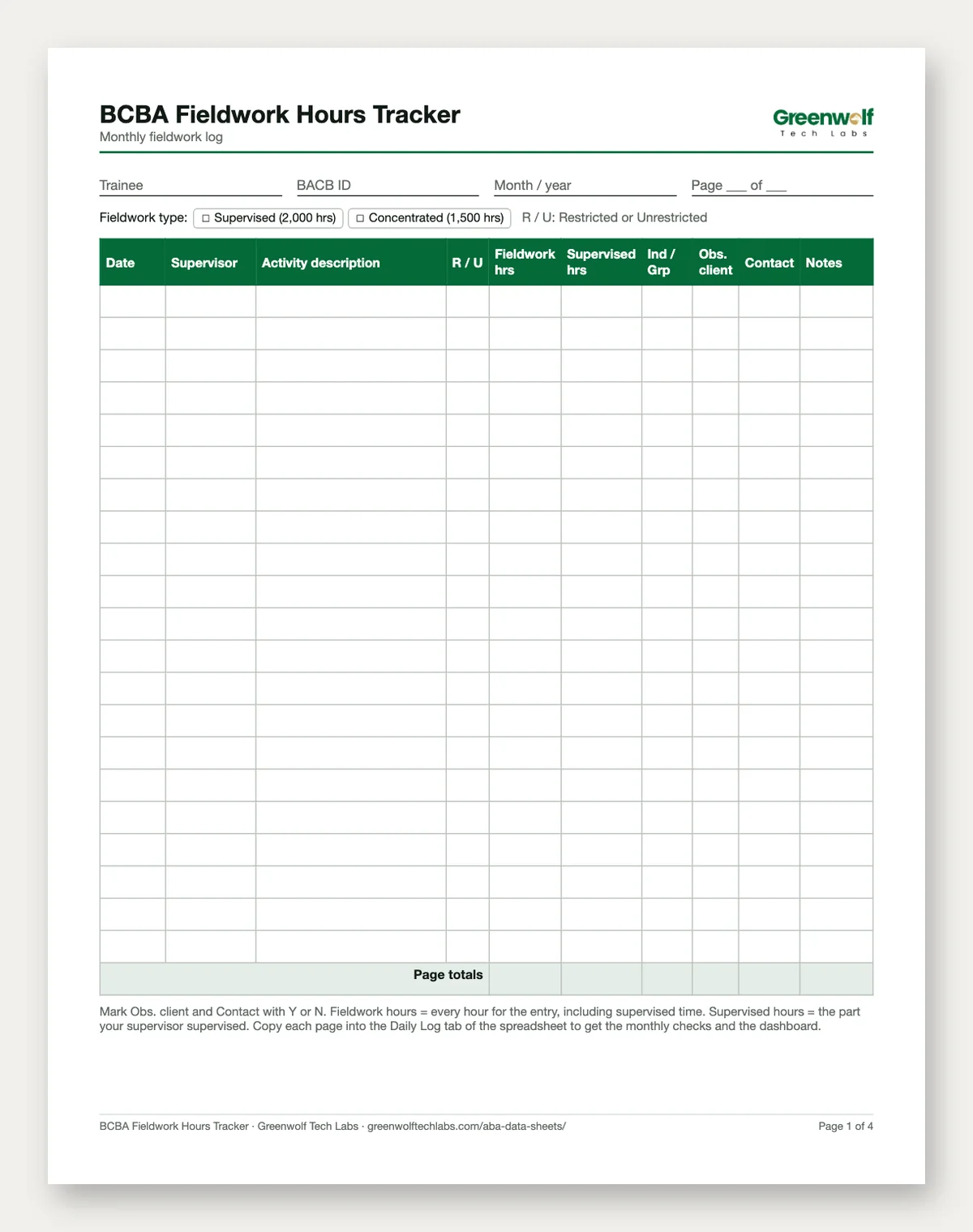
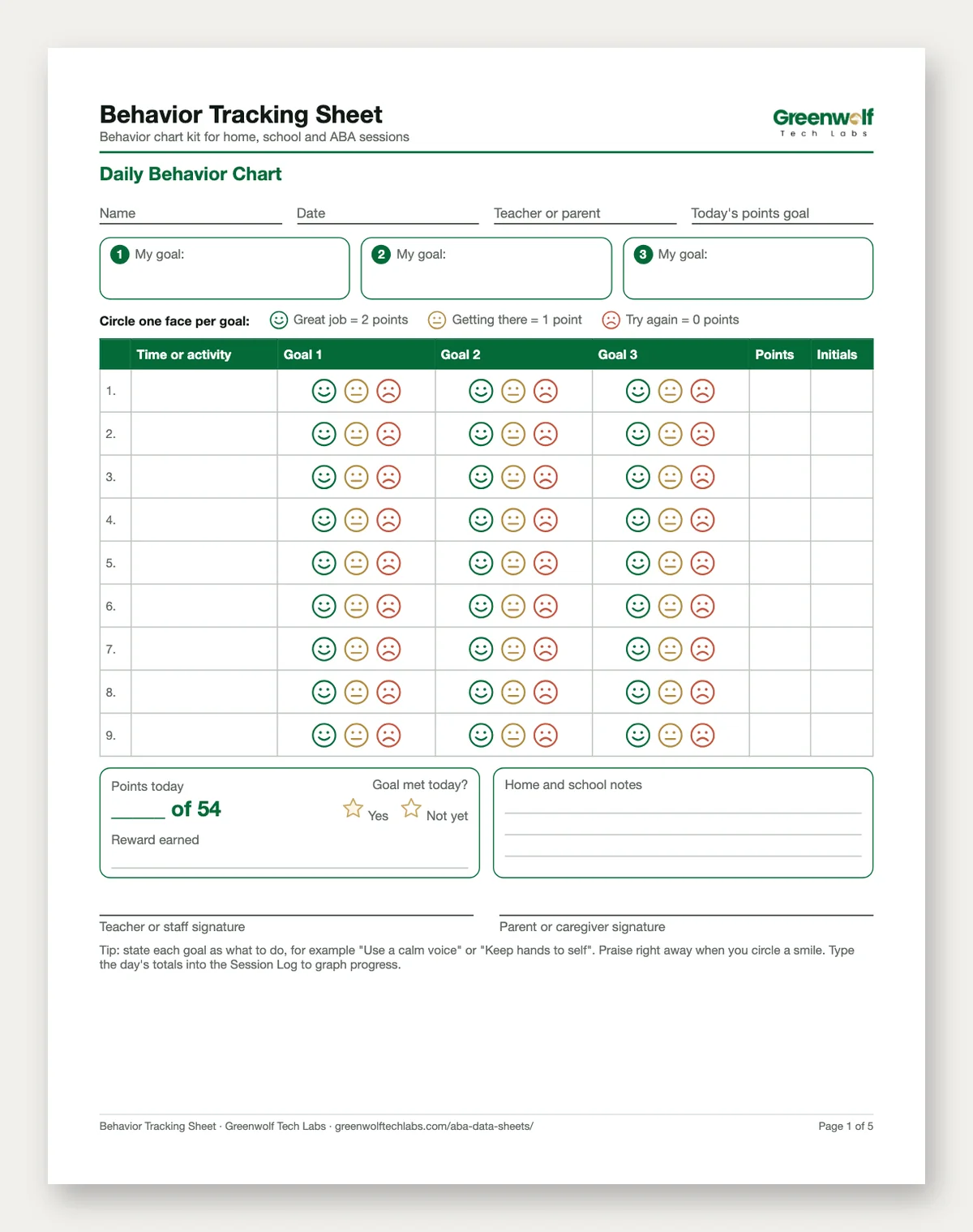
Behavior Tracking Sheet and Behavior Chart Kit
Frequency, duration and latency with automatic rates and graphs.
$12Details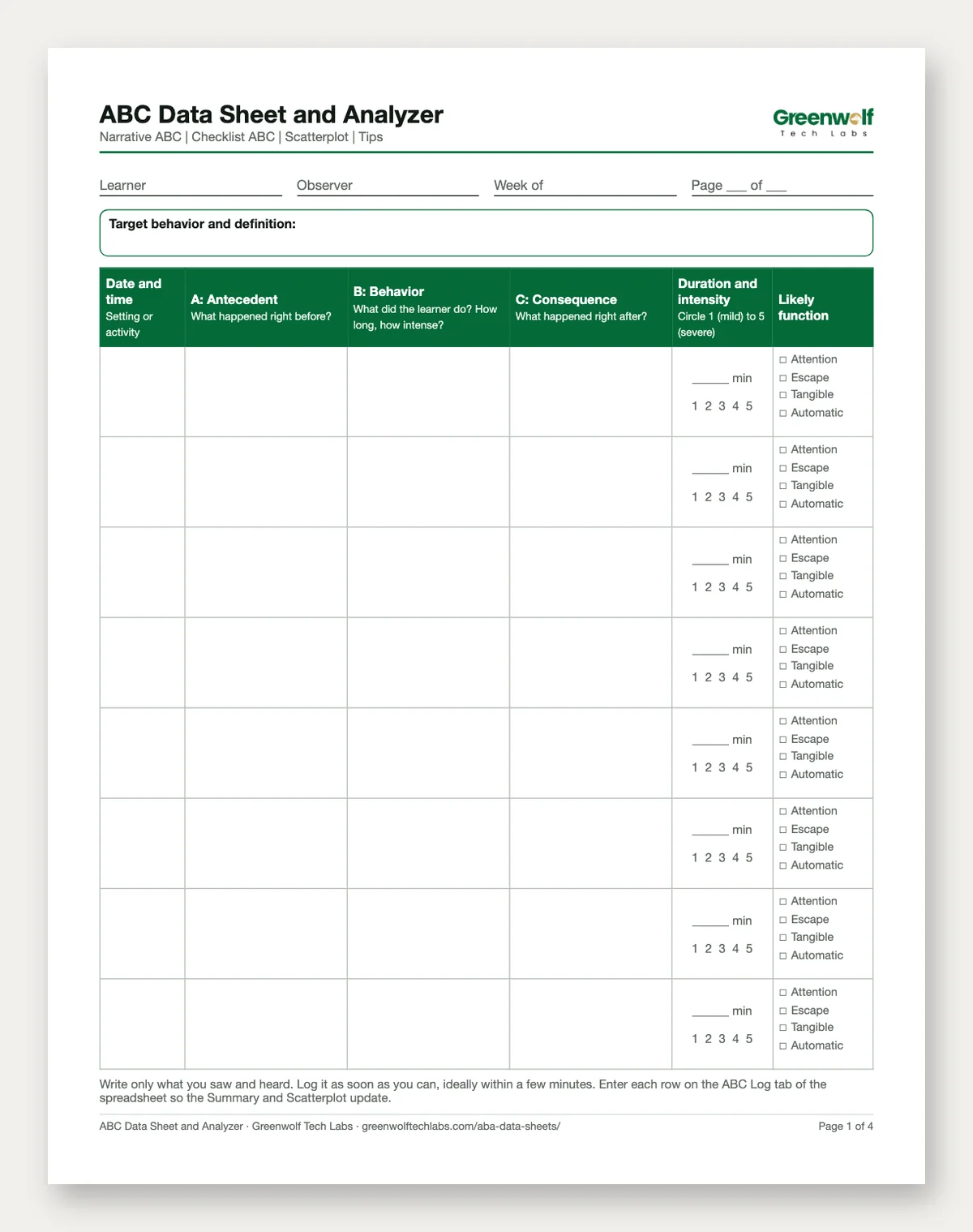
ABC Data Sheet and Analyzer
ABC logging that finds the top antecedents, consequences and likely function.
$9Details
Need this inside your practice software?
We build ABA data collection and practice management systems around how your clinic works, so data like this is captured once and reported automatically.
Part of our Healthcare Practice Automation hub. Start with our healthcare workflow automation.
Healthcare Practice Automation
More on healthcare workflow automation
ABA Practice Tracker for Authorizations, RBT Supervision and KPIs
RBT supervision tracker and ABA practice tracker for Excel and Google Sheets: monthly 5% supervision checks, authorization units, burn rate and clinic KPIs.
BCBA Hours Tracker for Fieldwork and Supervision
BCBA hours tracker for Excel and Google Sheets: log fieldwork daily and check supervision %, contacts, observation and monthly hour limits before month end.
BCBA Supervision Tracking for Supervisors and Trainees
Track BCBA fieldwork and RBT supervision hours, monthly percentages, contacts and observations for every trainee, with a ready tracker or a custom system.
Dental Appointment Reminders That Cut No-Shows and Fill the Chair
Automated dental appointment reminders over WhatsApp and SMS that confirm visits, fill recall gaps and cut no-shows, using the tools your clinic already runs.
Case Study: An ABA Practice Management System for PTC
Metric Before After Submission errors High Significantly reduced Time clinicians spent entering data 10-15 mins/day < 3 mins/day Admin review effort Heavy Lightweight & structured...