

Templates and trackers
Token Board Template, Reward Chart and Token Economy Kit
Free printable token board template, plus how to set up a token economy, choose rewards by age, use a first-then board and thin tokens step by step.
For BCBAs, RBTs, special education teachers and parents
Token Board and Token Economy Kit
$9USD · one-time purchase · instant download
Everything to run a token economy: boards to print, a reward choice menu, tokens to cut out, a plan for the team and a tracker that shows tokens earned, exchanged and when to thin.
- Printable 3, 5 and 10 token boards with an "I am working for" box
- First-then board and a picture choice menu with token costs
- 36 cut-out tokens: stars, coins, checks, smileys and blanks
- Token economy plan page for the BCBA or teacher
- Tracker: tokens earned and exchanged per day, favorite rewards and a thinning plan
You get: 8-page printable PDF · Excel tracker · Google Sheets-ready
Secure checkout by Razorpay. Cards accepted worldwide, charged in US dollars. Files arrive on screen and by email. Refund policy
02
What is a token board template?
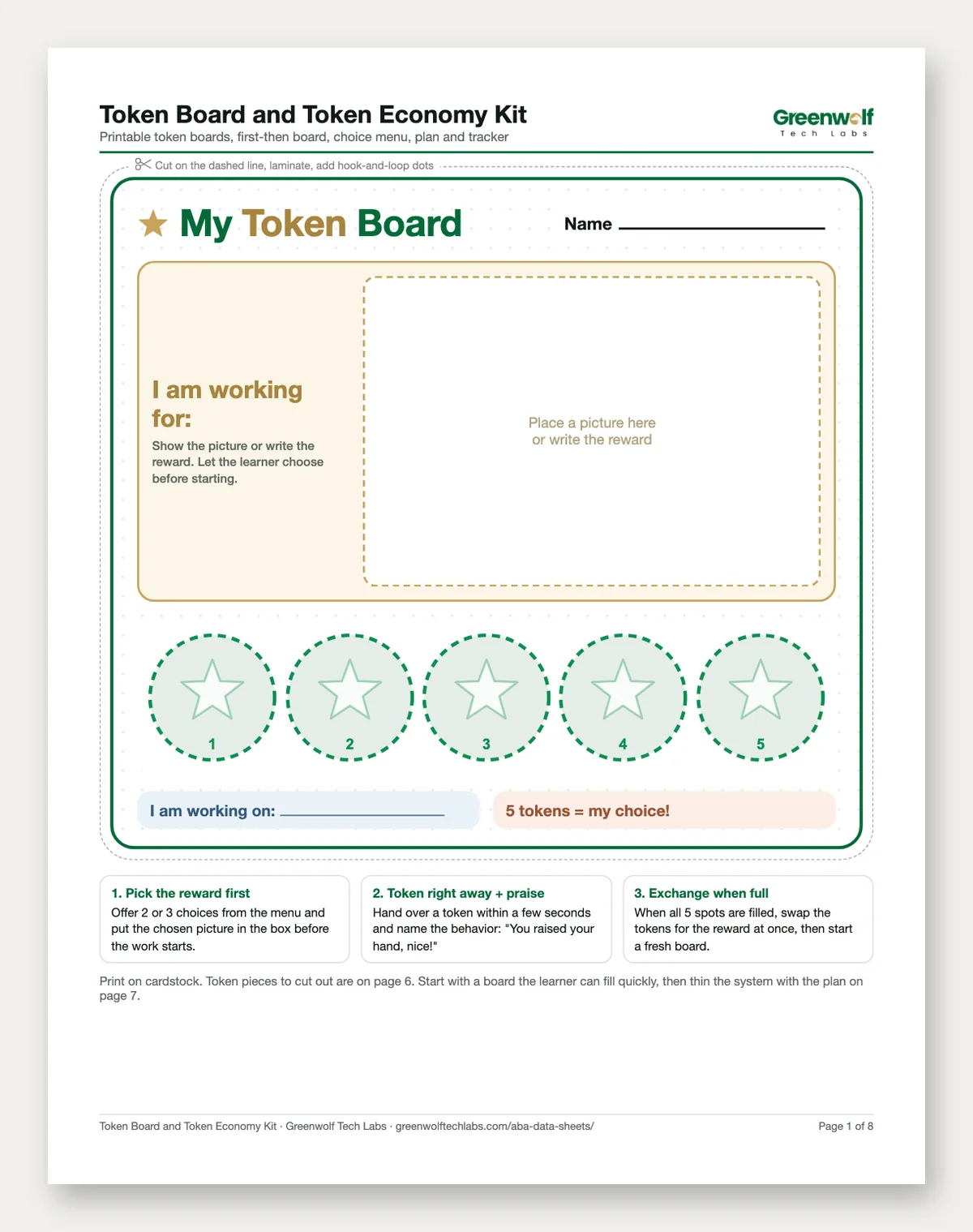
A token board template is a printable board with a set number of token spaces (often 3, 5 or 10) and a reward box. The learner earns a token for each target behavior and, when the board is full, trades the tokens for a reward chosen beforehand.
A token board is the visible part of a token economy: a reinforcement system in which tokens (stars, coins, checks) are earned for specific behaviors and later exchanged for backup reinforcers such as an activity, a toy or time with a favorite person. Behavior analysts, special education teachers and parents use it because it bridges the gap between the behavior and a reward that cannot be delivered every few seconds.
This page gives you a free printable 5-token board, explains how a token board differs from a reward chart, and walks through setting up, running and fading a token economy, with a worked example. The full kit adds 3 and 10 token boards, a first-then board, a picture choice menu, 36 cut-out tokens, a token economy plan for the BCBA or teacher and a spreadsheet tracker. It is one of our ABA data sheets and trackers.
03
Free printable token board template (PDF)
Download the free 5-token board printable (PDF, 1 page). It has an "I am working for" box, five numbered token spaces, a line for the target behavior, a short three-step guide (pick the reward first, give the token right away with praise, exchange when full) and a cut line for laminating.
Print it on cardstock, laminate it and add a hook-and-loop dot to each space. Any small tokens will work while you test it. The full Token Board and Token Economy Kit (above) adds the 3-token and 10-token boards, the first-then board with a travel card, a priced choice menu, 36 matching cut-out tokens, the token economy plan with a thinning table, a daily token tracker and an Excel and Google Sheets tracker that charts tokens earned and exchanged per day.
04
Token board vs reward chart vs sticker chart
People search for all three, and they are related but not the same. The main differences are how quickly the learner gets the reward and how many behaviors the system covers.
| Token board | Reward chart | Sticker chart | |
|---|---|---|---|
| What it tracks | One target behavior, or a few, within a session or activity | Several behaviors or routines across a day or week | Usually one routine (for example, staying in bed) across days |
| Time to reward | Minutes; the board fills quickly at first | Usually end of day or week | Often after a set number of days |
| Reward chosen | Before the board starts, shown in the "working for" box | Often agreed in advance for the week | Often fixed |
| Best for | Young learners, learners who need frequent reinforcement, therapy and classroom sessions | Older children and teens who can wait for a delayed reward | Simple home routines |
| Can be thinned | Yes: more tokens per exchange over time | Yes: longer periods or higher point targets | Rarely planned |
| Data kept | Tokens earned and exchanged per session (our tracker) | Points per day | Usually none |
A reward chart is effectively a token economy with a long delay. If a child does not respond to a weekly reward chart, the delay is often the problem: start with a token board that fills in a few minutes, then stretch it toward a daily chart once the system works. A token economy chart in a classroom usually sits between the two, with points or tokens per period and an exchange at the end of the day.
05
How to set up a token economy, step by step
Define one target behavior
Write it so two people would agree it happened: "raises hand and waits to be called" rather than "behaves well." Start with one behavior; add a second only after the board works.
Find what the learner will work for
Run a quick preference check: offer 2 or 3 items or activities and note what the learner picks or reaches for. Refresh it before each session, because preferences change.
Choose the board size
New learners usually start with 3 tokens so the board fills fast. Move to 5 once exchanges are smooth, and to 10 for longer work periods.
Let the learner choose the reward first
Put the picture or written reward in the "I am working for" box before work starts, so every token visibly moves toward something the learner wants.
Teach what a token means
For a few rounds, give tokens almost immediately and exchange as soon as the board is full. This pairing is what gives tokens their value.
Deliver tokens fast, with praise
Hand over the token within a few seconds of the behavior and name it: "You asked for help, great." Pairing tokens with specific praise lets praise carry more of the load later.
Exchange right away when the board is full
Delay at the start teaches that tokens are not worth much. Give the reward, then start a fresh board.
Record and review
Log tokens earned, exchanges and the reward chosen. Review weekly and thin only when the data show the learner is filling boards reliably.
06
Worked example: a sample token economy
This is a sample scenario for illustration, not a real client. Sam is 6 and leaves his seat during table work. The team writes one target behavior: "stays seated with feet on the floor and works on the task." A preference check shows Sam picks the tablet, bubbles and building blocks most often.
- Week 1: 3-token board, one token about every 1 to 2 minutes of seated work, each exchange buys 2 minutes of his chosen activity. Sam fills 6 boards per 30-minute session on average and accepts every exchange.
- Week 2: criterion met (3 sessions in a row with every board filled and no refusal), so the team moves to a 5-token board. Exchanges drop to 4 per session.
- Week 4: criterion met again. The team moves to 10 tokens, adds a second target behavior (asking for a break with a card) and raises the access time to 3 minutes per exchange.
On the daily token tracker, each period gets a row: time, target behavior, tokens shaded, tokens exchanged, reinforcer chosen and initials. Entered into the spreadsheet's Token Log, those rows show the daily totals, which rewards Sam picks most and whether the current thinning step's criterion has been met.
07
Target behaviors and rewards by age (examples)
Use these as starting ideas and adjust to the learner's goals, plan and preferences. Edible rewards should follow the plan and allergy information.
| Age group | Example target behaviors | Example rewards | Suggested board |
|---|---|---|---|
| Toddlers and preschool (about 2 to 5) | Sitting for a short activity, using a word or picture to request, following a one-step instruction, putting toys away | Bubbles, a spinning toy, a favorite song, a short swing, a sticker | First-then board, then a 3-token board |
| School age (about 6 to 11) | Raising a hand, starting work within a minute, completing a worksheet, waiting in line, using a break card | Tablet time, helper job, game with staff, drawing, choosing the class activity | 5 or 10 tokens; classroom token economy chart |
| Teens | Arriving on time, finishing homework blocks, using a coping strategy, completing chores | Screen time, choosing a meal or outing, phone time, a small purchase | 10 tokens or a points-based reward chart |
| Adults (vocational or residential) | Completing a work task, following a schedule, hygiene routines | Preferred activity, outing, privileges, small purchases | Points or checklist that exchanges daily or weekly |
Keep at least one low-cost option on the choice menu so every full board can end in an exchange, and price quick items low and big favorites high. If you are not sure why a problem behavior happens, collect a few days of data with the ABC data sheet before choosing the behavior to reinforce, and write the token system into the plan with the FBA and BIP template.
08
Thinning: how to fade a token board
Thinning means asking for more tokens, or more behavior per token, as the learner succeeds, so the behavior holds up with less frequent reinforcement. The goal is a system closer to what happens naturally at school, home or work, with praise and natural rewards doing most of the work.
Write the steps and the criterion for moving on before you start. A sample thinning plan:
| Step | Tokens per exchange | Criterion to move on (sample) |
|---|---|---|
| 1 | 3 | 3 sessions in a row with every board filled and no refusals at exchange |
| 2 | 5 | Same criterion, with target behavior at or above the baseline rate |
| 3 | 10 | Same criterion over a full session or class period |
| 4 | 10, exchange at end of session | Target behavior maintained for 2 weeks |
If the learner stops earning, refuses the board or problem behavior rises, step back to the last successful step and thin more slowly. The kit's plan page has this thinning table, and the spreadsheet shows the current step and the date each criterion was met. To measure the target behavior itself alongside tokens, pair it with the behavior tracking sheet.
09
How to use a first-then board (printable)
A first-then board is the simplest token system: two boxes, "First" for a less preferred task and "Then" for a reward. It is often the right starting point for young children before a full token board, and it helps with transitions such as leaving the playground.
- Put a picture of the task under First and something the learner wants right now under Then.
- Say it plainly while pointing: "First shoes, then swing."
- Keep the first task short at the start, then lengthen it.
- Deliver the Then item as soon as the task is done, every time.
- When the task has several steps, pair the first-then board with a 3-token board.
The kit's first-then board printable includes a full-size board and a mini travel card for outings.
10
Which page of the kit to use when
| Situation | Use |
|---|---|
| Learner is new to rewards or has trouble waiting | First-then board, then the 3-token board |
| Short work blocks in therapy or class | 5-token board (the free sample) |
| A full session or class period | 10-token board |
| Learner needs to choose a reward | Choice menu with token costs |
| Several adults run the system | Token economy plan: behaviors, delivery rules, exchange rate and thinning steps |
| You need to show progress | Daily token tracker and the Excel or Google Sheets tracker |
11
Common token economy mistakes
12
Token board and token economy questions
What is a token board?
Where can I get a free token board template?
How many tokens should a token board have?
What is the difference between a token board and a reward chart?
How do you set up a token economy?
What is a first-then board?
What does thinning a token board mean?
Can parents use a token board at home?
Is a token economy chart the same as a token board?
13
More ABA data sheets and trackers
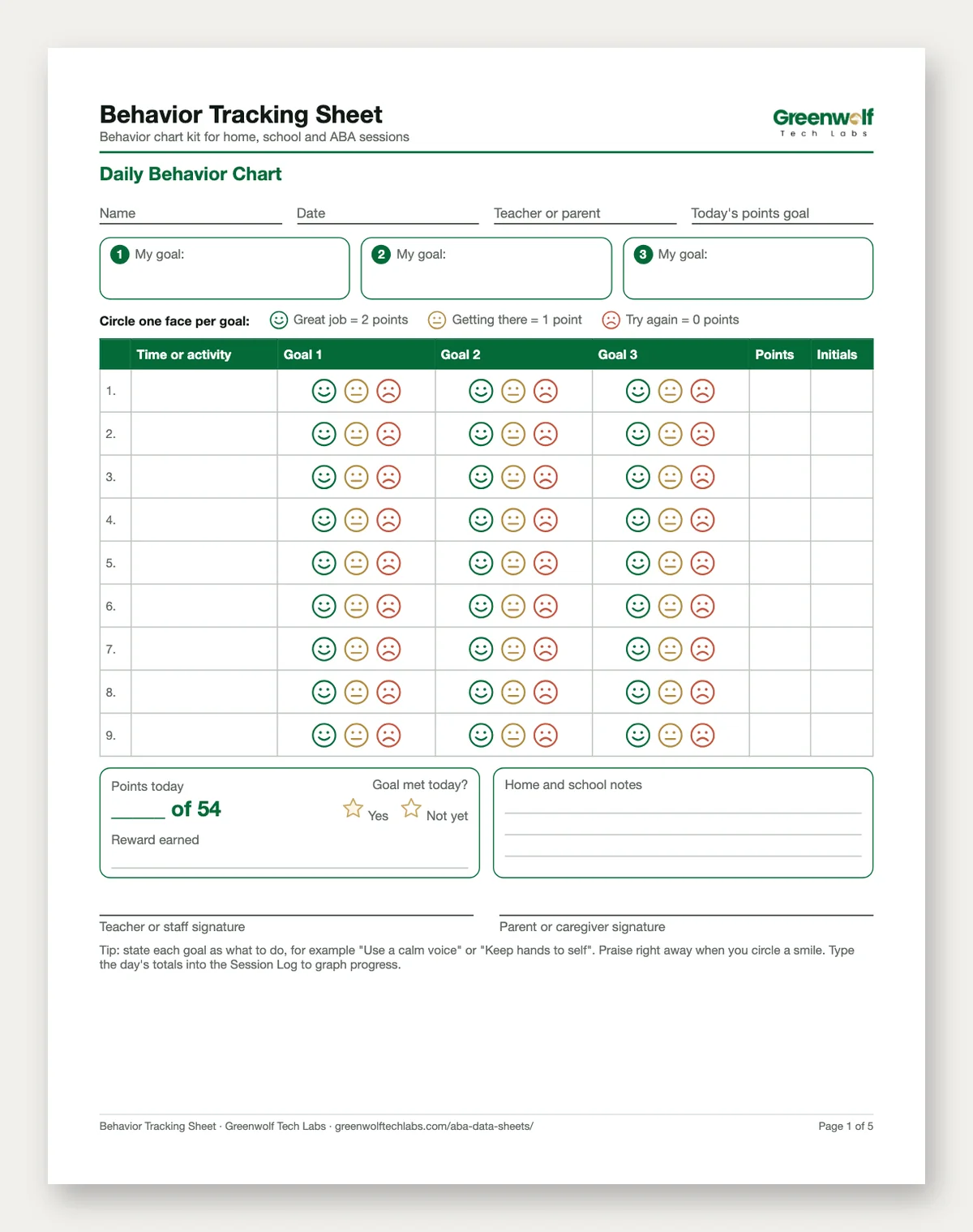
Behavior Tracking Sheet and Behavior Chart Kit
Frequency, duration and latency with automatic rates and graphs.
$12Details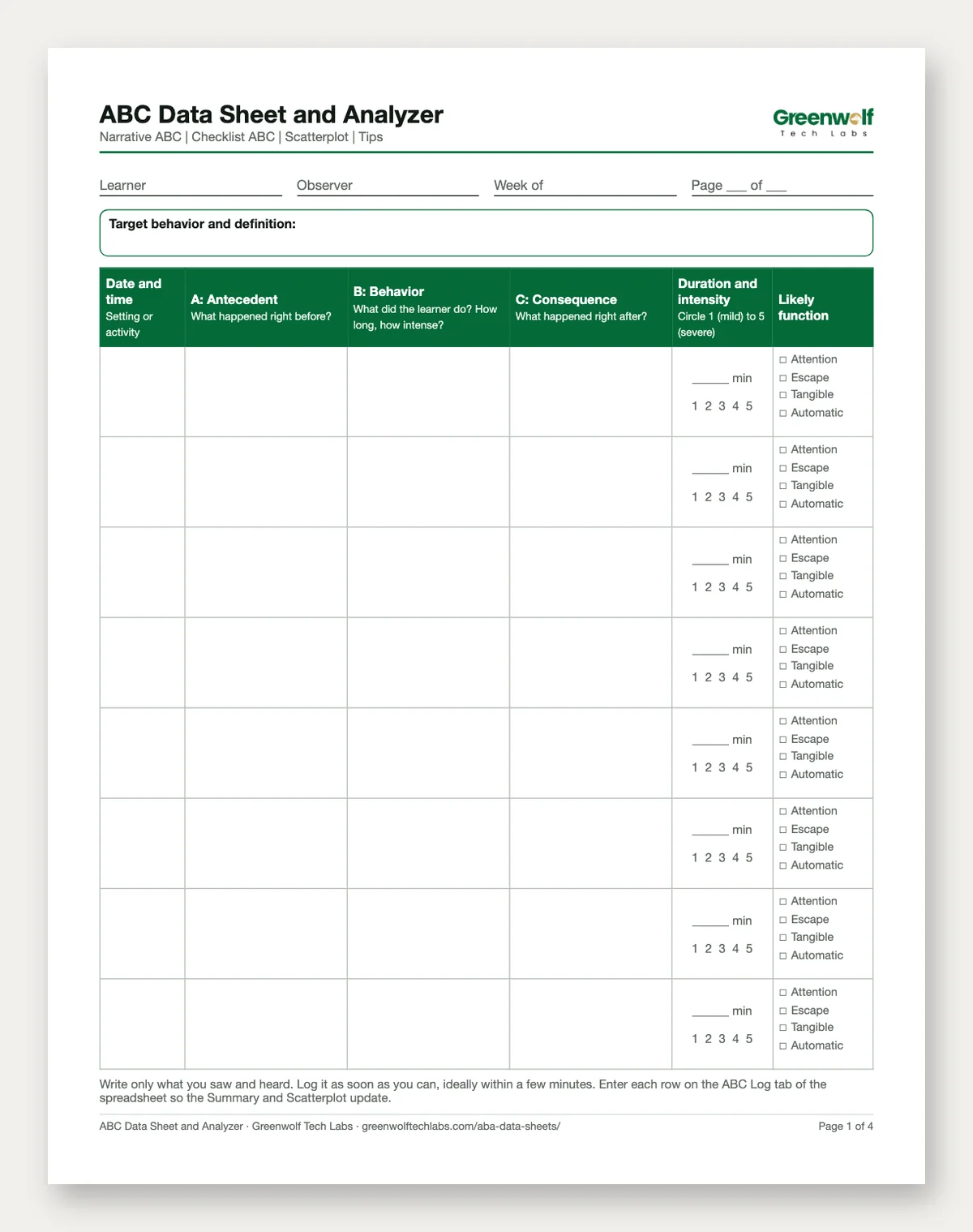
ABC Data Sheet and Analyzer
ABC logging that finds the top antecedents, consequences and likely function.
$9Details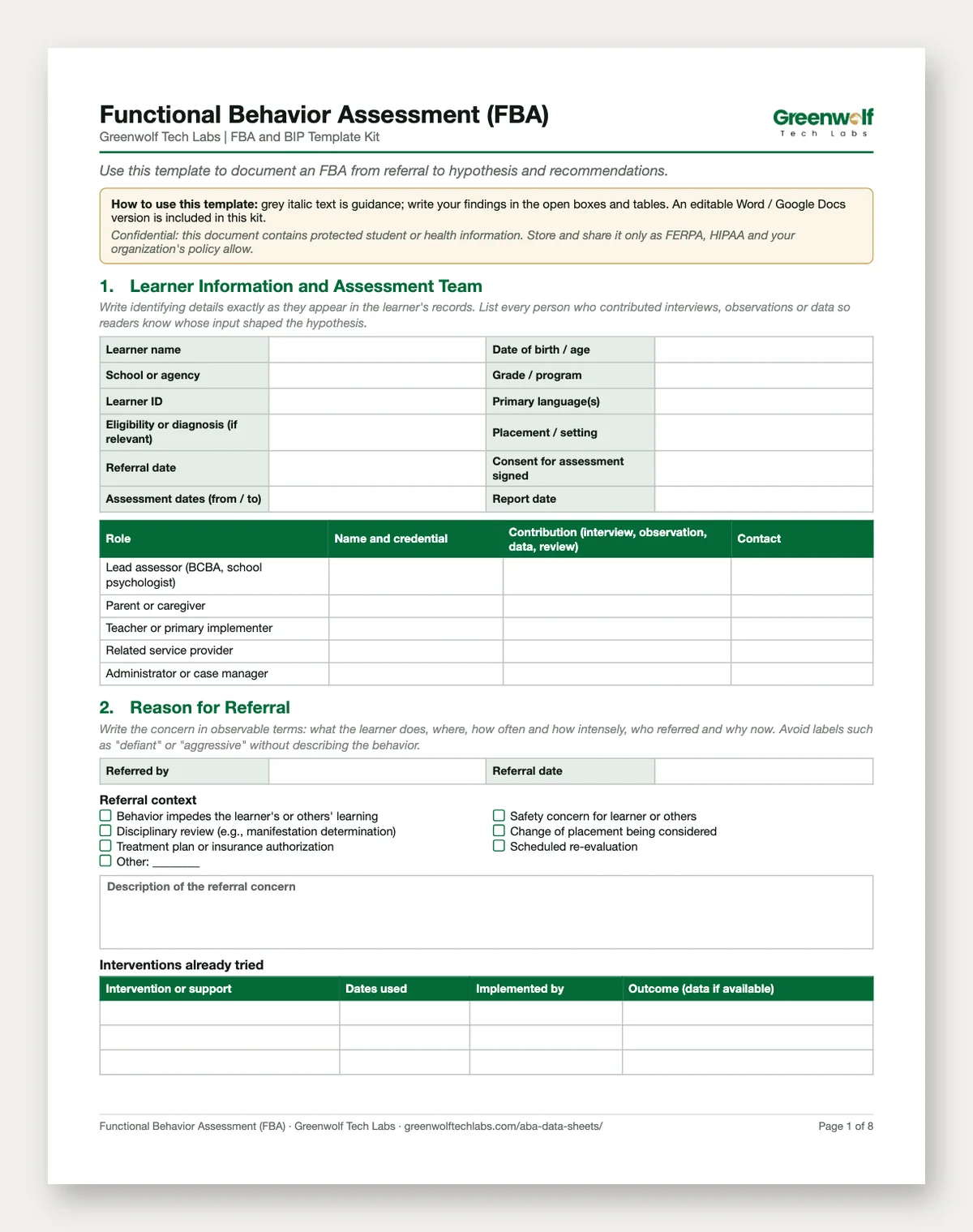
FBA and BIP Template Kit
Editable FBA and BIP templates with a hypothesis matrix and fidelity checklist.
$19Details
Need this inside your practice software?
We build ABA data collection and practice management systems around how your clinic works, so data like this is captured once and reported automatically.
See ABA data collection software and ABA practice management.
Part of our Healthcare Practice Automation hub. Start with our healthcare workflow automation.
Healthcare Practice Automation
More on healthcare workflow automation
ABC Chart and ABC Data Sheet: Antecedent, Behavior, Consequence
An ABC chart records the antecedent, behavior and consequence of each incident. Free printable ABC chart PDF, filled-in examples and how to analyze ABC data.
Printable Behavior Chart, Behavior Log and Tracking Sheet
Free printable behavior chart for kids at home and school, plus a behavior log and tracking sheet with frequency, duration and latency formulas and graphs.
BIP and FBA Templates with Examples and a Competing Behavior Pathway
Editable BIP and FBA templates in Word and PDF, with a worked FBA-to-BIP example, a competing behavior pathway and hypothesis statements for each function.
Dental Appointment Reminders That Cut No-Shows and Fill the Chair
Automated dental appointment reminders over WhatsApp and SMS that confirm visits, fill recall gaps and cut no-shows, using the tools your clinic already runs.
Case Study: An ABA Practice Management System for PTC
Metric Before After Submission errors High Significantly reduced Time clinicians spent entering data 10-15 mins/day < 3 mins/day Admin review effort Heavy Lightweight & structured...