

Templates and trackers
ABA Practice Tracker for Authorizations, RBT Supervision and KPIs
RBT supervision tracker and ABA practice tracker for Excel and Google Sheets: monthly 5% supervision checks, authorization units, burn rate and clinic KPIs.
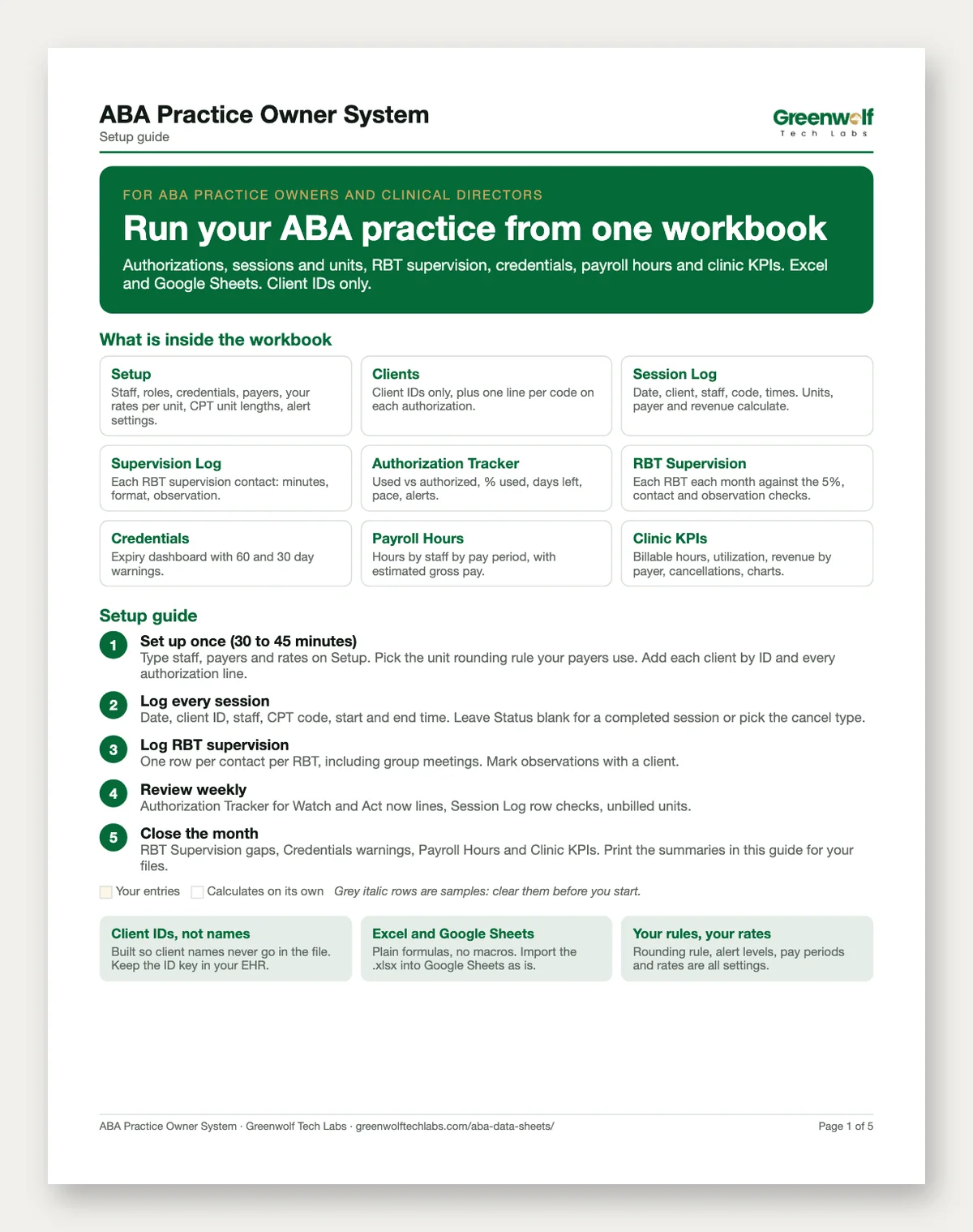
For ABA practice owners and clinical directors
ABA Practice Owner System
$59USD · one-time purchase · instant download
One workbook for the numbers an ABA practice owner checks every week: authorization units used and left, session units and estimated revenue, RBT supervision, credential expiry dates, payroll hours and clinic KPIs. Client IDs only, never names.
- Authorization tracker per client and CPT code: % used, units left, days left, pace, alerts at 80%, 100% and 30 days before the end date
- Session log that turns start and end times into 15-minute units with the rounding rule you choose
- RBT supervision check for every RBT every month: 5% of service hours, contacts, individual contact and observation
- Credentials dashboard with 60 and 30 day warnings, plus payroll hours by pay period
- Clinic KPIs: billable hours, utilization by staff, revenue by payer, cancellations, with charts
- 5-page guide: setup, monthly owner checklist, printable authorization and supervision summaries
You get: Excel workbook · Google Sheets-ready · 5-page PDF guide
Secure checkout by Razorpay. Cards accepted worldwide, charged in US dollars. Files arrive on screen and by email. Refund policy
02
What is an RBT supervision tracker?
An RBT supervision tracker is a log that records every supervision contact for each RBT and checks each calendar month against the BACB minimums: supervision for at least 5% of service hours, at least two face-to-face, real-time contacts, one of them individual, and one observation with a client.
An ABA practice tracker goes one step further. It keeps the other numbers that decide whether a clinic gets paid and stays in good standing in the same workbook: authorized units used against each authorization, the units each session produces, staff credential expiry dates, payroll hours and a handful of clinic KPIs.
Most of the risk sits in three places. Sessions delivered after an authorization runs out or past its unit limit may not be paid. An RBT who does not get the required monthly supervision puts their certification at risk. A credential that lapses means that person may not practice or bill. A spreadsheet that checks all three every week catches problems while there is still time to fix them.
This workbook does that with plain formulas that work in Excel and Google Sheets, and it uses client IDs only, so client names never go in the file. If you need scheduling, notes and billing in one system rather than a spreadsheet, see our ABA practice management service.
Last reviewed: 25 October 2026.
03
Free printable RBT monthly supervision summary (PDF)
Download the free RBT monthly supervision summary (PDF, 1 page). It is the same page that ships in the owner guide: month totals against each minimum (5% of service hours, 2 contacts, 1 individual contact, 1 observation with a client), a log for up to six supervision contacts with format, observation and modality, a feedback box and RBT and supervisor sign-off lines.
Print one per RBT per month and file it with your supervision records. The full ABA Practice Owner System adds the Excel and Google Sheets workbook that fills these numbers in for you from the Supervision Log, the authorization summary page, the monthly owner checklist, the credentials dashboard, payroll hours and the clinic KPI charts.
04
RBT supervision requirements each month (BACB RBT Handbook)
Under the BACB RBT Handbook (updated 06/2026), each RBT must receive ongoing supervision for at least 5% of the hours they spend providing behavior-analytic services each calendar month, with at least two face-to-face, real-time contacts, and the supervisor must observe the RBT providing services in at least one of them.
| Each calendar month, for each RBT | Requirement (our summary) | What the tracker checks |
|---|---|---|
| Supervised hours | At least 5% of service hours | Supervision minutes divided by service minutes, flagged under 5% |
| Contacts | At least 2, face-to-face and in real time (not phone or email) | Count of logged contacts |
| Individual contact | At least 1 of the 2 with no other RBTs or trainees present | Count of contacts marked Individual |
| Observation | At least 1 observation of the RBT with a client (in person preferred, real-time video allowed) | Count of contacts marked Observed with client |
| Group meetings | Small groups of 2 to 10 RBTs | Flags any group over 10 |
| Documentation | Dates, duration, format, observations and supervisor names, kept at least 7 years | One row per contact, plus the printable monthly summary |
The requirements apply at each organization where the RBT works (an RBT cannot split 3% at one clinic and 2% at another). RBT Supervisors can be BCBAs or BCaBAs, RBT Requirements Coordinators must be BCBAs, and ongoing supervision and professional development are separate requirements. On renewal, the handbook says the RBT renewal competency assessment is completed no more than 45 days before the expiry date, and from 2027 RBTs renew every two years. The Credentials tab flags each expiry 60 and 30 days ahead and notes when an RBT's 45-day window is open. Always confirm the current handbook; the BACB also publishes an RBT supervision checklist. For BCBA trainees, fieldwork supervision follows different rules: use the BCBA fieldwork hours tracker, or see our BCBA supervision tracker software page.
05
How to calculate RBT supervision hours: a worked example
The 5% is calculated on the hours the RBT actually spends providing behavior-analytic services that month, so you only know the final target at month end. Track it weekly against the hours delivered so far. Here is a sample month for one RBT (made-up numbers):
| Date | Contact | Minutes | Format | Observed with client |
|---|---|---|---|---|
| Mar 4 | 1 | 90 | Individual | Yes (in person) |
| Mar 12 | 2 | 60 | Group (6 RBTs) | No |
| Mar 19 | 3 | 60 | Individual | No |
| Mar 26 | 4 | 60 | Group (6 RBTs) | No |
- Service hours: the Session Log shows 112 hours of services for this RBT in March.
- Target: 5% of 112 hours = 5.6 hours = 336 minutes.
- Supervision so far: 90 + 60 + 60 + 60 = 270 minutes (4.5 hours), which is 4.0% of service hours.
- Other checks: 4 contacts (at least 2: met), 2 individual (at least 1: met), 1 observation with a client (at least 1: met).
- Gap: 336 minus 270 = 66 minutes short. The RBT Supervision tab marks the month as a gap and states what is missing, so the supervisor can book one more contact before March 31.
If the RBT picks up extra sessions in the last week, the target rises with them, which is why the workbook recalculates on every new session row rather than once a month.
06
ABA authorization tracking: units, burn rate and alerts
Many payers, including Medicaid plans, require prior authorization for ABA services and approve a set number of units for each CPT code over a date range. CPT codes 97151 to 97158 are each reported per 15 minutes, so every session has to be turned into units and counted against the right authorization.
For example, one Texas Medicaid managed care plan states that it requires prior authorization for all ABA services before they are delivered. Rules, unit limits and authorization periods differ by payer and state, so the workbook lets you enter each authorization exactly as approved.
| Minutes in a session (15-minute code) | Units under the CPT midpoint rule |
|---|---|
| Under 8 | 0 (not billed) |
| 8 to 22 | 1 |
| 23 to 37 | 2 |
| 38 to 52 | 3 |
Under the CPT time rule a unit counts once the midpoint has passed (payer summary of the rule; code list from the ABA Coding Coalition). Some payers use a different rule, so you can switch the workbook to round down to full units or round up. Each authorization line then shows units used, % used, units left, days left, your average units a week and whether you are on pace to run out before the end date.
Worked example (sample numbers). A client has 960 units of 97153 authorized from January 5 to July 5 (182 days). On day 70 the Session Log shows 420 units used.
| Measure | Formula | Result |
|---|---|---|
| % used | Units used ÷ units authorized | 420 ÷ 960 = 43.8% |
| % of time elapsed | Days elapsed ÷ days in the authorization | 70 ÷ 182 = 38.5% |
| Burn rate | % used ÷ % of time elapsed | 1.14 (using units 14% faster than an even pace) |
| Average units a week | Units used ÷ weeks elapsed | 420 ÷ 10 = 42 units (10.5 hours) |
| Units a week to use the rest evenly | Units left ÷ weeks left | 540 ÷ 16 = 33.75 units |
| Projected run-out | Units left ÷ average units a week | 540 ÷ 42 = about 12.9 weeks, about 3 weeks before the end date |
The line shows Watch (on pace to run out) so the BCBA can either lower weekly hours to about 34 units or start the reassessment and request more units early. At 80% used (768 units) it shows Watch again, and above 960 it shows Act now. Some payers count units differently or allow concurrent authorizations, so enter each line exactly as approved.
07
CPT codes 97151 to 97158: units overview (general information)
Adaptive behavior codes 97151 to 97158 are each reported per 15 minutes, according to the ABA Coding Coalition. The table below is a short plain-English summary, not CPT descriptor text. Who may deliver each code, modifiers and rates depend on your payer and state, so check your contracts and a qualified billing professional before you bill.
| Code | In short | Delivered by | Unit |
|---|---|---|---|
| 97151 | Behavior identification assessment | Physician or other qualified health care professional (QHP), such as a BCBA | 15 minutes |
| 97152 | Supporting assessment | Technician | 15 minutes |
| 97153 | Treatment by protocol, one client | Technician (for example an RBT) | 15 minutes |
| 97154 | Group treatment by protocol | Technician | 15 minutes |
| 97155 | Treatment with protocol modification | Physician or QHP | 15 minutes |
| 97156 | Family or caregiver treatment guidance | Physician or QHP | 15 minutes |
| 97157 | Multiple-family group guidance | Physician or QHP | 15 minutes |
| 97158 | Group treatment with protocol modification | Physician or QHP | 15 minutes |
Because every code is timed, a 3-hour 97153 session is 12 units under the midpoint rule, and a 50-minute 97155 session is 3 units. The Session Log converts start and end times into units with the rounding rule you pick on Setup.
08
ABA clinic KPIs and formulas
An ABA billing spreadsheet only tells you what was billed. These KPIs tell an owner whether the clinic is healthy. The Clinic KPIs tab calculates each one for any month you pick.
| KPI | Formula | Why it matters |
|---|---|---|
| Billable hours | Sum of completed session hours in the month | Core volume; drives revenue and payroll |
| Billable units | Sum of units from completed sessions | What you can actually claim |
| Estimated revenue | Units × your rate per unit for that payer and code | Expected income before denials and adjustments |
| Revenue by payer (share) | Payer revenue ÷ total estimated revenue | Shows dependence on one payer |
| Utilization by staff | Billable hours ÷ target hours for the period | Under-scheduled staff cost money; over 100% risks burnout |
| Cancellation rate | Client and staff cancels and no-shows ÷ all scheduled sessions | Lost hours and lost authorization use |
| Units not yet billed | Units from completed sessions not marked Billed | Cash waiting to be claimed |
| Authorization use | Units used ÷ units authorized on active authorizations | Low use can mean unmet treatment hours; high use means reauthorization pressure |
| Supervision status | RBTs met ÷ RBTs with services this month | Certification risk for your team |
| Credentials due | Count of credentials expired or due within 60 days | Staff who may soon be unable to practice or bill |
Revenue figures are estimates from the rates you enter, not remittances. Pair them with your billing system's paid and denied reports.
09
What is inside
Authorization Tracker
Every client authorization line by CPT code: authorized, used, % used, units left, days left, pace and a Watch or Act now level.
Session Log
3,000 rows. Pick client ID, staff and code, type the times. Units, payer, rate, estimated revenue and a row check fill in.
RBT Supervision
Each RBT for any month against the 5%, contact, individual and observation checks, a plain-English note of what is missing and a 12-month history.
Credentials and Payroll Hours
Expiry dashboard with 60 and 30 day warnings, and hours by staff for any pay period with estimated gross pay.
Clinic KPIs
Billable hours and units, estimated revenue by payer, utilization by staff, cancellation rate, authorization use and 12-month charts.
Owner guide (PDF)
Setup guide, monthly owner checklist and printable authorization and RBT supervision summary pages.
10
How to use it
Set it up once
Staff and credentials, payers and your rates per unit, the unit rounding rule, then each client ID and authorization line.
Log sessions and supervision
One row per session and one per RBT supervision contact. Units and checks calculate as you type.
Review weekly
Work the Watch and Act now authorization lines, clear row checks and bill completed units.
Close the month
Fix supervision gaps, act on credential warnings, check payroll hours and review the KPIs.
11
Common mistakes in RBT supervision and authorization tracking
- Checking the 5% only at month end. By then there is no time to add a contact. Check weekly against hours delivered so far.
- Counting phone or email check-ins. Contacts must be face-to-face and in real time.
- Two group meetings and no individual contact. At least one contact must be individual.
- Splitting supervision across employers. The minimums apply at each organization where the RBT works.
- Counting professional development as supervision. They are separate requirements.
- One authorization line for several codes. Units are approved per code, so track 97153, 97155 and 97156 as separate lines.
- Waiting for 100% used to reauthorize. Reassessments and progress reports take time; start when the line first shows Watch.
- Client names in the spreadsheet. Use client IDs and keep the key in your EHR.
12
Spreadsheet tracker or ABA practice management software?
| Need | ABA Practice Owner System (spreadsheet) | Practice management software |
|---|---|---|
| Cost | One-time $59 | Usually a monthly subscription |
| RBT supervision % and contact checks | Yes, per RBT per month | Varies by product |
| Authorization units, burn rate and alerts | Yes, per client and code | Usually yes |
| Scheduling, session notes, claims submission | No | Usually yes |
| Best for | Owners who want visibility now, small and growing clinics, or a cross-check on existing software | Clinics that need one system for scheduling, notes and billing |
Many owners start with the workbook and move to software when admin time grows. When that happens, we build ABA practice management and ABA data collection software around how your clinic already works. Session-level behavior data belongs on data sheets, not in the owner workbook: see all ABA data sheets and BCBA trackers.
13
ABA practice tracker questions
How much supervision does an RBT need per month?
How do I track RBT supervision hours?
How do you calculate 5% RBT supervision?
Is there a free RBT supervision log?
How do I track ABA authorization units?
How many units is an ABA session?
What KPIs should an ABA clinic track?
Can I use it as an ABA billing spreadsheet?
Does it work in Google Sheets?
14
More BCBA trackers
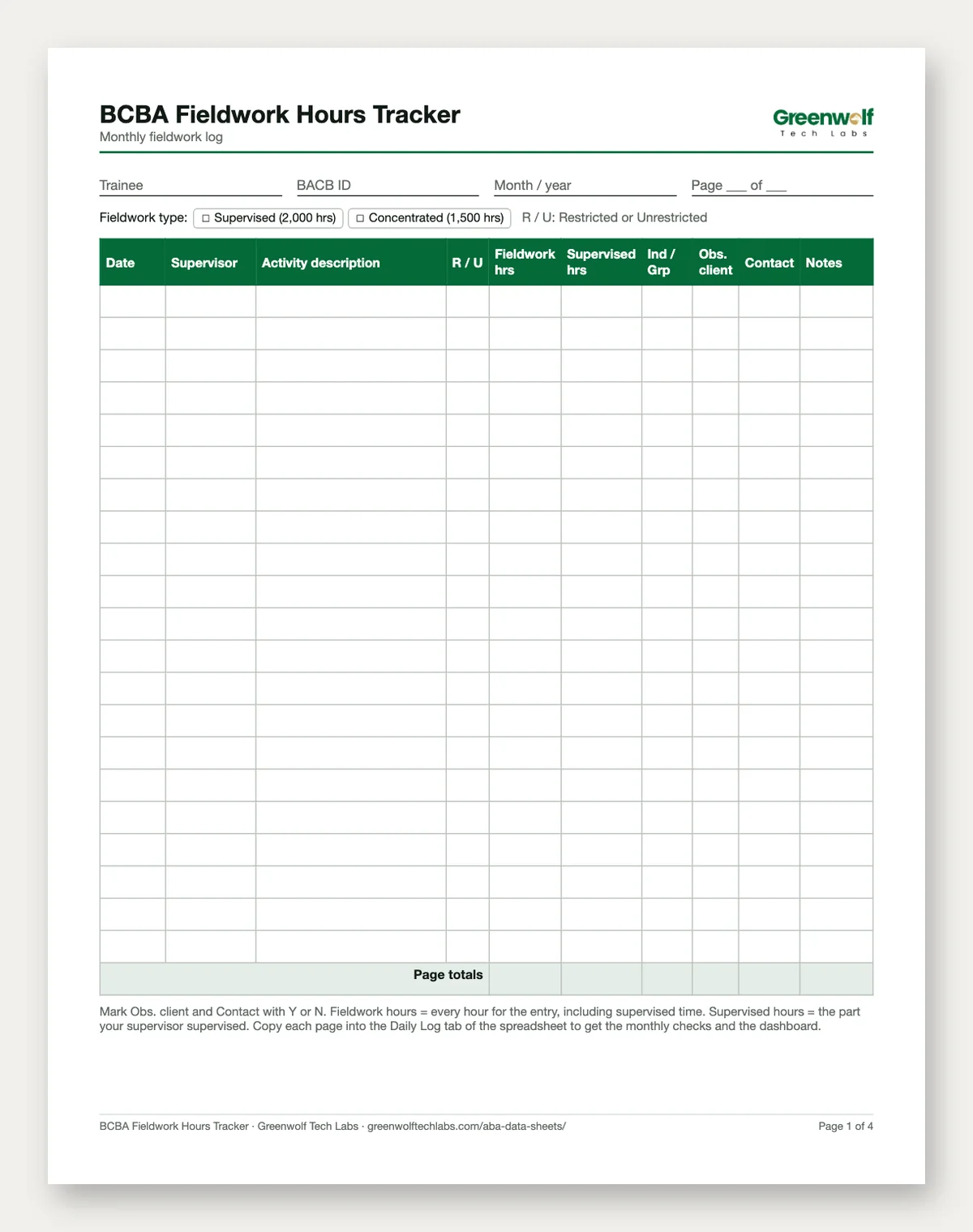
BCBA Fieldwork Hours Tracker
Log fieldwork daily and check every month against the requirements.
$29Details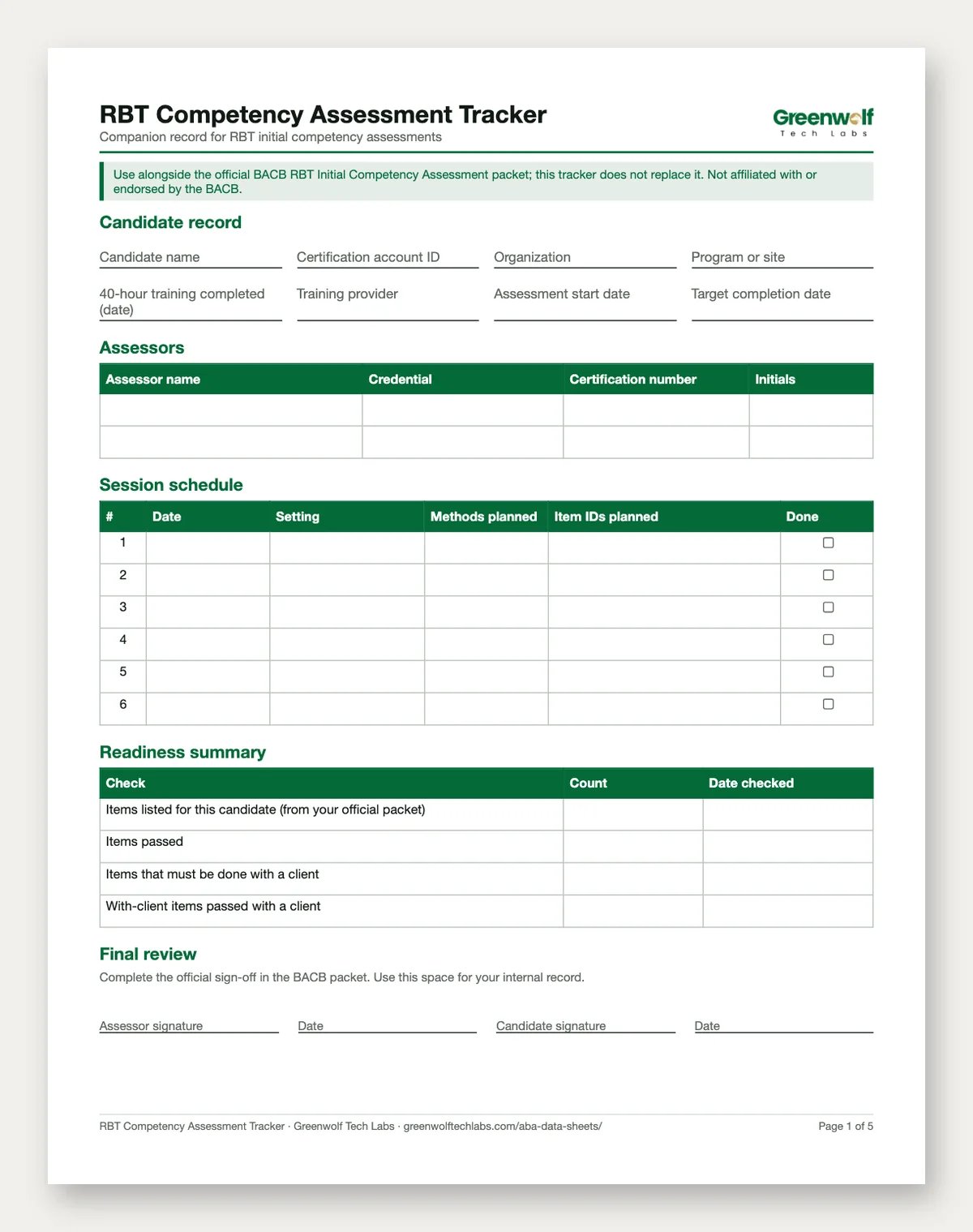
RBT Competency Assessment Tracker
Every candidate's progress through the initial competency assessment.
$19Details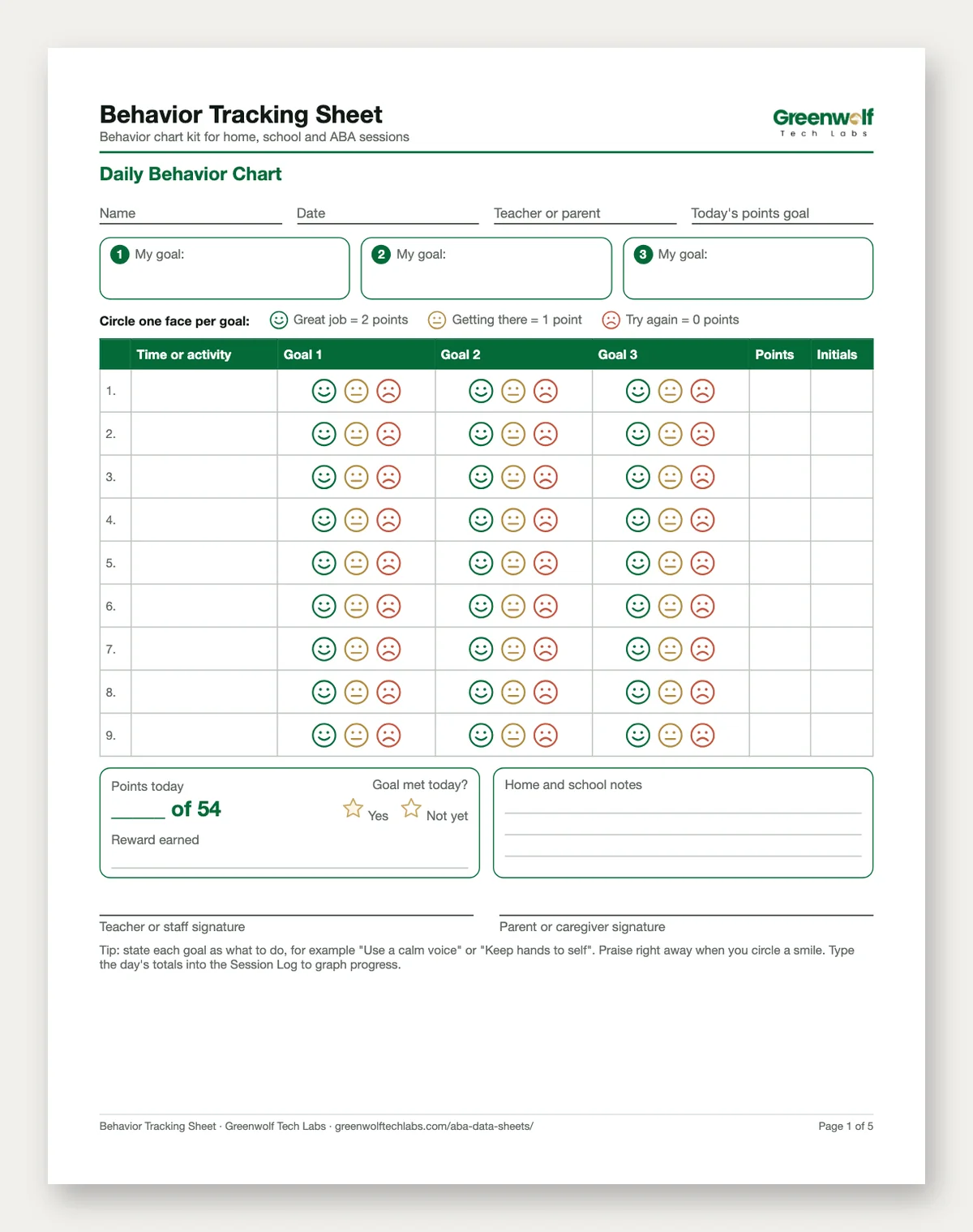
Behavior Tracking Sheet and Behavior Chart Kit
Frequency, duration and latency with automatic rates and graphs.
$12Details
Outgrown the spreadsheet?
We build ABA practice portals around how your clinic works. For a Virginia ABA practice, clinician session logging fell from 10 to 15 minutes a day to under 3.
Read the case study, or see ABA practice management and ABA data collection software.
16
Important
This workbook is a record-keeping and planning aid. It is not legal, billing, coding or clinical advice, and it does not guarantee payment or compliance with any payer, state or BACB rule. Payer rules, rounding rules and BACB requirements change and differ by payer and state: check the current BACB RBT Handbook, your payer contracts and a qualified billing or compliance professional. Revenue figures are estimates from the rates you enter. Greenwolf Tech Labs is not affiliated with or endorsed by the Behavior Analyst Certification Board (BACB). Use client IDs only and follow your own privacy and security policies.
Part of our Healthcare Practice Automation hub. Start with our healthcare workflow automation.
Healthcare Practice Automation
More on healthcare workflow automation
Case Study: An ABA Practice Management System for PTC
Metric Before After Submission errors High Significantly reduced Time clinicians spent entering data 10-15 mins/day < 3 mins/day Admin review effort Heavy Lightweight & structured...
ABA Practice Management, Built Around Your Clinic
Custom ABA practice management software: session notes against authorized hours, BSPs, quarterly reports and billing cycles, built around your clinic.
BCBA Hours Tracker for Fieldwork and Supervision
BCBA hours tracker for Excel and Google Sheets: log fieldwork daily and check supervision %, contacts, observation and monthly hour limits before month end.
BCBA Supervision Tracking for Supervisors and Trainees
Track BCBA fieldwork and RBT supervision hours, monthly percentages, contacts and observations for every trainee, with a ready tracker or a custom system.
RBT Initial Competency Assessment Tracker and Checklist
How the RBT competency assessment works under the 2026 BACB rules: who can assess, steps, timing and re-assessment, plus a free printable progress checklist.