

Templates and trackers
BIP and FBA Templates with Examples and a Competing Behavior Pathway
Editable BIP and FBA templates in Word and PDF, with a worked FBA-to-BIP example, a competing behavior pathway and hypothesis statements for each function.
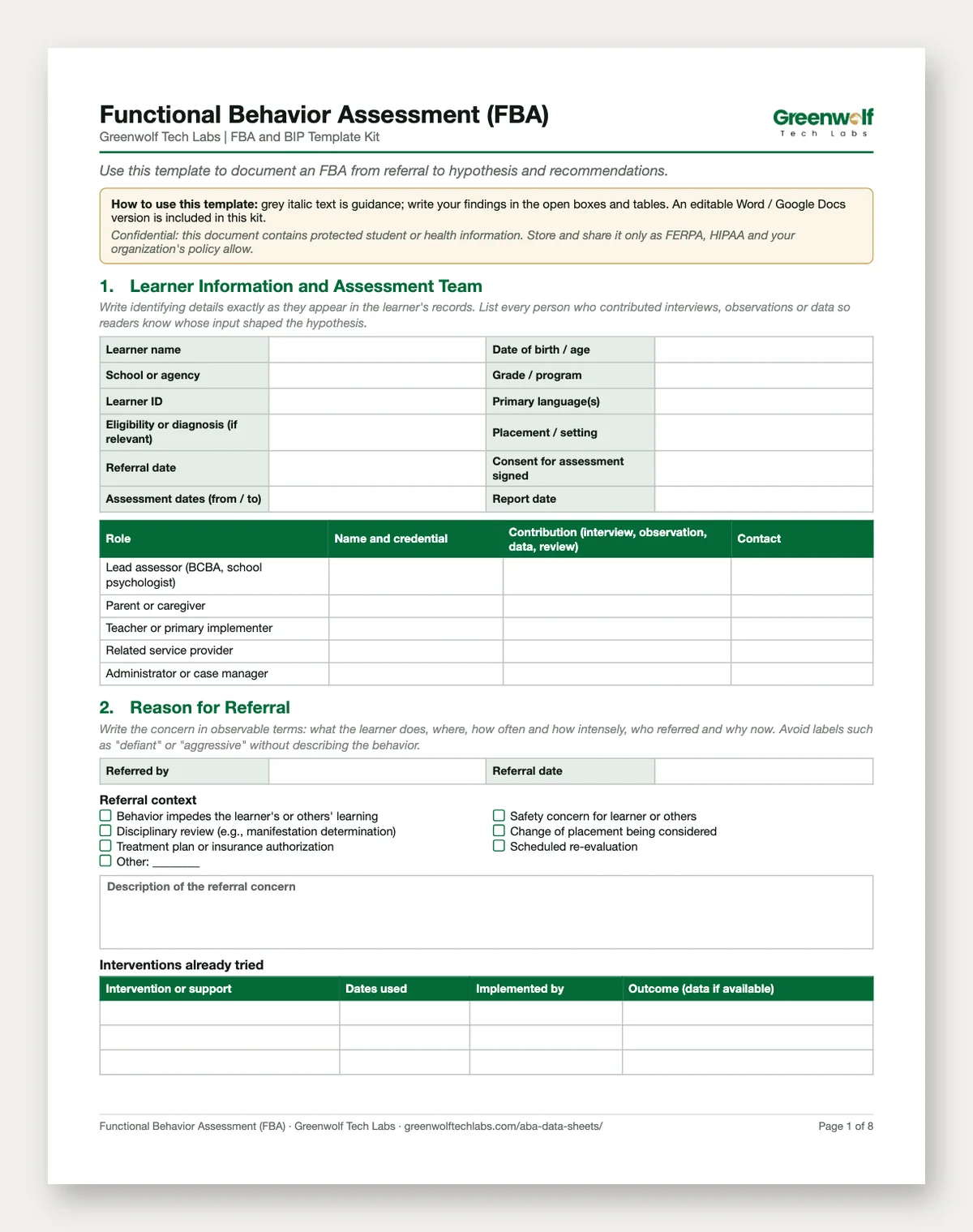
For BCBAs, school psychologists and special education teams
FBA and BIP Template Kit
$19USD · one-time purchase · instant download
A complete FBA report and BIP in Word, ready for Google Docs, with guidance in every section and a companion workbook for your data, hypotheses and treatment fidelity.
- FBA template: 13 sections from referral and record review to hypotheses and recommendations
- Competing behavior pathway diagram ready to fill in
- BIP template: 14 sections from replacement behaviors to crisis plan, fading and review
- Hypothesis matrix that weighs indirect and direct evidence by function
- BIP fidelity checklist with % fidelity per strategy and per observation
You get: 2 Word templates (Google Docs-ready) · Companion Excel workbook · 14-page printable PDF
Secure checkout by Razorpay. Cards accepted worldwide, charged in US dollars. Files arrive on screen and by email. Refund policy
02
What is a BIP template?
A BIP template is a ready-made structure for a behavior intervention plan: the document that takes the function found in a functional behavior assessment (FBA) and sets out replacement behaviors to teach, antecedent changes, reinforcement, staff responses, a crisis plan, data collection and review dates, so every plan covers the same essentials.
The FBA comes first. It gathers records, interviews and direct observation, defines the behavior, and ends with a hypothesis about why it happens: to get attention, to get an item or activity, to escape or avoid something, or because the behavior is automatically reinforcing. The BIP then answers one question: what will we change so the learner no longer needs the problem behavior?
This kit gives you both: an FBA report template in 13 sections and a BIP template in 14 sections, as editable Word documents that open in Google Docs, a 14-page printable PDF, and a companion Excel workbook with a hypothesis matrix and a BIP fidelity checklist. Every section has grey guidance text telling you what to write.
03
Free printable competing behavior pathway (PDF)
Download the free competing behavior pathway template (PDF, 1 page). It lays out setting event, antecedent, problem behavior and maintaining consequence across the middle, the desired behavior and its usual consequence above, and the replacement behavior below, with four boxes for setting-event, antecedent, teaching and consequence strategies to carry into the BIP.
The full kit adds the complete FBA and BIP templates in Word and PDF, plus the workbook that weighs your evidence by function and scores treatment fidelity. You can also browse all our ABA data sheets and BCBA templates.
04
FBA vs BIP: what each one does
| Functional behavior assessment (FBA) | Behavior intervention plan (BIP) | |
|---|---|---|
| Question it answers | Why does the behavior happen? | What will we do about it? |
| Main inputs | Record review, interviews, rating scales, ABC data, scatterplots, sometimes a functional analysis | The FBA hypothesis and baseline data |
| Key output | Operational definitions, baseline, hypothesis statements, competing behavior pathway | Replacement behaviors, antecedent and reinforcement strategies, staff responses, crisis plan, goals |
| Data | Baseline level, trend and variability | Ongoing data on problem and replacement behavior, fidelity, review decisions |
| In this kit | 13-section FBA report template | 14-section BIP template plus fidelity checklist |
FBA template sections: learner information and team, reason for referral, record review, indirect assessment, direct observation, operational definitions, baseline, setting events and antecedents and consequences, hypothesis statements, competing behavior pathway, optional functional analysis summary, summary and recommendations, signatures.
BIP template sections: plan details, target behaviors and definitions, hypothesized functions, replacement behaviors and teaching plan, antecedent and setting-event strategies, reinforcement, consequence strategies, crisis and safety plan, data collection and graphing, generalization and maintenance, fading plan, staff training and fidelity, review dates and criteria for success, consent and signatures.
05
How to go from FBA to BIP
Define the behavior
Write an operational definition two observers would agree on, with onset, offset, examples and non-examples.
Gather indirect data
Review records and interview the people who see the behavior most. Note where informants agree and where they differ.
Observe directly
Collect ABC data and a scatterplot across the times and settings where the behavior is most and least likely. Use our ABC data sheet to find the top antecedents and consequences.
Take a baseline
Measure frequency, duration or intensity before intervention; many teams aim for at least five data points.
Write the hypothesis
Use the frame: When [antecedent], [learner] will [behavior] in order to [get or escape something]. Rate how well each data source supports it.
Map the competing behavior pathway
Name the desired behavior and a replacement behavior that earns the same outcome with less effort.
Write the BIP
Choose strategies that make the problem behavior irrelevant, inefficient and ineffective, and set goals, data collection and review dates.
Train staff and check fidelity
Train with instruction, modeling, rehearsal and feedback, then score fidelity so you know the plan is being run as written before you judge it.
06
Behavior intervention plan example: FBA to BIP (sample)
This is a fictional, clearly labelled sample written to show how the sections connect. It is not a real student and not clinical advice.
Referral. Sam, a third grader, pushes materials off his desk and leaves his seat during independent writing. His teacher refers him because he is missing most writing instruction.
Functional behavior assessment example: the data.
| Source | Sample finding |
|---|---|
| Teacher and parent interviews | Both describe the behavior mainly during writing; teacher usually sends Sam to the calm corner or shortens the task. |
| Baseline (5 writing blocks of 30 minutes) | Mean 6 episodes per block, range 4 to 8, stable trend. |
| ABC data (22 episodes) | A writing task was presented before 17 (77%); the task was removed, delayed or shortened after 18 (82%). |
| Scatterplot | Episodes cluster in independent writing; rare in math and read-aloud. |
Hypothesis (escape). When Sam is given an independent writing task of more than a few sentences, he will push materials off his desk and leave his seat in order to escape the writing task.
Competing behavior pathway. Desired behavior: completes the writing task and earns teacher praise and free time. Replacement behavior: hands the teacher a break card, which earns a 2-minute break (the same escape, with less effort).
BIP strategies (sample).
- Antecedent: split writing into three-sentence chunks, use a first-then board, offer sentence starters and a choice of pencil or keyboard.
- Teaching: teach the break card with modeling and rehearsal, prompt it at the first sign of frustration, and fade prompts over two weeks.
- Reinforcement: honor every break card at first (differential reinforcement of an alternative behavior); praise and a token for each chunk completed; then gradually increase the work required before a break.
- Consequence: if Sam pushes materials, staff calmly prompt the break card and keep the writing task in place, so the break follows the card, not the problem behavior.
- Data and review: count episodes per writing block and break-card use; graph weekly; review every two weeks; revise if there is no downward trend after 10 data points.
Goal (sample). One or fewer episodes per writing block for 10 consecutive blocks, with independent break-card use in at least 80% of opportunities. Track it with our behavior tracking sheet.
07
Competing behavior pathway explained, with an example
A competing behavior pathway is a one-page diagram that lines up what happens now (setting event, antecedent, problem behavior, maintaining consequence) against two alternatives: the desired behavior expected in that situation and a replacement behavior that gets the learner the same outcome as the problem behavior, more easily. The model is commonly credited to O'Neill and colleagues (1997); the Texas Education Agency competing pathways guide describes the same red, blue and green paths.
| Pathway box | What to write | Example (Sam, sample) |
|---|---|---|
| Setting event | What makes the behavior more likely today | Short sleep, writing after recess |
| Antecedent | What happens right before | Independent writing task presented |
| Problem behavior | The defined target behavior | Pushes materials off desk, leaves seat |
| Maintaining consequence | What the learner gets or avoids | Writing task removed or delayed |
| Desired behavior | What is expected long term | Completes the writing task |
| Typical consequence | What usually follows the desired behavior | Praise, free time |
| Replacement behavior | Same function, less effort | Hands over a break card for 2 minutes |
Strategies then aim to make the problem behavior irrelevant (change setting events and antecedents so it is not needed), inefficient (the replacement works faster and with less effort) and ineffective (the problem behavior no longer produces the outcome). Use one pathway per target behavior. If the replacement is harder than the problem behavior, the plan will usually fail.
08
Hypothesis statement examples for each function
All examples are fictional samples. Each statement names the antecedent, the behavior and the outcome, so it can be tested.
| Function | Hypothesis statement (sample) | Possible replacement behavior |
|---|---|---|
| Attention (social positive) | When the teacher is working with another small group, Maya will call out and make loud noises in order to get adult attention. | Raise a help card or hand to get attention |
| Tangible or activity (social positive) | When a peer takes a turn with the tablet during free choice, Leo will grab the tablet in order to get access to it. | Ask for a turn and wait with a visual timer |
| Escape or avoidance (social negative) | When Sam is given an independent writing task of more than a few sentences, he will push materials off his desk and leave his seat in order to escape the writing task. | Request a break with a break card |
| Automatic (sensory) | When Ana has little to do during long waits, she will rock and flap her hands, which appears to be maintained by the sensory stimulation it produces, since it occurs across settings regardless of what others do. | Access to matched sensory activities and a richer environment |
A behavior can serve more than one function; write a separate statement for each and record which data support it. The kit's workbook weighs interviews, rating scales and direct observation by function to help you rate confidence.
09
What IDEA requires for school BIPs vs clinic BIPs
Schools. Under the federal special education regulations:
- For a child whose behavior impedes their learning or that of others, the IEP Team must consider positive behavioral interventions and supports and other strategies (34 CFR 300.324(a)(2)(i)).
- Within 10 school days of a decision to change a child's placement for a code of conduct violation, the team must hold a manifestation determination (34 CFR 300.530(e)).
- If the conduct is a manifestation of the disability, the IEP Team must conduct an FBA (unless one was done before the behavior) and implement a BIP, or review and modify the existing BIP (34 CFR 300.530(f)).
- A child removed beyond those limits must receive, as appropriate, an FBA and behavioral intervention services and modifications designed so the behavior does not recur (34 CFR 300.530(d)(1)(ii)).
- For weapons, illegal drugs or serious bodily injury, a school may use an interim alternative setting for up to 45 school days regardless of manifestation (34 CFR 300.530(g)).
IDEA does not define an FBA or prescribe a BIP format (OSERS guidance on functional behavioral assessments (November 2024); see also the OSERS Q&A on IDEA discipline provisions (July 2022)). That is why states and districts set their own forms, timelines and who may conduct an FBA. Check your state education agency and district policy before you use any template in a school, and keep their mandated sections.
Clinics and home programs. IDEA does not govern clinic BIPs. Here the plan is shaped by the BCBA's professional and ethical obligations, the funder or insurer's documentation and medical necessity rules, state licensure law and your organization's policies, including any rules on restrictive procedures. The same function-based structure works in both settings; what changes is the required paperwork around it.
Last reviewed: 25 October 2026. This is general information, not legal advice.
10
Common FBA and BIP mistakes
11
BIP and FBA template questions
What is the difference between an FBA and a BIP?
What should a behavior intervention plan include?
What is a competing behavior pathway?
How do you write a hypothesis statement for an FBA?
Is there a functional behavior assessment example?
Is a BIP required under IDEA?
Who can write an FBA or BIP?
Can I edit the templates?
Do you include assessment tools like the FAST or QABF?
12
More BCBA trackers
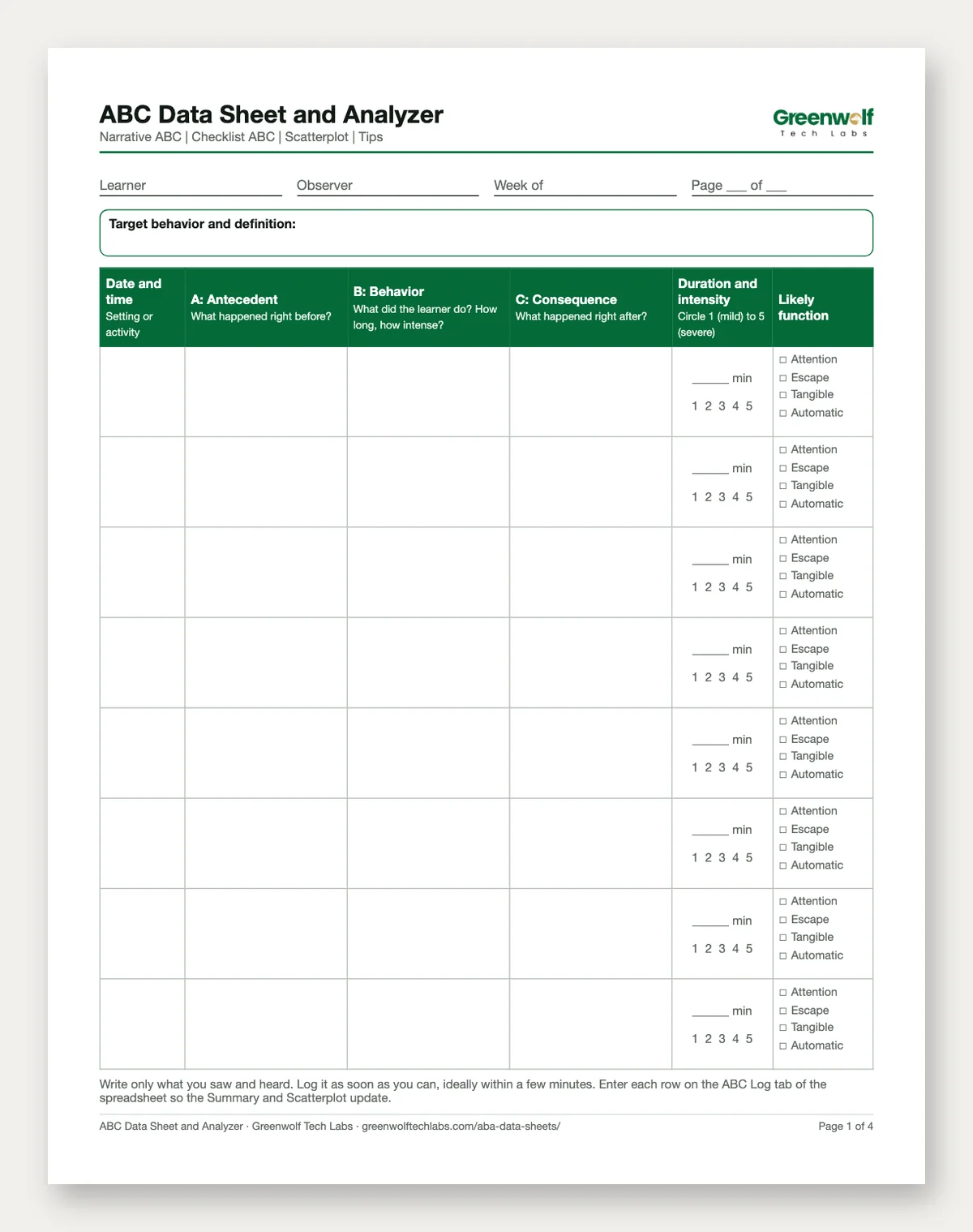
ABC Data Sheet and Analyzer
ABC logging that finds the top antecedents, consequences and likely function.
$9Details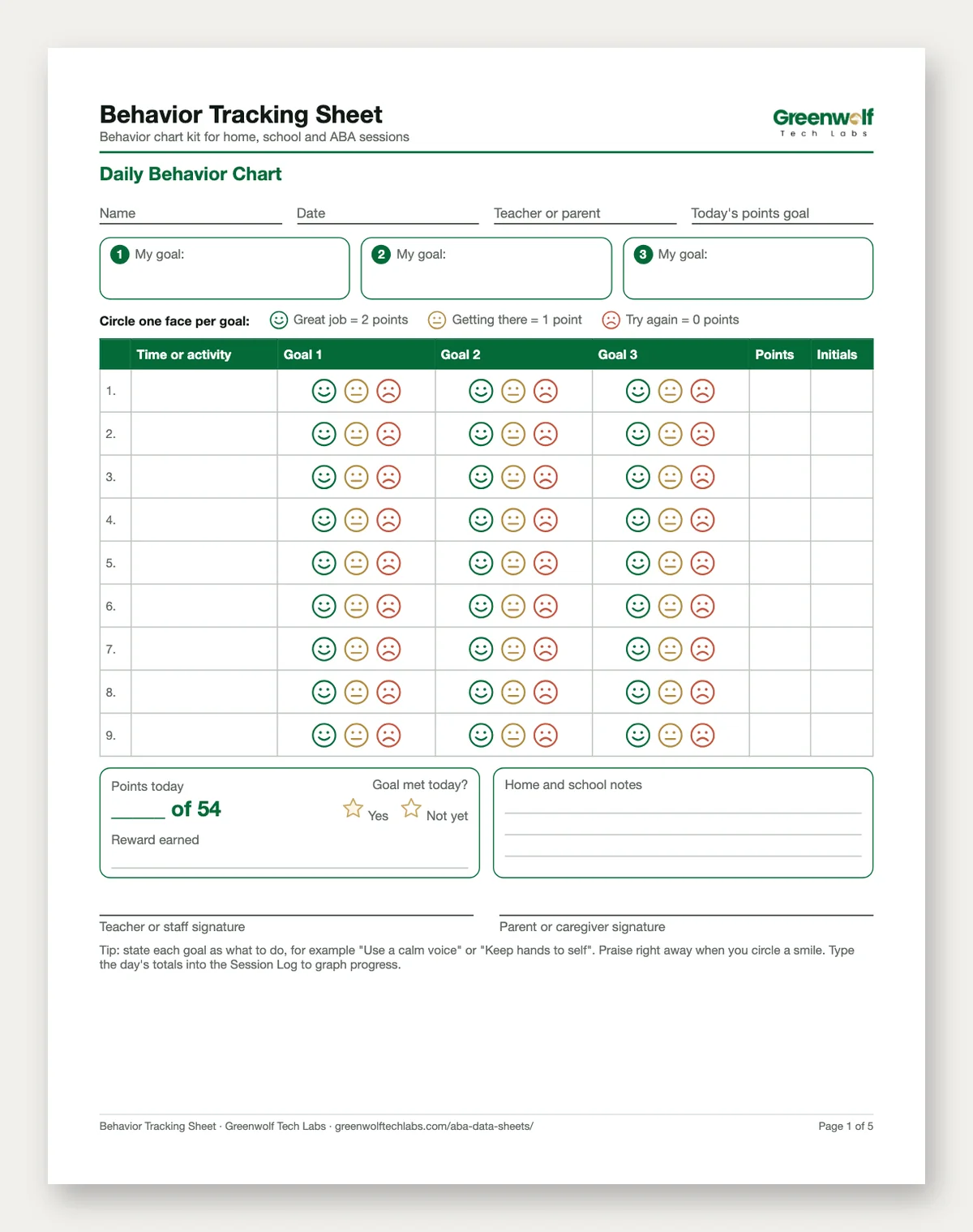
Behavior Tracking Sheet and Behavior Chart Kit
Frequency, duration and latency with automatic rates and graphs.
$12Details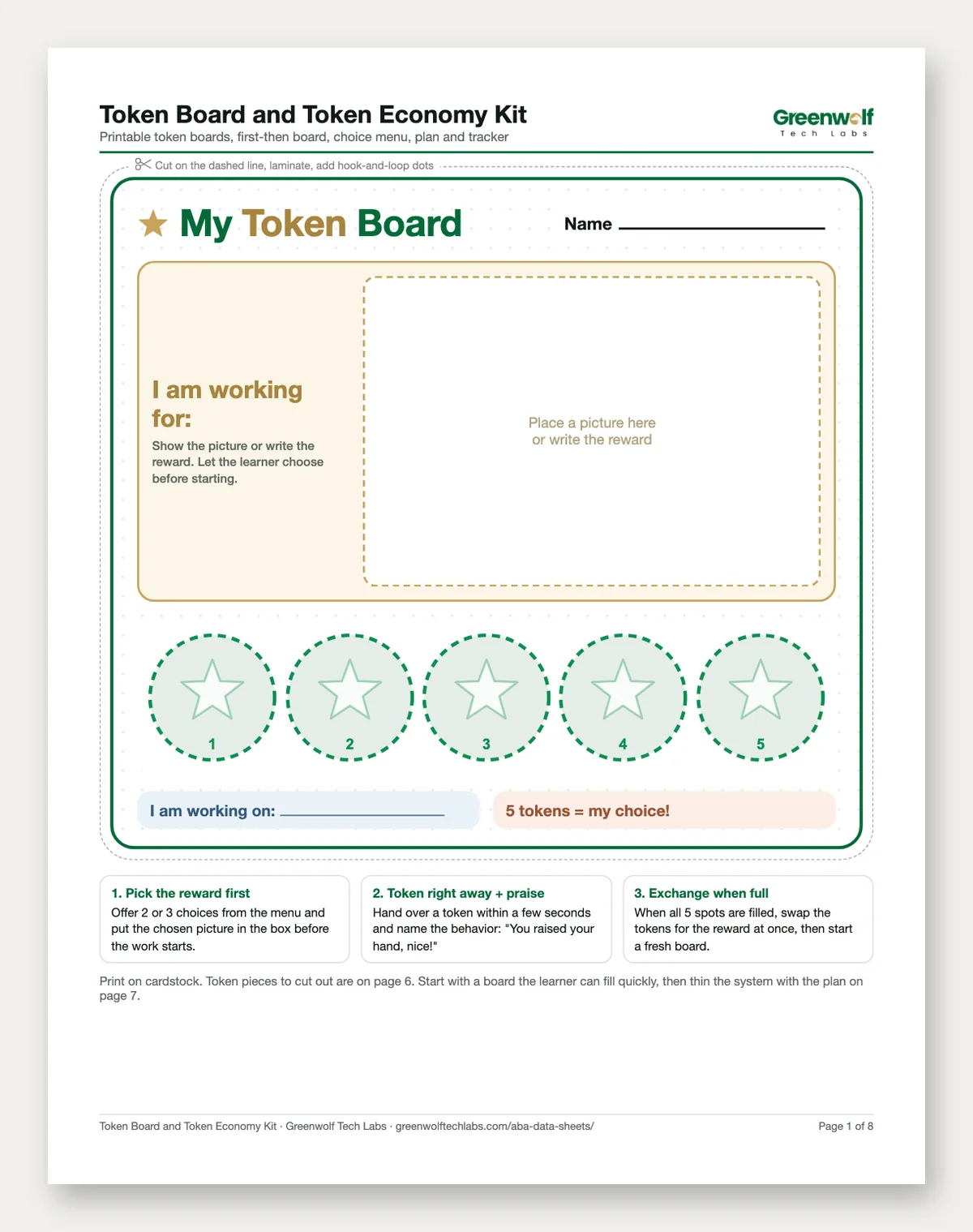
Need this inside your practice software?
We build ABA data collection and practice management systems around how your clinic works, so data like this is captured once and reported automatically.
Part of our Healthcare Practice Automation hub. Start with our healthcare workflow automation.
Healthcare Practice Automation
More on healthcare workflow automation
ABC Chart and ABC Data Sheet: Antecedent, Behavior, Consequence
An ABC chart records the antecedent, behavior and consequence of each incident. Free printable ABC chart PDF, filled-in examples and how to analyze ABC data.
Printable Behavior Chart, Behavior Log and Tracking Sheet
Free printable behavior chart for kids at home and school, plus a behavior log and tracking sheet with frequency, duration and latency formulas and graphs.
Token Board Template, Reward Chart and Token Economy Kit
Free printable token board template, plus how to set up a token economy, choose rewards by age, use a first-then board and thin tokens step by step.
Dental Appointment Reminders That Cut No-Shows and Fill the Chair
Automated dental appointment reminders over WhatsApp and SMS that confirm visits, fill recall gaps and cut no-shows, using the tools your clinic already runs.
Case Study: An ABA Practice Management System for PTC
Metric Before After Submission errors High Significantly reduced Time clinicians spent entering data 10-15 mins/day < 3 mins/day Admin review effort Heavy Lightweight & structured...