

Templates and trackers
Fire Door Inspection Checklist, Regulations and Register (UK)
Free fire door inspection checklist (PDF) and UK fire door regulations explained: who checks, 3-monthly and 12-monthly checks, gaps, seals and records.
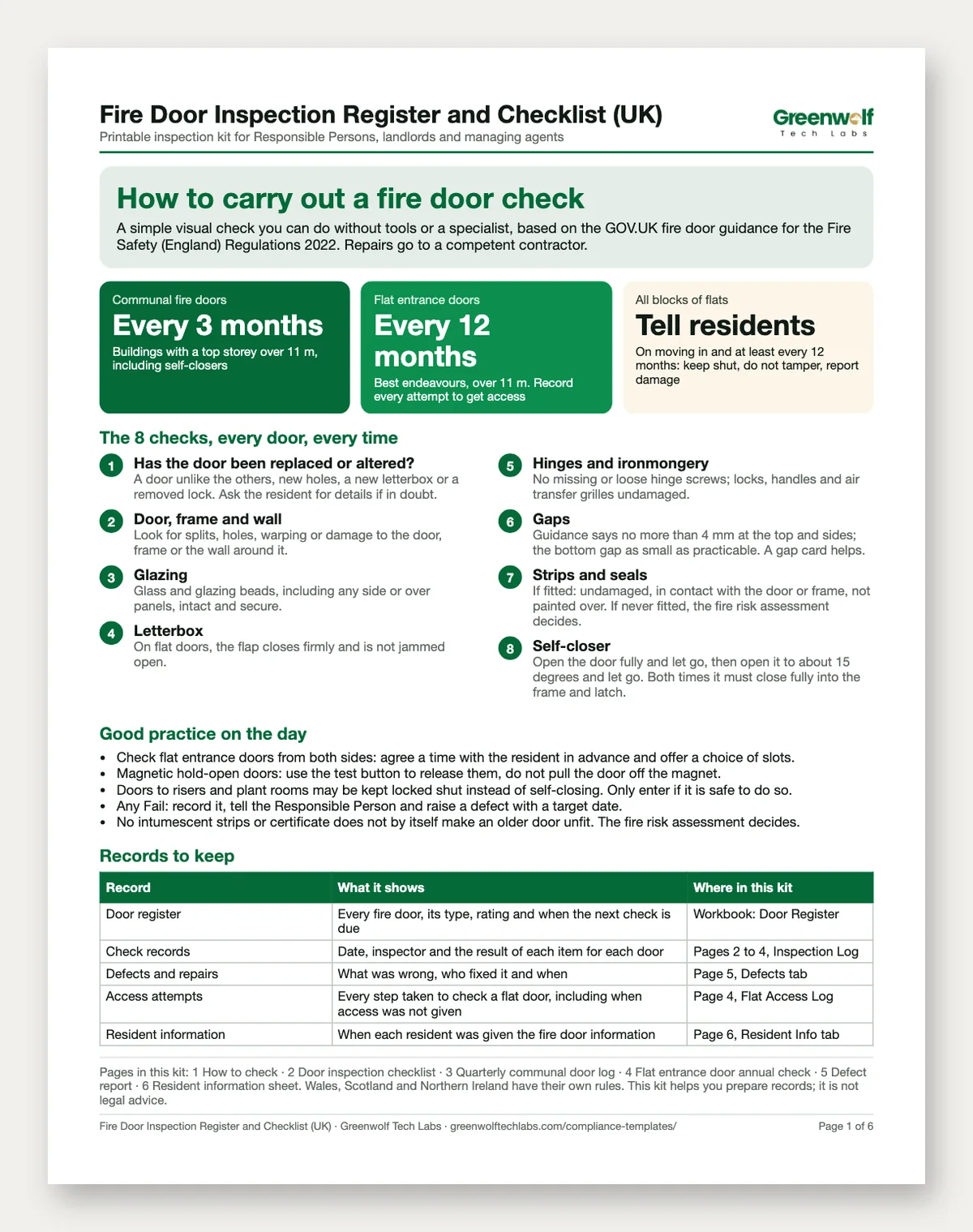
For Responsible Persons, landlords and managing agents
Fire Door Inspection Register and Checklist (UK)
$29USD · one-time purchase · instant download
List every fire door once, log each check against an 11-point checklist and let the register work out when each door is next due, which checks are overdue and which defects are still open.
- Door register with next check due set by door type: 3 months for communal doors, 12 months for flat entrance doors (editable)
- Inspection log with Pass, Fail or N/A for 11 items, from gaps and seals to the self-closer test
- Defects and remedial actions tracker with priorities, target dates and overdue flags
- Flat access log that records every attempt to check a flat door: your best endeavours record
- Resident information tracker plus a printable resident sheet about fire doors
- 6-page A4 kit: how to check, door checklist, quarterly log, flat door annual form, defect report
You get: Excel workbook · Google Sheets-ready · 6-page printable PDF (A4)
Secure checkout by Razorpay. Cards accepted worldwide, charged in US dollars. Files arrive on screen and by email. Refund policy
02
What is a fire door inspection checklist?
A fire door inspection checklist is a one-page record of a visual check on a single fire door: the door, frame and wall, glazing, letterbox, hinges, gaps, intumescent strips and smoke seals, and a test that the self-closer shuts the door fully into its frame, marked pass or fail.
In England, the Fire Safety (England) Regulations 2022 turned these checks into a legal duty for blocks of flats whose top storey is more than 11 metres above ground: communal fire doors at least every 3 months and flat entrance doors at least every 12 months, on a best endeavours basis. The government guidance describes the checks as simple and visual, with no tools or specialist needed, and suggests a checklist to plan the checks and record each outcome. That is exactly what this page and the register give you.
Below you will find the fire door regulations in plain English, who must check what and how often, a 5-step check with what a pass and a fail look like, a gaps and seals table, what to do with defects, what records to keep and the faults to look for. Every legal point links to the GOV.UK source it comes from.
Last reviewed: 25 October 2026.
03
Free printable fire door inspection checklist (PDF)
Download the single-door checklist page from the kit for free: fire door inspection checklist template (PDF, 1 page, A4). It has the 11 check items with Pass, Fail and N/A boxes, an overall result, a comments box, an action plan (issue, proposed action, timescale, person responsible) and a sign-off line, following the headings of the government sample checklist.
The full kit adds the Excel and Google Sheets register that works out when each door is next due and flags overdue checks, the quarterly communal door log, the flat entrance door annual form with a best endeavours access record, the defect report, a defects tracker and a printable resident information sheet.
04
Fire door regulations explained (England, Wales, Scotland)
In England, fire doors in blocks of flats are covered by three layers of law: the Regulatory Reform (Fire Safety) Order 2005, the Fire Safety Act 2021 and the Fire Safety (England) Regulations 2022. The Building Regulations and Approved Document B set the standard for new doors and building work, not a check regime.
| Law or guidance | What it means for fire doors |
|---|---|
| Regulatory Reform (Fire Safety) Order 2005 | The Responsible Person must take general fire precautions, decided by a fire risk assessment, so that common parts are safe as a means of escape, and must keep fire safety measures, including fire doors, in good working order and good repair. It applies to every block with common parts, whatever its height, and to workplaces (GOV.UK fact sheet, workplace fire safety). |
| Fire Safety Act 2021 | Confirmed that flat entrance doors are within the scope of the Order, so they must be considered in the fire risk assessment (fact sheet). |
| Fire Safety (England) Regulations 2022, regulation 10 | In force since 23 January 2023. Above 11 m: check communal fire doors every 3 months and use best endeavours to check flat entrance doors every 12 months, recording the steps taken. All blocks with two or more flats and common parts: give residents fire door information on moving in and at least every 12 months (GOV.UK fire door guidance; full text: SI 2022/547). |
| Building Regulations and Approved Document B | Approved Document B is the government guidance on fire safety for building work in England, such as new flats. The 2022 guidance states that the purpose of the Regulations is not to make existing flat entrance doors meet the current standard for doors in new blocks (guidance foreword). |
Wales, Scotland and Northern Ireland. The 2022 Regulations apply in England only. In Wales, the Welsh Government publishes its own fire doors in flats guidance for building owners. In Scotland, the Scottish Government's practical fire safety guidance for existing high rise domestic buildings notes that Part 3 of the Fire (Scotland) Act 2005 does not generally apply to individual flats or the common areas of blocks of flats, and that the duty to maintain common areas falls on those who control them. Northern Ireland has its own rules too. If your building is outside England, use the register with intervals set by your own fire risk assessment and local guidance.
Breaching the 2022 Regulations is a criminal offence where it puts one or more people at risk of death or serious injury in the event of fire (GOV.UK guidance, section 1.2).
05
Fire door checks: who must check what, and how often
The Responsible Person, usually the freeholder, building owner or managing agent, organises the checks. The checks themselves can be done by a caretaker, housing officer, managing agent or maintenance worker after some instruction.
| Door | Building | How often | Who can check | Record |
|---|---|---|---|---|
| Communal fire doors: stairways, lobbies, corridor doors, including self-closers | Top storey over 11 m | At least every 3 months | Trained caretaker, managing agent, housing officer or maintenance worker | Quarterly log per door |
| Plant room, service cupboard and riser doors | Top storey over 11 m | At least every 3 months (guidance) | As above | Quarterly log |
| Flat entrance doors, checked from both sides | Top storey over 11 m | At least every 12 months, best endeavours | As above, by appointment with the resident | Steps taken, including when access was refused (required) |
| Any fire door | Blocks at or below 11 m | No set interval in the 2022 Regulations: set by your fire risk assessment | Competent person | Good practice |
| Any fire door | Offices, shops, care homes and other non-domestic premises | No interval in the 2022 Regulations: set by your fire risk assessment | Competent person | Good practice |
Lift landing doors are not part of the regulation 10 checks. Doors held open on magnetic devices should be tested with the test button rather than pulled off the magnet, and double doors with a selector should be checked to close in the right order (guidance 6.10 to 6.13).
06
How to do a fire door check in 5 steps
Is it still the right door?
Pass: the same design as the other fire doors, no new holes, letterbox or removed lock, and a visible fire rating on modern doors. Fail: a replaced or altered door with no evidence it is fire-resisting. Ask the resident for details if in doubt.
Door, frame, wall and glazing
Pass: no splits, holes or warping in the door, frame or surrounding wall; glass, beads and side or over panels intact; a letterbox that closes firmly. Fail: any damage or a letterbox jammed open.
Hinges and ironmongery
Pass: no missing or loose hinge screws, and locks, handles and air transfer grilles undamaged. Fail: loose or missing screws, broken hardware or a damaged grille.
Gaps, strips and seals
Pass: gaps at the top and sides no more than about 4 mm, the bottom gap as small as practicable, and any strips or seals intact, in contact and not painted over. Fail: large gaps or damaged, missing or painted seals.
Self-closer test
Open the door fully and let go, then open it to about 15 degrees and let go. Pass: both times it closes fully into the frame and latches. Fail: it stops short, does not latch or the closer is disconnected. Check it is not wedged open.
07
Fire door gaps and seals: what to look for
The GOV.UK guidance cites an industry standard of no more than 4 mm around the top and sides of a fire door, with the bottom gap as small as practicable without the door catching the floor. A gap card or a set of feeler gauges makes this quick and consistent.
| Item | Pass looks like | Fail looks like |
|---|---|---|
| Top and side gaps | No more than about 4 mm along the head and both sides | Gaps wider than 4 mm, often from warping, dropped hinges or a door planed down |
| Bottom gap | As small as practicable while the door still swings freely | A large gap under the door, for example after flooring was removed |
| Intumescent strips (if fitted) | Continuous, undamaged, not painted over | Missing sections, cut-outs, paint over the strip |
| Smoke seals (if fitted) | Brushes or blades intact and touching the door or frame | Flattened, torn, missing or painted seals |
| No strips or seals at all | Not a fail on its own: your fire risk assessment decides whether the door is adequate | Record it and refer to the risk assessor |
Source: GOV.UK fire door guidance, paragraph 6.7 (f) and (g). The guidance is explicit that a missing strip, missing seal or missing certificate does not by itself mean an older door is unfit for purpose.
08
Worked example: one year of fire door checks in a sample block
Sample scenario, for illustration only. A purpose-built block of 32 flats whose top storey is 20 m above ground has 12 communal fire doors (stair and lobby doors) and 4 riser and plant room doors.
- Quarterly: 16 doors are checked every 3 months, so 64 door checks a year go into the inspection log. The register sets each door's next due date 3 months after its last check and turns it amber, then red, as it falls due.
- Annual: 32 flat entrance doors. Letters go out offering three dates; 27 doors are checked on the day, 3 on a second visit. Two flats do not reply after a letter, an email and a visit. Each attempt goes into the Flat Access Log with the evidence kept, and those doors show "Overdue: access being sought".
- Defects: In the October round, door 3F-L1 fails step 5: it closes from fully open but stops short from 15 degrees. A defect is raised with a priority and target date, a competent contractor adjusts the closer, and the door is re-checked and passed. The defect closes with the date and the contractor's note.
- Residents: The resident sheet goes to every flat on moving in and to all flats once a year; the register shows when the next reminder is due.
At the end of the year the Responsible Person can show the fire risk assessor and any enforcing authority 64 communal checks, 30 flat door checks, a dated access record for the 2 doors not reached and every defect from discovery to close.
09
What to do when a fire door fails
Record the fault, decide the priority, and have a competent contractor repair or replace the door as soon as reasonably practicable, as the government guidance requires (paragraph 6.4). Then re-check the door and close the defect with a date.
- Mark the item as a Fail on the checklist and photograph it.
- Raise a defect with a reference, location, what is wrong and the action needed.
- Set a priority. A self-closer that does not work or a door that is wedged open or missing affects escape routes, so treat it as urgent and consider interim measures with your fire risk assessor.
- Instruct a competent contractor. Repairs and replacements are not part of the simple visual check.
- If a resident has replaced or altered their flat entrance door, ask them to show it is fire-resisting and was installed by a competent person ({a(G1,"guidance 6.7a")}).
- Re-check the door after the work and record who checked it and when.
10
Record keeping for fire door inspections
For flat entrance doors in buildings over 11 m, regulation 10 requires a record of the steps taken to check them over every 12-month period, including where access was not given. For communal doors, a dated log for every door is the simplest way to show the 3-monthly checks happened.
A good record shows, for each door: its ID, location and type; the date and who checked it; the result of each item; any defect reference; and the repair and re-check. For flat doors, add every access attempt (letter, email, call or visit), the outcome and where the evidence is kept. The guidance says you can plan and record checks on paper or electronically, so a spreadsheet register is fine.
Keep the register with your fire risk assessment so the assessor can see door condition and open defects when they review it.
11
What is inside
Door Register
Up to 300 doors with type, fire rating and self-closer. Last check, last result, next due date and status calculate on their own.
Inspection Log
One row per check with Pass, Fail or N/A for 11 items. Any Fail gives an overall Fail and a column for the defect reference.
Defects and Flat Access Log
Track repairs to completion with target dates by priority, and record every attempt to get into a flat to check its door.
Dashboard and printable kit
Overdue checks, open defects and resident reminders at a glance, plus a 6-page A4 kit with forms and a resident information sheet.
12
How to use the register
Set up the building
Enter the building and Responsible Person, say whether the top storey is over 11 m and check the intervals and defect target days.
List your fire doors
Use the doors identified in your fire risk assessment. Give each an ID, location and type.
Check and log
Walk the building with the printable checklist or quarterly log, then enter the results. Raise a defect for every Fail.
Follow up
Use the dashboard to chase overdue checks, open repairs, flat access and resident reminders.
13
Common fire door failures to look for
14
Related templates and services
Browse all our compliance templates and record kits. Landlords with US properties use the NSPIRE inspection checklist for Section 8 units, built the same way: a printable checklist plus a register that tracks due dates and repairs. If you manage a large portfolio and want inspections on a phone or tablet with photos, we also build custom inspection apps in AppSheet.
15
Fire door inspection questions
How often do fire doors need to be inspected in flats?
What are the fire door regulations in the UK?
What should a fire door inspection checklist include?
Who can carry out fire door checks?
What is the maximum gap around a fire door?
What if a resident will not let me check their flat entrance door?
Do fire doors without intumescent strips or a certificate need replacing?
Do the 2022 fire door check rules apply in Scotland or Wales?
Does the register work in Google Sheets?
16
Important
This register and checklist help you plan, carry out and record fire door checks. They are not legal advice and do not replace your fire risk assessment or a competent fire safety professional. Rules change and differ across England, Wales, Scotland and Northern Ireland: check the current GOV.UK guidance and legislation for your building. Greenwolf Tech Labs is not a law firm and is not affiliated with any government agency, and the product does not certify any door or building as meeting any standard.
Part of our Compliance Templates hub. Start with our compliance templates.
Compliance Templates
More on compliance templates
First Aid Kit Checklist: Workplace Contents List and Monthly Inspection
Free first aid kit checklist (PDF) with workplace contents lists for the US (ANSI Class A and B), UK and Australia, plus a monthly inspection log.
Forklift Inspection Checklist (OSHA Daily, Free PDF)
Free forklift inspection checklist (PDF) for electric and LPG trucks, plus OSHA 1910.178 rules: daily checks, out of service and 3-year evaluations.
NSPIRE Inspection Checklist for Section 8 and HQS Units
Free NSPIRE inspection checklist PDF for Section 8 and HQS units: what fails, fix times by severity, smoke and CO rules and the Feb 1, 2027 voucher date.
PAT Testing Register: Record Sheet, Log and Intervals (UK)
Free PAT user check form (PDF) and a PAT testing register: appliance list, test log, next-due dates from HSE intervals, failed items. UK, A4.
Pre-Trip Inspection Checklist and DVIR Form (FMCSA)
Free pre-trip inspection checklist (PDF) for trucks and vans, plus DVIR rules under 49 CFR 396.11: what to check, no-defect reports, repairs and retention.
Tell us where the week goes
A senior consultant will map where the time goes, name what is worth automating and what it takes. No obligation after it.