

Templates and trackers
NSPIRE Inspection Checklist for Section 8 and HQS Units
Free NSPIRE inspection checklist PDF for Section 8 and HQS units: what fails, fix times by severity, smoke and CO rules and the Feb 1, 2027 voucher date.
For Section 8 landlords and property managers
NSPIRE and Section 8 Inspection Checklist Kit
$19USD · one-time purchase · instant download
Walk each unit with an 86-item checklist built from HUD's NSPIRE standards, see every deficiency with its fix-by date, and track repairs and PHA inspection dates across all your units.
- Room-by-room self-inspection for the unit, inside common areas and outside, with Pass, Deficiency or N/A dropdowns
- Each item shows its typical NSPIRE severity; the deficiency list calculates fix-by dates (24 hours, 30 or 60 days)
- Repair log with cost, completion date and Open, Overdue, Done or Done late status
- Inspection schedule for every unit with next due dates and a dashboard of what is overdue
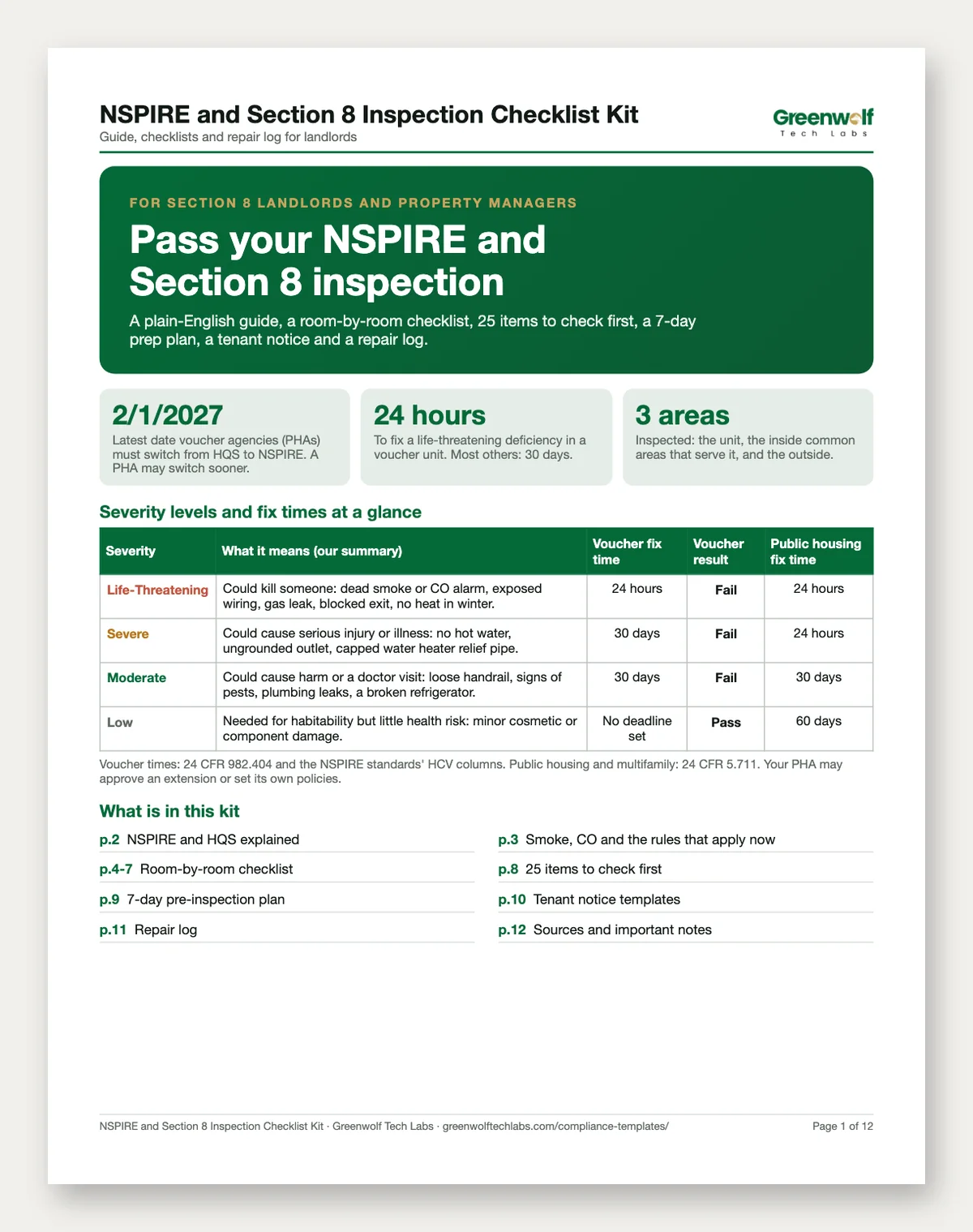
- 12-page PDF: plain-English guide, printable checklist, 25 items to check first, 7-day prep plan, tenant notice text and repair log
You get: Excel workbook · Google Sheets-ready · 12-page printable PDF
Secure checkout by Razorpay. Cards accepted worldwide, charged in US dollars. Files arrive on screen and by email. Refund policy
02
What is an NSPIRE inspection checklist?
An NSPIRE inspection checklist is a room-by-room list of the items a HUD inspector checks under the National Standards for the Physical Inspection of Real Estate, with each item's severity and fix time, so a landlord can find and repair deficiencies in a Section 8 unit before the PHA inspection.
NSPIRE is HUD's single set of inspection standards. For Housing Choice Voucher (Section 8) and Project-Based Voucher units it replaces the old Housing Quality Standards (HQS), and public housing agencies (PHAs) must switch no later than February 1, 2027. Many PHAs still inspect under HQS today, so this page covers both: what the NSPIRE standards check, how they differ from HQS, what fails, how long you have to fix it and how to get a unit ready in 7 days.
Last reviewed: October 25, 2026.
03
Free NSPIRE checklist PDF: 25 items to check first
Download one page of the kit for free: 25 items to check first (NSPIRE and Section 8 checklist PDF, 1 page). It lists the smoke and CO alarm, GFCI, wiring, water heater, venting, egress, guardrail, heat, pest and mold items that carry the highest severity or are easy to miss, each with a quick fix and a Done box. It is our selection, not a HUD statistic.
The full kit adds the 86-item room-by-room checklist for the unit, inside and outside areas, the Excel and Google Sheets workbook that dates every deficiency, a repair log, an inspection schedule for up to 100 units, the 7-day prep plan and tenant notice templates.
04
NSPIRE vs HQS: what changes for Section 8 landlords
HQS rated a voucher unit against 13 key aspects of housing quality, item by item, pass or fail. NSPIRE inspects three areas, rates each deficiency by severity, adds affirmative requirements such as GFCI protection and guardrails, and lets Low deficiencies pass in a voucher unit.
| HQS (as previously defined) | NSPIRE standards | |
|---|---|---|
| Rule | Old 24 CFR 982.401: performance requirements and acceptability criteria | 24 CFR 5.703 and the NSPIRE standards; 982.401 now points to them |
| Structure | 13 key aspects: sanitary facilities, food preparation, space and security, thermal environment, illumination and electricity, structure and materials, interior air quality, water supply, lead-based paint, access, site and neighborhood, sanitary condition, smoke detectors | 3 inspectable areas (unit, inside, outside), affirmative requirements and a list of deficiencies |
| How items are rated | Meets or fails the standard | Life-Threatening, Severe, Moderate or Low |
| Low or minor items | A failed item fails the unit | Low deficiencies pass a voucher unit |
| Fix time for owners | Life-threatening: 24 hours; other defects: 30 days or a PHA-approved extension | Life-threatening: 24 hours; other failing deficiencies: 30 days or a PHA-approved extension (982.404) |
| Smoke alarms | At least one working alarm on each level, including basements | Each level, inside every bedroom, within 21 feet of each bedroom door, plus the 2023 federal alarm type rules |
| Local variations | HUD-approved acceptability criteria variations | HUD-approved variations in the PHA administrative plan; PHAs may add life-threatening items with HUD approval |
| When it applies | PHAs may keep using it until February 1, 2027 | Required for vouchers by February 1, 2027; a PHA may switch earlier |
Sources: the NSPIRE final rule (88 FR 30442, May 11, 2023, effective October 1, 2023), the NSPIRE standards notice (88 FR 40832, June 22, 2023) and HUD's September 30, 2025 notice (90 FR 46911), which set the voucher compliance date of February 1, 2027 after two earlier extensions. HUD's July 2026 PIH notice repeats that date. Under either standard, the smoke alarm and carbon monoxide requirements already apply, because they come from federal law.
05
Inspectable areas: what an NSPIRE inspection covers
An NSPIRE inspection covers three areas: the unit, the inside (common areas and building systems inside the building) and the outside (site, exterior and systems outside). For a voucher unit, inside and outside are limited to what serves that unit (24 CFR 5.703).
- Unit: every room of the assisted unit, including the kitchen, bathroom, bedrooms, living areas and utility or laundry space.
- Inside: the path from the unit entry door to the public way, common features tied to residential use such as the laundry room, community room and mail room, and the systems equipment that directly serves the unit, such as a shared boiler or water heater.
- Outside: walkways, steps, porches, the building exterior and site features tied to the unit.
The unit's affirmative requirements include hot and cold running water in the kitchen and bathroom, a private bathroom with a sink, tub or shower and flushable toilet, a kitchen with a sink, cooking appliance, refrigerator and space to prepare and store food, at least one bedroom or living/sleeping room per two people, two working outlets (or one outlet and a permanent light) in every habitable room, GFCI protection within 6 feet of a water source, a permanent light in the kitchen and each bathroom, guardrails at drops of 30 inches or more and no unvented space heaters burning gas, oil or kerosene.
State and local codes still apply to your property, but for vouchers they are not part of the pass/fail decision unless HUD has approved them as a PHA variation (24 CFR 5.705).
06
NSPIRE severity levels and fix timeframes
Every NSPIRE deficiency is rated Life-Threatening, Severe, Moderate or Low. In a voucher unit you must fix a life-threatening deficiency within 24 hours of notice and other deficiencies within 30 days, unless the PHA approves an extension. Under the NSPIRE standards, Low items do not fail a voucher inspection.
| Severity | Example | Voucher (HCV / PBV) | Public housing and multifamily |
|---|---|---|---|
| Life-Threatening | Smoke or CO alarm missing or silent, exposed wiring, blocked exit, no heat in winter | 24 hours, fails | 24 hours |
| Severe | No hot water, ungrounded outlet, capped water heater relief pipe | 30 days, fails | 24 hours |
| Moderate | Loose handrail, signs of pests, plumbing leak | 30 days, fails | 30 days |
| Low | Minor component damage with little health risk | Passes | 60 days |
Voucher times come from 24 CFR 982.404 and the HCV columns of the NSPIRE standards; public housing times from 24 CFR 5.711. If repairs are late, the PHA may withhold and then must abate your housing assistance payment, and can end the HAP contract if the unit still fails after 60 days or a longer period it sets. If the PHA finds the family caused damage beyond normal wear, it may make the family responsible instead.
07
Smoke and CO alarm rules for Section 8 units
Smoke and carbon monoxide alarms are the most important items on any Section 8 inspection checklist: a missing, blocked or silent alarm is a life-threatening deficiency, and HUD says these rules apply now, whether your PHA uses HQS or NSPIRE.
| Rule | Smoke alarms | Carbon monoxide alarms |
|---|---|---|
| Where | Every level of the unit, inside every bedroom, within 21 feet of each bedroom door along the path of travel, and on the living-area side of a door between them; every level of the building's common areas | Required in HUD-assisted housing; HUD guidance ties it to units with fuel-burning appliances or an attached garage. Confirm placement with your PHA and local code |
| Type | Units built before December 29, 2022: hardwired, or sealed, tamper-resistant 10-year battery with a silencing means. Units built or substantially rehabilitated after that date: hardwired | Per the HUD notice and your PHA |
| Hearing loss | Alarms that alert the household, such as strobes, where needed | Follow your PHA |
| Fails as | Missing, obstructed or not sounding: life-threatening | Missing, wrongly placed, obstructed or not sounding: life-threatening |
| Law | Consolidated Appropriations Act 2023, Div. AA, Sec. 601 | Consolidated Appropriations Act 2021, Div. Q, Sec. 101 |
Sources: HUD's September 30, 2025 notice and the August 5, 2025 smoke alarm notice (90 FR 37546). Swap old 9-volt alarms for sealed 10-year or hardwired units before the inspection, and test every alarm the day before.
08
How a PHA inspection works
The PHA inspects a unit before the lease starts and then at least every 24 months (every 3 years for small rural PHAs), plus interim inspections when a tenant or official reports a problem (24 CFR 982.405).
- Notice: the PHA sends an inspection letter with the date, the time window and the standard it uses. Read it first: your PHA's letter and administrative plan come before any general checklist.
- Inspection: an adult must give access to every room, the utility areas and the electrical panel. The inspector records each deficiency and its severity.
- Results: you get a list of deficiencies with fix-by dates: 24 hours for life-threatening items and 30 days for others in a voucher unit.
- Proof of repair: the PHA may reinspect or accept photos or other reliable evidence that a deficiency was fixed.
- If repairs are late: the PHA may withhold and then must abate the housing assistance payment, and the HAP contract ends if the unit is still out of compliance 60 days after the noncompliance determination (or a longer PHA period). You cannot evict the tenant because of the abatement.
The PHA may not charge you for the initial inspection, but may charge a reasonable reinspection fee if a deficiency was not corrected, and you cannot pass that fee to the family. For interim complaints, a reported life-threatening condition is inspected within 24 hours and must be fixed within 24 hours; other conditions are inspected within 15 days and fixed within 30 days. For a new tenancy, a PHA may approve a unit that failed only for non-life-threatening items, with the repairs due within 30 days of the HAP contract. Tenant-caused damage beyond normal wear can be made the family's responsibility (982.404).
09
Section 8 inspection checklist: items to check first
Start with the affirmative requirements and the life-threatening items: they fail a unit outright and must be fixed within 24 hours. Under 24 CFR 5.703 and the NSPIRE standards, check that:
- smoke alarms work on every level, inside every bedroom and within 21 feet of each bedroom door; the 2023 federal law calls for hardwired alarms or sealed, tamper-resistant 10-year battery alarms
- carbon monoxide alarms are installed and sound where your PHA requires them, typically where there is a fuel-burning appliance or attached garage
- outlets within 6 feet of a sink, tub or outdoor tap are GFCI protected and trip when tested
- there are no exposed wires, damaged outlets or open panel slots
- bedroom escape windows on the 3rd floor and below open, and exits are clear
- guardrails are in place at drops of 30 inches or more, and handrails are secure
- the water heater relief pipe is present, not capped, runs downhill and ends 2 to 6 inches above the floor or drain
- dryer ducts are attached and made of suitable metal, and nothing is stored within 3 feet of a furnace or fuel-burning water heater
- heat works from October 1 to March 31, and there are no unvented gas, oil or kerosene space heaters
- there are no signs of pests or mold-like growth, and the bathroom has working ventilation
Your PHA may use HUD-approved local variations (24 CFR 5.705), and local housing codes still apply, so read your PHA's inspection letter and administrative plan too.
10
How to prepare for an NSPIRE or Section 8 inspection in 7 days
Day 7: Confirm and notify
Confirm the date, time window and whether the PHA uses HQS or NSPIRE. Send the tenant written notice of entry and check your state notice rules.
Day 6: Walk the unit
Do a full self-inspection with the checklist. Mark every deficiency and photograph it.
Day 5: Life safety first
Test and replace smoke and CO alarms, fit GFCIs, cover exposed wiring, fix gas and vent problems. Buy parts for the rest.
Day 4: Mechanical
Water heater relief pipe, furnace or boiler service, dryer duct, heat and hot water. Book licensed trades where needed.
Day 3: Doors, windows, stairs
Locks, latches, sashes, bedroom escape windows, handrails, guardrails and trip hazards.
Day 2: Kitchen, bath, pests, moisture
Burners, oven, fridge, sinks, toilet, bathroom fan, leaks, mold-like growth and pest signs. Outside: address numbers, lights, steps, trash.
Day 1: Final check
Re-test every alarm and GFCI, clear paths, the furnace area and windows, file receipts and photos, and confirm access with the tenant.
11
Worked example: a self-inspection with fix-by dates
Sample scenario, for illustration only. A landlord self-inspects a two-bedroom voucher unit on November 2, 2026, ahead of a PHA inspection. Using the NSPIRE severity for each item and the voucher fix times, the workbook's deficiency list shows:
| Deficiency found | Typical severity | Fails a voucher unit? | Fix by (from Nov 2) |
|---|---|---|---|
| Smoke alarm in bedroom 2 does not sound when tested | Life-Threatening | Yes | Nov 3 (24 hours) |
| Dryer transition duct is foil and detached | Life-Threatening | Yes | Nov 3 (24 hours) |
| GFCI outlet by the kitchen sink does not trip | Severe | Yes | Dec 2 (30 days) |
| Stair handrail is loose | Moderate | Yes | Dec 2 (30 days) |
| Minor cosmetic damage with no health or safety risk | Low | No | No voucher deadline |
The landlord fixes the two life-threatening items the same day, replaces the GFCI and secures the handrail that week, logs each repair with cost and photos in the repair log, and walks into the PHA inspection with no failing items open. In a real PHA inspection the clock starts from the PHA's notice, not your self-inspection.
12
What is inside
Self-Inspection Checklist
86 items across the unit, inside common areas and outside, each with what to check and its typical severity. Pass, Deficiency or N/A dropdowns and live counts.
Deficiency List
Every item marked Deficiency is listed automatically with its severity, fix-by date and whether it fails a voucher inspection. Print it for your contractor.
Repair Log
300 rows across all units: date notified, fix-by date, contractor, estimated and actual cost, completion date and status.
Units and Schedule
Up to 100 units with last PHA inspection, next due date, days left, status and open repairs, plus your own self-inspection dates.
Dashboard and Setup
Overdue inspections and repairs, open life-threatening items, repair spend and a chart by severity. Fix times switch between voucher and public housing rules.
12-page PDF guide
NSPIRE in plain English, smoke and CO rules, a printable room-by-room checklist, 25 items to check first, a 7-day prep plan, tenant notice text and a repair log page.
13
How to use it
Set up
Enter your PHA, pick voucher or public housing rules and list your units with their last inspection dates.
Walk the unit
Use the printed checklist or a tablet. Mark every line and note what you found.
Fix in order
The deficiency list puts dates on every item. Do life-threatening items the same day.
Track and prove
Log each repair with cost and photos, and watch the dashboard for overdue items and upcoming inspections.
14
Common reasons units fail a Section 8 inspection
15
Related templates and services
See all our compliance templates and inspection checklists. Property managers with UK blocks of flats use the fire door inspection checklist and register, built the same way. If you inspect many units and want the checklist on a phone with photos and automatic repair tickets, we build custom inspection apps in AppSheet. Older homes: follow HUD's lead-based paint rules in 24 CFR part 35.
16
NSPIRE and Section 8 inspection questions
What is the difference between NSPIRE and HQS?
When does NSPIRE start for Section 8 (Housing Choice Voucher) units?
What fails a Section 8 inspection under NSPIRE?
How long do I have to fix a failed item?
What smoke alarms does a Section 8 unit need?
How often are Section 8 units inspected?
Is there a free NSPIRE checklist PDF?
What is on a Section 8 inspection checklist?
Can my PHA add its own requirements?
17
Important
This kit helps you prepare for an inspection and keep repair records. It is not legal advice and it does not guarantee that a unit will pass. Your PHA's inspection letter, forms and administrative plan come first, HUD updates the NSPIRE standards from time to time, and state and local codes also apply. Check the current rules and use licensed trades where your local rules require them. Greenwolf Tech Labs is not a law firm and is not affiliated with HUD or any public housing agency.
Part of our Compliance Templates hub. Start with our compliance templates.
Compliance Templates
More on compliance templates
Fire Door Inspection Checklist, Regulations and Register (UK)
Free fire door inspection checklist (PDF) and UK fire door regulations explained: who checks, 3-monthly and 12-monthly checks, gaps, seals and records.
First Aid Kit Checklist: Workplace Contents List and Monthly Inspection
Free first aid kit checklist (PDF) with workplace contents lists for the US (ANSI Class A and B), UK and Australia, plus a monthly inspection log.
Forklift Inspection Checklist (OSHA Daily, Free PDF)
Free forklift inspection checklist (PDF) for electric and LPG trucks, plus OSHA 1910.178 rules: daily checks, out of service and 3-year evaluations.
Pre-Trip Inspection Checklist and DVIR Form (FMCSA)
Free pre-trip inspection checklist (PDF) for trucks and vans, plus DVIR rules under 49 CFR 396.11: what to check, no-defect reports, repairs and retention.
VEVRAA and Section 503 Affirmative Action Plan Template (2026)
VEVRAA explained for federal contractors: who needs a plan, the 5.1% hiring benchmark, 2026 rule changes, VETS-4212 and an AAP template with a free calendar.
Tell us where the week goes
A senior consultant will map where the time goes, name what is worth automating and what it takes. No obligation after it.