

Templates and trackers
First Aid Kit Checklist: Workplace Contents List and Monthly Inspection
Free first aid kit checklist (PDF) with workplace contents lists for the US (ANSI Class A and B), UK and Australia, plus a monthly inspection log.
For office managers, safety leads and first aiders
Workplace First Aid Kit Checklist and Register
$9USD · one-time purchase · instant download
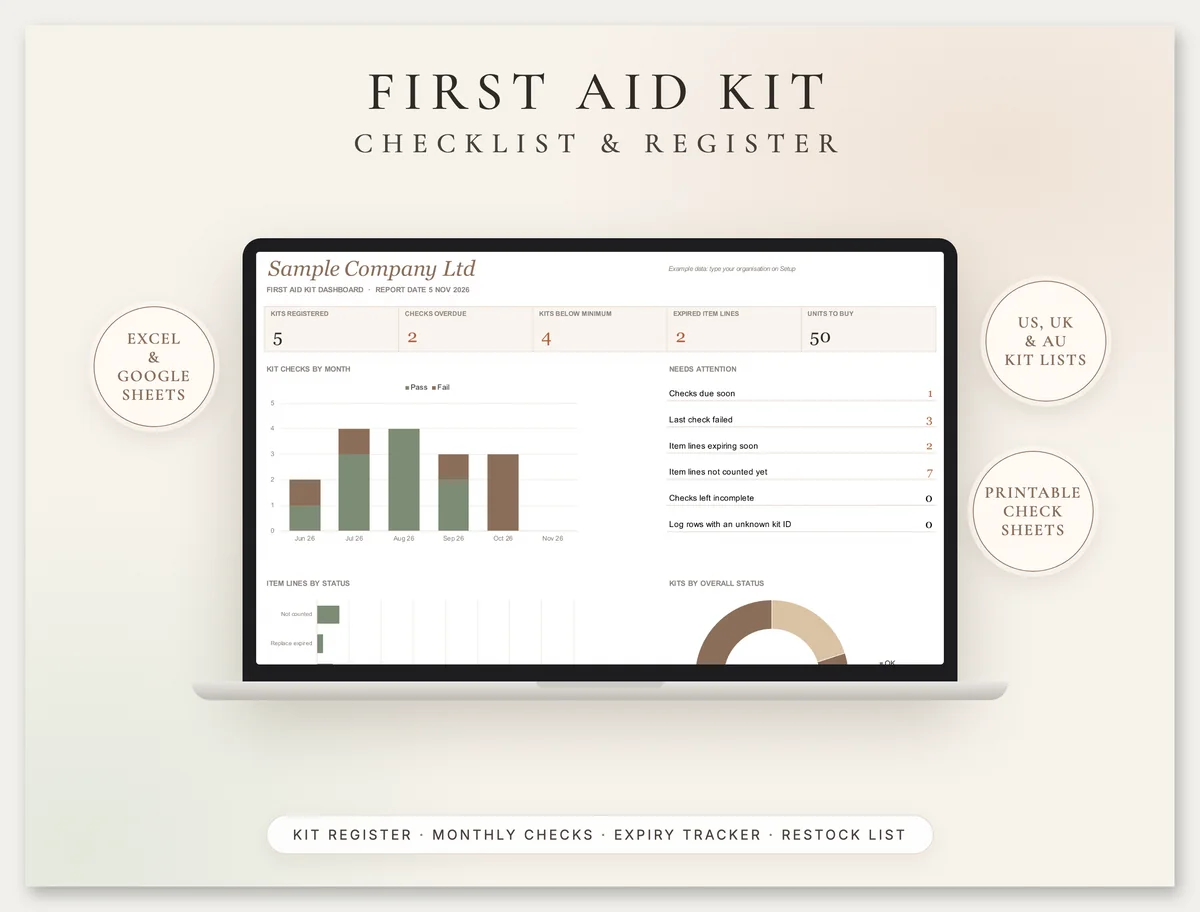
List every kit once, choose its type and the workbook fills in the contents list, works out when each kit is next due for a check, flags anything short or out of date and builds your restock shopping list.
- Contents lists with minimum quantities for US Class A and Class B, UK low-hazard and travelling kits, and Australian workplace kits (all editable)
- Kit register for up to 100 kits by location, with next check due, status and an overall action flag
- Kit stock sheet that fills in each kit's items: type what is on hand and the earliest expiry date
- Expiry tracker with Expired and Expires soon flags, and a restock list by kit and by item
- Monthly inspection log with 8 yes/no checks and a dashboard of overdue checks and units to buy
- Printable check sheets: US Letter (Class A, Class B) and A4 (UK, travelling, Australia), a year per page
You get: Excel workbook · Google Sheets-ready · 4-page printable PDF (US Letter) · 4-page printable PDF (A4)
Secure checkout by Razorpay. Cards accepted worldwide, charged in US dollars. Files arrive on screen and by email. Refund policy
02
What is a first aid kit checklist?
A first aid kit checklist is a list of every item a workplace kit should hold, with the minimum quantity of each, that you tick off on a regular check. It shows at a glance what is missing, what has been used and what has passed its expiry date, so the kit is complete before someone needs it.
Most workplaces use it in two ways. The contents list says what a full kit looks like, which depends on the country and the size and hazards of the workplace. The inspection record shows that someone actually opened each kit, counted it, threw out anything out of date and restocked it. This page gives you both: the contents lists that regulators and standards bodies publish for the US, UK and Australia, a monthly check you can print, and a workbook that keeps the register for you.
Every quantity below links to the source it comes from. Where a list belongs to a paid standard we have not read, we say so and tell you how to check it.
Last reviewed: 30 October 2026.
03
Free printable first aid kit checklist (PDF)
Download a free monthly check sheet for a US Class A kit: first aid kit checklist template (PDF, 1 page, US Letter). It lists the 19 items in the ANSI/ISEA Z308.1-2021 Class A minimum fill with their sizes and quantities, then gives you a column for each month of the year and rows for container condition, expired items replaced, contents list signed, initials and date. Pin one inside each kit and one year of checks fits on a page.
The full kit adds the same year-on-a-page sheet for Class B kits, UK low-hazard and travelling kits and the Australian Code of Practice list, an expiry and restock record, and the Excel and Google Sheets register that tracks every kit, expiry date and order for you.
04
Workplace first aid kit requirements in the US, UK, Canada and Australia
None of the four countries publishes one fixed list for every workplace. Each requires adequate first aid supplies, points to a list or standard as a guide, and expects you to size kits to your own hazards and headcount.
| Country | What the rule says | The list most people use | How often to check |
|---|---|---|---|
| United States | OSHA 29 CFR 1910.151(b): adequate first aid supplies shall be readily available (OSHA 1910.151). | Non-mandatory Appendix A points to ANSI Z308.1 as an example of minimum contents; the current edition defines Class A and Class B kits (Appendix A). | No interval in the OSHA rule. Assess needs periodically and restock after use. |
| United Kingdom | Every employer needs a suitably stocked first aid kit, an appointed person and information for staff (HSE first aid in work). | No mandatory list. HSE's L74 guidance suggests a minimum for low-hazard work and for travelling workers; BS 8599-1 is the British Standard for kit contents, but kits do not have to meet it by law (HSE L74, HSE kit page). | Examine frequently and restock soon after use (L74 paragraph 38). |
| Canada | Set by each province and territory. A Canada Gazette proposal of 3 October 2026 notes CSA Z1220 is incorporated by reference in every province's and territory's regulations and proposes the same for federal workplaces (Canada Gazette). | CSA Z1220, First aid kits for the workplace (2024 edition), plus any schedule in your provincial regulation. | Check your provincial regulation. |
| Australia | Model WHS Regulations, with the model Code of Practice 'First aid in the workplace' adopted state by state (Safe Work Australia). | Appendix E of the Code lists example contents for most workplaces, with outdoor, remote and burn modules. | After each use or, if not used, at least once every 12 months, signing and dating the inventory list. |
Because the rules only set a floor, most safety teams pick a fixed monthly check. It is short, it catches used items before they are needed again and it gives you a dated record if an inspector, insurer or auditor asks how kits are maintained.
05
First aid kit contents list: ANSI Class A and Class B (US)
A Class A kit is built for the most common workplace injuries, such as minor cuts, abrasions and sprains. A Class B kit carries more items and larger quantities for complex or higher-risk work, adding a splint, a tourniquet, a 4-inch roller bandage and a larger eyewash. These are the 2021 minimum fill quantities as published by a university safety office (CSN EHS table). ANSI/ISEA Z308.1 is a paid standard we have not reproduced; check the contents list printed on your kit.
| Item | Minimum size | Class A | Class B |
|---|---|---|---|
| Adhesive bandage | 1 x 3 in (2.5 x 7.5 cm) | 16 | 50 |
| Adhesive tape | 2.5 yd (2.3 m) | 1 | 2 |
| Antibiotic application | 1/57 oz (0.5 g) | 10 | 25 |
| Antiseptic (e.g. alcohol swab) | 1/57 oz (0.5 g) | 10 | 50 |
| Breathing barrier (CPR) | - | 1 | 1 |
| Burn dressing (gel soaked) | 4 x 4 in (10 x 10 cm) | 1 | 2 |
| Burn treatment | 1/32 oz (0.9 g) | 10 | 25 |
| Cold pack | 4 x 5 in (10 x 12.5 cm) | 1 | 2 |
| Eye covering, with means of attachment | 2.9 sq in (10 sq cm) | 2 | 2 |
| Eye/skin wash, 1 fl oz | 1 fl oz (29 ml) | 1 | 0 |
| Eye/skin wash, 4 fl oz | 4 fl oz (118.3 ml) | 0 | 1 |
| Foil blanket | 52 x 84 in (132 x 213 cm) | 1 | 1 |
| First aid guide | - | 1 | 1 |
| Hand sanitizer | 1/32 oz (0.9 g) | 10 | 20 |
| Medical exam gloves (pairs) | - | 2 | 4 |
| Roller bandage, 2 in | 2 in x 4 yd (5 cm x 3.66 m) | 1 | 2 |
| Roller bandage, 4 in | 4 in x 4 yd (10 cm x 3.66 m) | 0 | 1 |
| Scissors | - | 1 | 1 |
| Splint | 4 x 24 in (10.2 x 61 cm) | 0 | 1 |
| Sterile pad | 3 x 3 in (7.5 x 7.5 cm) | 2 | 4 |
| Tourniquet | 1.5 in wide (3.8 cm) | 0 | 1 |
| Trauma pad | 5 x 9 in (12.7 x 22.9 cm) | 2 | 4 |
| Triangular bandage | 40 x 40 x 56 in (101 x 101 x 142 cm) | 1 | 2 |
OSHA's Appendix A adds two points worth acting on. Larger or multiple operations should consider more kits or larger quantities, and where staff could contact blood while giving first aid, you must provide suitable protective equipment under the bloodborne pathogens standard. Separately, 1910.151(c) requires quick drenching or flushing facilities where eyes or body may be exposed to injurious corrosive materials, which a small eyewash bottle in a kit does not replace.
06
UK and Australia first aid kit contents
In the UK there is no mandatory list. For low-hazard work such as desk-based offices, HSE's guidance on the First-Aid Regulations suggests the minimum stock below; a smaller list for travelling workers sits alongside it (L74 Appendix 2).
| Item (HSE L74) | Workplace kit | Travelling kit |
|---|---|---|
| Leaflet with general first aid guidance | 1 | 1 |
| Sterile plasters, individually wrapped | 20 | 6 |
| Sterile eye pads | 2 | - |
| Triangular bandages, individually wrapped | 2 | 2 |
| Safety pins | 6 | 2 |
| Large sterile unmedicated wound dressings | 2 | 1 |
| Medium sterile unmedicated wound dressings | 6 | - |
| Disposable gloves (pairs) | 3 | 2 |
| Individually wrapped moist cleansing wipes | - | Yes (no number given) |
HSE adds that containers should be marked with a white cross on a green background, kept free of dust and damp, examined frequently, restocked soon after use, and should not hold tablets or medicines. If you buy a kit, HSE suggests looking for one made to BS 8599, but the contents should still match your needs assessment.
Australia. Appendix E of the model Code of Practice lists 29 lines for most workplaces, including 5 pairs of nitrile gloves, 8 x 15 ml saline, 10 wound cleaning wipes, a packet of 50 adhesive strips, small, medium and large non-adherent pads, conforming and crepe bandages, an emergency rescue blanket, 4 eye pads, hydrogel sachets where clean running water is not available, and an instant ice pack. The Code says medication such as paracetamol and aspirin should not be in kits, and that kits should be placed so that a multistorey workplace has at least one on every second floor. The workbook carries the full list with quantities.
07
How to do a monthly first aid kit inspection
Find the kit
It is in its marked place, the sign can be seen and nothing blocks it. A missing kit is the first failure to fix.
Check the container
Clean, dry, undamaged and closing properly, with a contents list inside. Replace a cracked or damp case.
Count against the minimum
Count each item on the checklist and write the number on hand. Anything below the minimum goes on the restock list.
Check every expiry date
Sterile dressings, eyewash, saline, burn gel and antiseptics carry dates. Remove anything out of date and note the next date to expire.
Check seals and extras
Sterile packs sealed and intact; eyewash stations, AED pads or extras in date. Medicines out of the kit.
Restock and record
Order what is short, refill the kit, sign and date the sheet and log the check, so the next due date moves on a month.
08
Worked example: five kits across three countries
Sample scenario, for illustration only. A company has a Class A kit in its US office kitchen (K-01), a Class B kit at a warehouse dock (K-02), an HSE low-hazard kit in its London office (K-03), an Australian Code kit in a Sydney workshop (K-04) and a UK travelling kit in a service van (K-05). Checks are monthly.
- K-01: 9 adhesive bandages against a minimum of 16 and 1 pair of gloves against 2. The kit is short on 2 lines, so the restock list asks for 7 bandages and 1 pair of gloves. The antibiotic ointment expires on 10 December 2026, within the 60-day warning window, so it shows Expires soon.
- K-02: last checked 28 August 2026, so with a 30-day interval the next check was due 27 September and the kit shows Overdue. Its burn treatment expired on 12 October: expired stock counts as zero, so the list asks for all 25 packets, plus 1 cold pack.
- K-03: 14 plasters against HSE's suggested 20, so 6 to buy.
- K-04: the 8 saline ampoules expired on 30 September (replace all 8) and gloves are down to 3 pairs against 5 (buy 2).
- K-05: never checked, so its first check is due on the date set on the Setup tab.
Total on the restock list: 8 + 26 + 6 + 10 = 50 units across 7 lines, with order totals by item for one purchase. The dashboard shows 5 kits, 1 overdue check, 4 kits below minimum and 2 expired lines.
09
Common first aid kit mistakes
10
What is inside
Contents Lists
US Class A and B, UK low-hazard and travelling, and Australian Code lists with minimum quantities, plus blank lists for Canada and two custom kits.
Kit Register and Kit Stock
Up to 100 kits. Items fill in from the kit type; type what is on hand and the earliest expiry date per item.
Inspection Log, Expiry Tracker, Restock List
Monthly checks with 8 yes/no questions, expired and soon-to-expire items, and a shopping list by kit and by item.
Dashboard and printable sheets
Overdue checks, kits short and units to buy, plus year-per-page check sheets in US Letter and A4.
11
How to use the workbook
Set it up
Enter your organisation and people, and check the interval, expiry warning and first due date.
Register kits
One row per kit with its location and type. Edit the contents list if your kit differs.
Count stock
Type the quantity on hand and earliest expiry date for each item.
Check monthly
Use the printed sheet, log the check, print the restock list and order.
12
First aid kit checklist questions
What should be in a workplace first aid kit?
How often should a first aid kit be checked?
What is the difference between a Class A and Class B first aid kit?
Does OSHA require an ANSI first aid kit?
Do first aid kit items expire?
Should first aid kits contain painkillers?
Does the workbook work in Google Sheets?
13
Important
This checklist and workbook help you plan, record and restock first aid kits. They are not medical, legal or safety advice and do not replace your own first aid needs assessment or the advice of a competent safety professional. Quantities come from the sources linked above and can change; ANSI/ISEA Z308.1, BS 8599-1 and CSA Z1220 are paid standards that we describe but have not reproduced, so check the contents list supplied with your kit. Greenwolf Tech Labs is not affiliated with OSHA, HSE, Safe Work Australia, CSA Group, ISEA or ANSI, and the product does not certify any kit as meeting any standard. See our terms and refund policy.
Part of our Compliance Templates hub. Start with our compliance templates.
Compliance Templates
More on compliance templates
Fire Door Inspection Checklist, Regulations and Register (UK)
Free fire door inspection checklist (PDF) and UK fire door regulations explained: who checks, 3-monthly and 12-monthly checks, gaps, seals and records.
Forklift Inspection Checklist (OSHA Daily, Free PDF)
Free forklift inspection checklist (PDF) for electric and LPG trucks, plus OSHA 1910.178 rules: daily checks, out of service and 3-year evaluations.
NSPIRE Inspection Checklist for Section 8 and HQS Units
Free NSPIRE inspection checklist PDF for Section 8 and HQS units: what fails, fix times by severity, smoke and CO rules and the Feb 1, 2027 voucher date.
Pre-Trip Inspection Checklist and DVIR Form (FMCSA)
Free pre-trip inspection checklist (PDF) for trucks and vans, plus DVIR rules under 49 CFR 396.11: what to check, no-defect reports, repairs and retention.
Controlled Substance Log and Narcotic Count Sheet
Controlled substance log and free narcotic count sheet (PDF): running balance, witnessed waste and a DEA biennial inventory sheet under 21 CFR 1304.
Tell us where the week goes
A senior consultant will map where the time goes, name what is worth automating and what it takes. No obligation after it.