

Templates and trackers
Controlled Substance Log and Narcotic Count Sheet
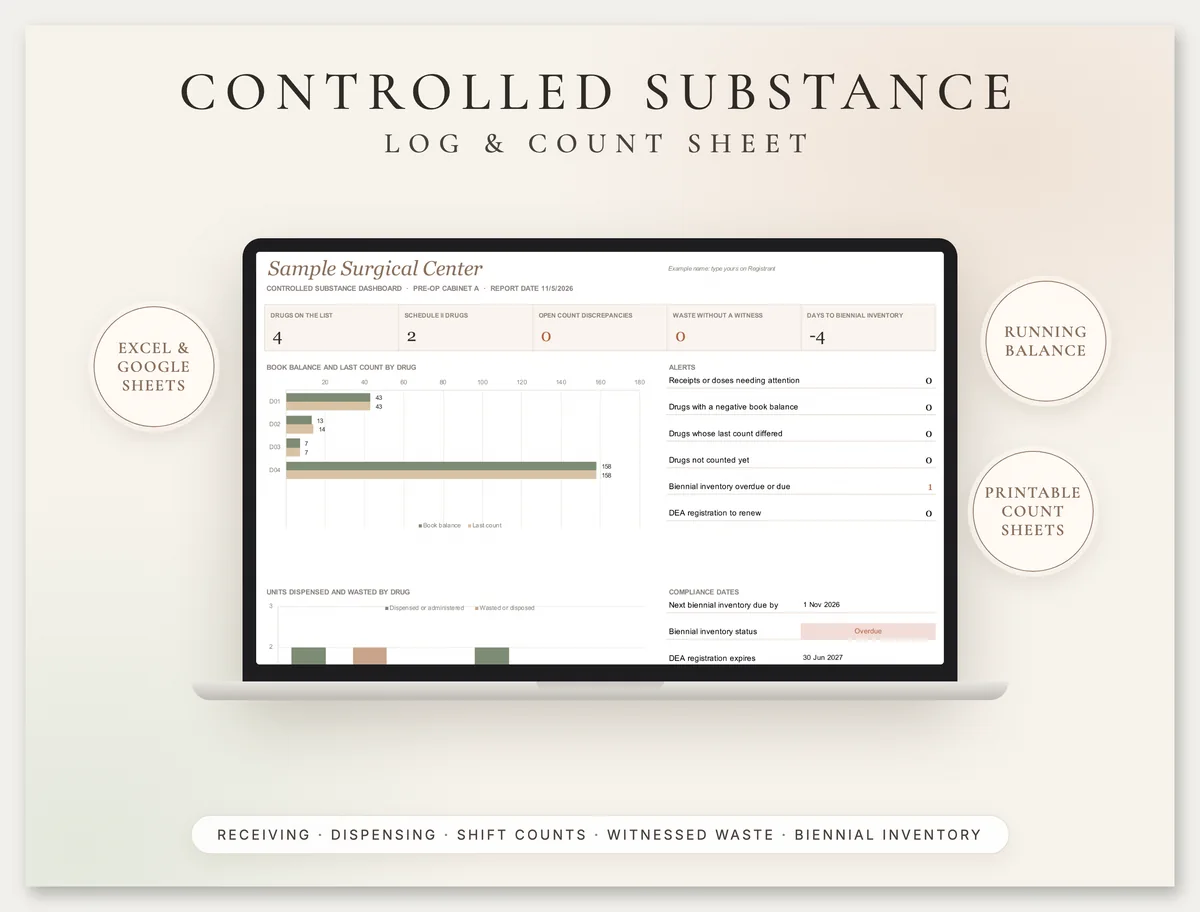
Controlled substance log and free narcotic count sheet (PDF): running balance, witnessed waste and a DEA biennial inventory sheet under 21 CFR 1304.
For clinics, surgery centers, practices, veterinary hospitals and pharmacies (US)
$15USD · one-time purchase · instant download
Keep one drug list, log every receipt, dose and waste, and let the workbook carry a running balance per drug, check every shift count against the book and lay out your biennial inventory with the right count rule for each schedule.
- Drug list with name, strength, form, schedule and NDC, and a live book balance from every log
- Receiving log that flags a Schedule II receipt without a DEA Form 222 or CSOS order reference
- Dispensing and administration log with the running balance after every dose
- Shift count sheet that compares each count with the book balance at that minute and flags discrepancies until resolved
- Waste and disposal log with a witness check, partial-dose waste handled without double counting, and Form 41 references
- Biennial inventory sheet with exact or estimated count by schedule, plus a printable narcotic count sheet and per-drug perpetual log
You get: Excel workbook · Google Sheets-ready · 5-page printable PDF (US Letter)
Secure checkout by Razorpay. Cards accepted worldwide, charged in US dollars. Files arrive on screen and by email. Refund policy
01
What is a controlled substance log?
A controlled substance log is a running record of every unit of a scheduled drug a DEA registrant receives, dispenses, administers, wastes or destroys, with dates, quantities, patients, the people involved and a balance, backed by regular counts. It is how a practice shows that every dose is accounted for.
Under 21 CFR 1304.21, every registrant must keep a complete and accurate record of each controlled substance received, sold, delivered or otherwise disposed of, and 21 CFR 1304.04 says those records must be kept for at least 2 years and be available for DEA inspection. A narcotic count sheet sits alongside the log: two people count the stock at every shift change and compare it with the book.
This page explains the federal record rules, how a shift count works, how to record waste, how the biennial inventory is counted, and what this kit does not replace. Every rule links to the regulation on eCFR.
Last reviewed: 30 October 2026.
02
Free printable narcotic count sheet (PDF)
Download the shift narcotic count sheet (PDF, 1 page, US Letter) free. It lists up to 16 drugs with schedule, book and actual count for three counts a day, and a sign-off table for the off-going and on-coming person, any discrepancy and who it was reported to.
The full kit adds a per-drug perpetual inventory record, a witnessed waste record, a biennial inventory worksheet and a one-page summary of the DEA record rules, plus the Excel and Google Sheets workbook that keeps the running balance for you.
03
DEA controlled substance record-keeping rules
Federal law asks for complete records of every controlled substance, kept at the registered location for at least 2 years, with Schedule II kept apart and a full inventory at least every two years.
| Rule | What it says | Source |
|---|---|---|
| Retention | Every inventory and record kept at least 2 years from its date and available for inspection | 1304.04(a) |
| Schedule II separate | Schedule I and II inventories and records kept separately from all other records; III, IV and V separately or readily retrievable | 1304.04(f) to (h) |
| Dispensing records | Units dispensed, name and address of the person dispensed to, date, and the name or initials of who dispensed or administered | 1304.22(c) |
| Actual dates | Record the date the drug was actually received, transferred or destroyed | 1304.21(d) |
| Perpetual inventory | Not required by DEA (1304.21(a)); many state boards and facilities require one for Schedule II | 1304.21(a) |
| Ordering Schedule II | Each distribution needs a DEA Form 222 or its electronic equivalent (CSOS) | 1305.03 |
| Theft or significant loss | Written notice to the DEA Field Division Office within one business day of discovery; DEA Form 106 within 45 days | 1301.76(b) |
States add their own rules on top, from count frequency to how long records are kept. Check with your state board of pharmacy or licensing board.
04
How a shift narcotic count works
At each hand-off, the off-going and on-coming person count every controlled substance together, compare each count with the book balance and both sign. Any difference stops the hand-off until it is explained. DEA rules do not set a shift-count routine; it is a facility policy, often required by state rules or accreditation, and it is the fastest way to catch a loss while the people involved are still on site.
| Step | What to do |
|---|---|
| 1. Count | Both people count each drug: sealed packs by seal, opened packs unit by unit |
| 2. Compare | Book balance = opening + received - given - wasted units. The workbook works this out at the exact count time |
| 3. Discrepancy | Recount, check the dispensing and waste entries since the last count, check returns bins and charts |
| 4. Escalate | Tell the person in charge and pharmacy. Record what was found and how it was resolved |
| 5. Report | If it is a theft or a significant loss, notify DEA in writing within one business day and file Form 106 within 45 days |
DEA lists factors for deciding whether a loss is significant, including the quantity relative to your business, the drug, whether it can be tied to specific people, patterns of losses and local diversion trends (1301.76(b)).
05
Recording waste and destruction
Leftover drug from a dose given at your registered location, such as the rest of a vial or syringe, is recorded in the dispensing record and does not need a DEA Form 41. Destroying stock on site under 1317.95 is recorded on a DEA Form 41 with the names and signatures of the two employees who witnessed it. Both rules are in 21 CFR 1304.21(e).
The waste log in this kit separates the two. A partial dose records the amount wasted (for example 2 mg, 0.5 mL) and removes 0 units, because the vial was already deducted when the dose was given. A dropped vial, a dose prepared but not given, expired stock sent to a reverse distributor or stock destroyed on site removes whole units from the balance. Every row needs a witness who is not the person wasting, and the check column flags a missing Form 41 or transfer reference.
06
Biennial inventory: exact and estimated counts
Take an inventory of all controlled substances on hand at least every two years, on any date within two years of the last one, and say whether it was taken at the opening or close of business. For opened containers, 21 CFR 1304.11(e)(6) says dispensers make an exact count for Schedule I and II, and may estimate for Schedule III, IV and V unless the container holds more than 1,000 tablets or capsules.
| Schedule | Opened container | Example |
|---|---|---|
| II (e.g. morphine, hydromorphone, fentanyl) | Exact count | 18 vials counted one by one |
| III to V, container of 1,000 or fewer | Estimate allowed | About half of a 100-tablet bottle: 50 |
| III to V, container over 1,000 tablets or capsules | Exact count | A 2,000-capsule bottle, counted |
Each registered location needs its own inventory, kept in written, typed or printed form at that location (1304.11(a)). Include expired stock you still hold.
07
How to set up a controlled substance log
Start with a count
Count everything on hand and enter it as the opening balance with the date. If you are a new registrant, that is your initial inventory (1304.11(b)).
One line per product
Each strength and form is its own drug: morphine 4 mg/mL vials and 10 mg/mL vials are two lines.
Log as it happens
Receipts on arrival, doses when given, waste when it happens, always with the time.
Count at every hand-off
Two people, every drug, every shift change. Resolve any difference before the off-going person leaves.
Review and keep
Check the dashboard weekly and keep every record at least 2 years, longer if your state requires it.
08
Worked example: one week in a surgery center cabinet
Sample data, for illustration only. A pre-op cabinet starts October with 20 morphine 4 mg/mL vials (Schedule II) and 60 tramadol 50 mg tablets (Schedule IV).
- Receipt: on 10/20, 25 morphine vials arrive on a CSOS order and 100 tramadol tablets on the same invoice. Morphine book balance: 20 + 25 = 45.
- Doses: one vial at 8:30 AM and one at 2:10 PM on 10/21. Balance after: 44, then 43. A 0.5 mL leftover is wasted at 8:35 AM with a witness: 0 units removed, amount recorded.
- Count: at 7 PM on 10/22 the day shift counts tramadol at 157. Book: 60 + 100 - 2 = 158. Difference -1: DISCREPANCY. A tablet is found in the returns bin, the recount is 158 and the row is marked resolved.
- Biennial inventory: on 10/30 at close of business, morphine is counted exactly: 1 sealed box of 25 plus 18 loose = 43, matching the book. Tramadol may be estimated, but here the opened bottle is counted: 100 + 58 = 158.
Had the tablet not been found and the loss been judged significant, the next step would be written notice to DEA within one business day and Form 106 within 45 days.
09
Common controlled substance record mistakes
10
What is inside
Drug List and Registrant
Up to 150 products with schedule and NDC, live book balance and last count. DEA registration and biennial inventory dates with warnings.
Receiving and Dispensing
1,000 receipt rows with 222/CSOS check, 3,000 dose rows with the running balance after each.
Shift Count and Waste
Counts compared with the book at that minute, discrepancies tracked to resolution, and witnessed waste with Form 41 references.
Biennial inventory and printables
Count rule by schedule and book comparison, plus a printable count sheet, perpetual log, waste record and inventory worksheet.
11
Related templates
Browse all our compliance templates and record kits. Clinics that store vaccines also use the vaccine temperature log, built on the CDC storage and handling toolkit.
12
Controlled substance log questions
How long must controlled substance records be kept?
What must a controlled substance dispensing log include?
Is a narcotic count sheet required by DEA?
How often is a DEA biennial inventory required?
Do I count or estimate opened bottles on the inventory?
What do I do if controlled substances are missing?
Does this replace DEA Form 222 or CSOS?
13
Important
This log helps you organise controlled substance records. It is not legal or pharmacy-practice advice and does not replace DEA Form 222 or CSOS orders, DEA Form 106, DEA Form 41, ARCOS reporting where it applies, or your state's rules, which are often stricter. Verify every requirement at ecfr.gov and deadiversion.usdoj.gov and with your state board. Greenwolf Tech Labs is not affiliated with the DEA or any government agency. See our terms and refund policy.
Part of our Compliance Templates hub. Start with our compliance templates.
Compliance Templates
More on compliance templates
PAT Testing Register: Record Sheet, Log and Intervals (UK)
Free PAT user check form (PDF) and a PAT testing register: appliance list, test log, next-due dates from HSE intervals, failed items. UK, A4.
Fridge Temperature Log: Printable Sheets and Workbook
Free printable fridge temperature log (PDF) plus a freezer and food temperature log workbook in °F or °C. FDA 41 °F and FSA 8 °C rules explained.
OSHA 300 Log in Excel: 300, 300A and 301 Recordkeeping
OSHA 300 log in Excel with an automatic 300A summary, 301 details and TRIR and DART rates, plus 1904 rules: what to record, 7 days, posting and ITA.
RFI Log Template, Submittal Log and Change Order Log (Excel)
RFI log template with submittal log and change order log for Excel and Google Sheets: due dates, ball in court, at-risk submittals and contract sum.
Vaccine Temperature Log: Printable Sheets and Workbook
Free vaccine temperature log (PDF) and a vaccine fridge log workbook: daily min/max checks, excursion flags and data logger calibration, per the CDC toolkit.
Tell us where the week goes
A senior consultant will map where the time goes, name what is worth automating and what it takes. No obligation after it.