

Templates and trackers
PAT Testing Register: Record Sheet, Log and Intervals (UK)
Free PAT user check form (PDF) and a PAT testing register: appliance list, test log, next-due dates from HSE intervals, failed items. UK, A4.
For office managers, landlords, facilities teams and small contractors
PAT Testing Register and Record Sheets (UK)
$15USD · one-time purchase · instant download
List every appliance once, record each user check, formal visual inspection and combined inspection and test, and let the register work out what is next due, what is overdue and what is out of use.
- Appliance register for up to 1,000 items with asset ID, Class I or II, category, location and environment
- Next visual and next test dates from an editable interval table that starts at HSE's suggested initial intervals
- Test log for user checks, formal visual inspections and combined inspection and test, with readings fields
- Failed and removed tracker: labelled faulty, repair, replace or dispose, and back in service after a retest
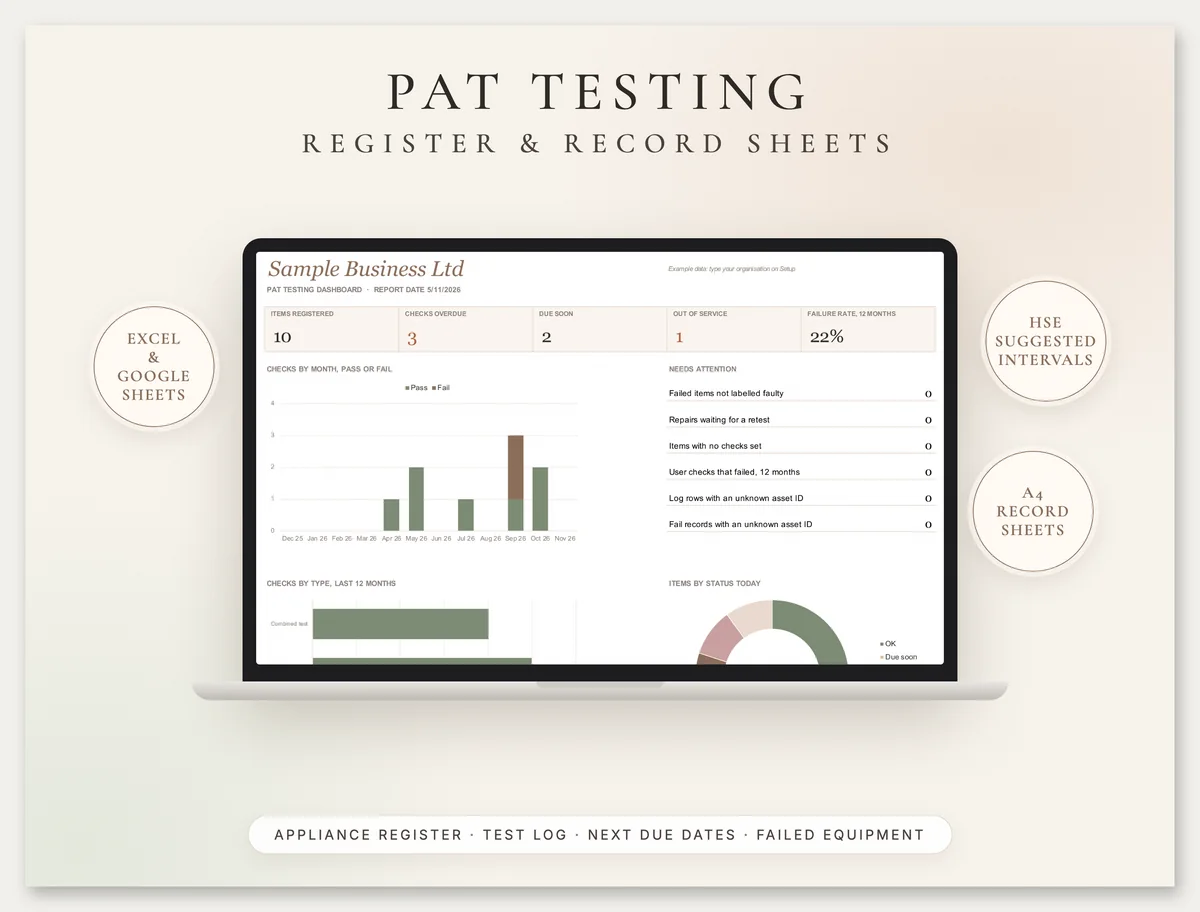
- Dashboard with overdue items, due soon, out of service and the 12-month failure rate for reviewing intervals
- 4-page A4 kit: how it works with the HSE interval table, register sheet, inspection and test record, user check form
You get: Excel workbook · Google Sheets-ready · 4-page printable PDF (A4)
Secure checkout by Razorpay. Cards accepted worldwide, charged in US dollars. Files arrive on screen and by email. Refund policy
02
What is a PAT testing register?
A PAT testing register is a list of every portable electrical appliance in a workplace with a record of each inspection and test: what was checked, when, by whom and the result. It shows which items are due for their next check, which failed and what happened to them, so you can show your equipment is being maintained.
PAT stands for portable appliance testing, the term HSE uses for examining electrical appliances and equipment to make sure they are safe to use. In practice a good register covers three levels of check, not just the test: quick user checks before use, formal visual inspections by a trained member of staff, and combined inspection and testing by a competent person with the right instrument. HSE stresses that most electrical safety defects can be found by looking, and that some can only be found by looking.
A register is also what turns a one-off test into a maintenance system. Over time the results show which kinds of equipment fail and where, and HSE's guidance is to use that evidence to lengthen or shorten your intervals.
Last reviewed: 30 October 2026.
03
Free PAT user check form (PDF)
Download the user check form for free: PAT user check record sheet (PDF, 1 page, A4). It lists the eight things HSE asks users to look for before plugging in (damaged lead, damaged plug, taped joins, coloured wires showing at the plug, damaged casing, signs of overheating, unsuitable wet or dusty conditions, trapped cables) with eight weekly tick columns, a box for who faults were reported to, and a plain-English panel telling staff what to do with a faulty item.
The full kit adds the Excel and Google Sheets register, an A4 appliance register sheet, an inspection and test record sheet with readings columns, and a one-page guide to the three levels of check and HSE's suggested intervals.
04
Is PAT testing a legal requirement in the UK?
No. The Electricity at Work Regulations 1989 require electrical equipment that could cause injury to be maintained in a safe condition, but they do not say what must be done, by whom or how often, and they do not make inspection or testing, or annual testing, a legal requirement (HSE PAT FAQs).
What the law expects is a risk-based approach: look at the type of equipment, how it is used and where, then decide what checks keep it safe. For a lot of equipment in a low-risk office, HSE says a portable appliance test is not needed at all and user checks plus visual inspections are enough. For equipment that is used a lot and moved around, such as a kettle or a floor cleaner, testing alongside visual checks can be an important part of an effective regime.
| Question | HSE's answer |
|---|---|
| Do I have to test every year? | No. Frequency depends on the equipment and the environment. |
| Do I have to keep records? | No legal requirement, but records are a useful management tool and show a scheme exists. |
| Do I have to label equipment? | No. If you do, HSG107 says the label should not show a next test due date. |
| Does new equipment need a test? | No formal test; a simple visual check that it is not damaged is recommended. |
| Must an electrician do it? | No. A trained member of staff can do visual inspections; combined testing needs more knowledge and the right equipment. |
Landlords and some sectors have their own rules and contract terms, so check what applies to you as well.
05
PAT testing frequency: HSE suggested initial intervals
HSE's guidance HSG107 (Maintaining portable electrical equipment) gives suggested starting intervals by type of equipment and environment. They are not legal requirements: where a range is given, use the shorter end for more demanding use, then adjust with experience.
| Equipment | Examples | Suggested initial interval |
|---|---|---|
| Battery operated (under 40 V) | Cordless phones, battery radios | User: no. Visual: no. Test: no |
| Extra low voltage (under 50 V AC) | Telephone equipment, low-voltage desk lights | User: no. Visual: no. Test: no |
| Office IT, rarely moved | Desktop computers, VDU screens, photocopiers, fax machines | Visual: 2 to 4 years. Test: no if double insulated, otherwise up to 5 years |
| Class II, moved occasionally, not hand-held | Fans, table lamps | Visual: 2 to 4 years. Test: no |
| Class II, hand-held | Some floor cleaners, some kitchen equipment, hairdryers | User: yes. Visual: 6 months to 1 year. Test: no |
| Class I (earthed) | Kettles, some floor cleaners, irons, microwaves, toasters | User: yes. Visual: 6 months to 1 year. Test: 1 to 2 years |
| Cables, leads, extension leads, chargers | Mains extension leads, IEC leads, battery chargers | User: yes. Visual: 6 months to 4 years. Test: 1 to 5 years, by what it connects to |
| Light industrial | Workshop equipment in light industry | User: yes. Visual: before first use, then 6-monthly. Test: 6 to 12 months |
HSG107 adds rows for heavy industrial work (user check daily, visual weekly, test every 6 to 12 months) and for construction sites, where 110 V equipment is visually inspected monthly and tested before first use on site then every 3 months, and 230 V equipment is inspected weekly and tested monthly. Equipment for hire should be inspected before issue and after return and tested before issue. The low-risk leaflet INDG236 (HSE INDG236) has the same office figures. The workbook carries all 13 rows as editable defaults.
Two rules worth applying: if items are grouped and tested together, use the shortest interval in the group; and the person doing the test should not set the next date, because that is the dutyholder's decision based on risk.
06
Class I and Class II: which appliances need a test?
Class I equipment relies on an earth connection for safety, so HSE recommends a portable appliance test to make sure the earth is sound. Class II (double insulated) equipment has extra insulation, does not need an earth and will not need a portable appliance test, but still needs user checks and visual inspections.
Class II items carry the double-square symbol. If you cannot see it, HSE says assume the item is Class I and test it. The register uses this: choose Class I, Class II or Not marked, and the test interval comes from the Class I or Class II column on Setup. Cables, leads and plugs fitted to Class II equipment are maintained as part of that equipment; loose extension leads and chargers are tracked as items of their own.
07
How to run a PAT testing register
List everything portable
Kettles, computers, chargers, extension leads, cleaners, heaters, staff-owned and leased items. Give each an asset ID.
Classify and categorise
Class I or II, then the category and environment. The interval table sets the next visual and test dates.
Train users
Show staff the user check and how to report faults. Pin the user check form where equipment is used.
Inspect and test
Formal visual inspections by trained staff; combined inspection and testing by a competent person for the items that need it.
Act on failures
Take the item out of use at once, label it faulty, then repair, replace or dispose. Retest after repair.
Review intervals
After the first few rounds, use the failure rate to lengthen intervals where few faults are found and shorten them where many are.
08
Worked example: a small office and a site store
Sample scenario, for illustration only. A small business registers 10 items. On 30 October 2026 the register shows:
- Kettle (Class I): visual inspection on 15 April 2026 plus 6 months is 15 October 2026; combined test on 12 October 2025 plus 12 months is 12 October 2026. Both passed, so it shows Overdue.
- Desktop computer (Class I, office IT): tested 3 March 2025; next visual 3 March 2027 (24 months) and next test 3 March 2030 (60 months, HSE's "up to 5 years"). OK.
- Monitor (Class II, office IT): visual only, next 3 March 2027; test Not needed.
- 110 V drill on site: monthly visual on 1 October 2026, so next 1 November 2026 (Due soon); combined test 1 September 2026, so next 1 December 2026.
- Microwave: failed its combined test on 20 September 2026 and is logged as FR-001, labelled faulty and awaiting repair: Out of service. Toaster: failed with a scorched plug and was disposed of on 22 September: Removed.
In the last 12 months there were 9 formal visual inspections and combined tests, with 2 fails: a 22.2% failure rate, both in the kitchen, which is the kind of pattern HSE suggests using to review the kitchen interval.
09
Common PAT testing mistakes
10
What is inside
Appliance Register
Up to 1,000 items. Last visual, last test, next due dates, last result and status calculate from the log and your intervals.
Test Log
User checks, formal visual inspections and combined tests, with earth continuity, insulation resistance, current, polarity, functional and fuse fields.
Failed and Removed
Fault, labelled faulty, repair, replace or dispose, date completed and retest, with days out of use.
Dashboard and A4 kit
Overdue, due soon, out of service and failure rate by category, plus four printable A4 sheets.
11
PAT testing questions
How often should PAT testing be done?
Is PAT testing a legal requirement?
Do I need to keep PAT testing records?
What should a PAT test record sheet include?
Can I do PAT testing myself?
Do Class II appliances need PAT testing?
Does the register work in Google Sheets?
12
Important
This register and the record sheets help you plan and record the maintenance of portable electrical equipment. They are not legal or electrical safety advice and do not replace a risk assessment or a competent person. The workbook sets no pass or fail limits for readings: the person doing the test decides, for example following the IET Code of Practice for In-service Inspection and Testing of Electrical Equipment (IET), which we describe but have not reproduced. Intervals are HSE's suggested starting points and must be adjusted to your equipment and environment. Greenwolf Tech Labs is not affiliated with HSE or the IET, and the product does not certify any appliance as safe. See our terms and refund policy.
Part of our Compliance Templates hub. Start with our compliance templates.
Compliance Templates
More on compliance templates
Controlled Substance Log and Narcotic Count Sheet
Controlled substance log and free narcotic count sheet (PDF): running balance, witnessed waste and a DEA biennial inventory sheet under 21 CFR 1304.
Fire Door Inspection Checklist, Regulations and Register (UK)
Free fire door inspection checklist (PDF) and UK fire door regulations explained: who checks, 3-monthly and 12-monthly checks, gaps, seals and records.
Fridge Temperature Log: Printable Sheets and Workbook
Free printable fridge temperature log (PDF) plus a freezer and food temperature log workbook in °F or °C. FDA 41 °F and FSA 8 °C rules explained.
NPIP Certification: How to Get Certified, Testing and Records
How to get NPIP certified: contact your state agency, band and test birds for pullorum-typhoid and avian influenza, then keep records. Steps, costs, free form.
OSHA 300 Log in Excel: 300, 300A and 301 Recordkeeping
OSHA 300 log in Excel with an automatic 300A summary, 301 details and TRIR and DART rates, plus 1904 rules: what to record, 7 days, posting and ITA.
Tell us where the week goes
A senior consultant will map where the time goes, name what is worth automating and what it takes. No obligation after it.