

Templates and trackers
NPIP Certification: How to Get Certified, Testing and Records
How to get NPIP certified: contact your state agency, band and test birds for pullorum-typhoid and avian influenza, then keep records. Steps, costs, free form.
For backyard breeders and small hatcheries
NPIP Flock Record Kit
$19USD · one-time purchase · instant download
Keep the records NPIP and your State Inspector ask about in one workbook: banded birds, purchases, tests, sales and shipments, hatches and deaths, with test-due reminders and a biosecurity self-audit.
- Flock register by pen and breed with leg band IDs, age and 'old enough to test'
- Testing log with tester and role, birds tested, result and next test due (Overdue and Due within 30 days flags)
- Purchases log that flags non-NPIP sources, and a sales log that flags interstate shipments without paperwork
- Hatch records with fertility and hatch rates, a mortality log and a 29-question biosecurity self-audit with % score
- Annual summary for your records review, plus a printable plain-language guide to getting NPIP certified
You get: Excel workbook · Google Sheets-ready · 9-page printable PDF
Secure checkout by Razorpay. Cards accepted worldwide, charged in US dollars. Files arrive on screen and by email. Refund policy
02
What is NPIP certification?
NPIP certification means your flock takes part in the National Poultry Improvement Plan through your state's Official State Agency and has qualified as U.S. Pullorum-Typhoid Clean. To get NPIP certified you apply to that agency, band your breeders, have an authorized tester blood test them, then keep records and retest yearly.
NPIP is a voluntary, cooperative federal, state and industry program that began in 1935 to control pullorum disease (APHIS NVAP Reference Guide). USDA APHIS works with an Official State Agency in each state, which runs the Plan locally and may set higher standards than the federal rules (9 CFR 145.2). It covers chickens, turkeys, waterfowl, game birds and ratites, but not doves and pigeons (9 CFR 145.1). Backyard and show breeders usually fall under Subpart E (hobbyist and exhibition poultry), meat-type waterfowl under Subpart I, and game birds such as quail, pheasants, partridge and guineas under Subpart J.
Federally, joining is voluntary. In practice, APHIS notes that the vast majority of states only let poultry in if it comes from pullorum-typhoid clean sources or tested negative before leaving home. That is why breeders who ship chicks or hatching eggs across state lines, sell at swaps and shows, or sell to buyers who ask for an NPIP number get certified. If you only keep layers for your own eggs, you probably do not need it.
Last reviewed: 25 October 2026. Federal rules are quoted from the current eCFR text of 9 CFR part 145; state details are examples only, so confirm yours with your state agency.
03
Free printable NPIP testing record (PDF)
Download the free NPIP testing record page (PDF), taken straight from the kit. It has columns for test date, test type, method, who collected the samples and their role, lab, pens, birds tested out of birds in the flock, result, report number and next due date, with the retest intervals printed at the foot of the page. Print a few copies and keep your official test charts behind it.
The full NPIP Flock Record Kit adds the Excel and Google Sheets workbook that works out next-due dates and flags overdue tests, plus the flock register, purchases and mortality log, sales and shipments log, hatch record, biosecurity self-audit and annual records review.
04
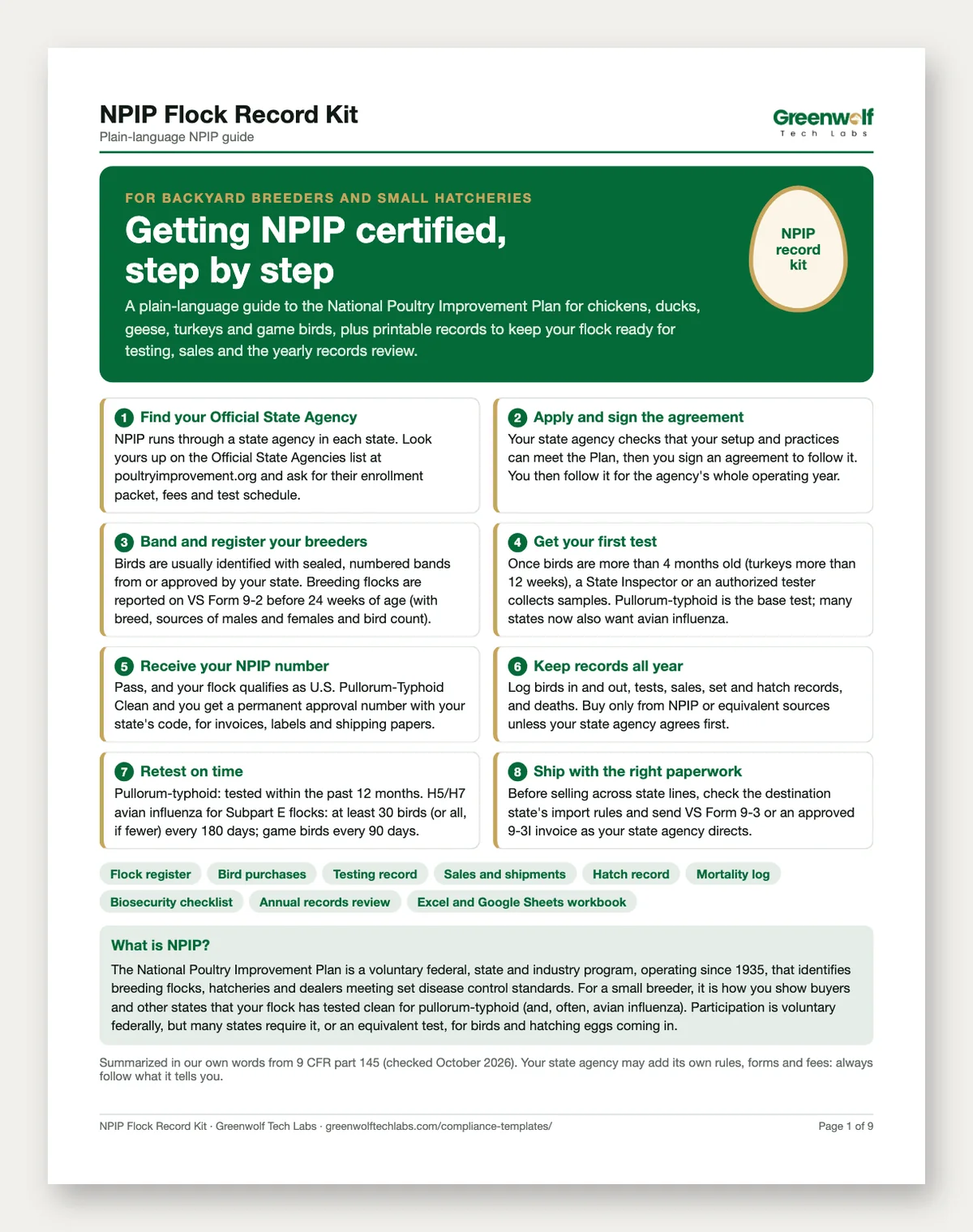
How to get NPIP certified, step by step
- Find your Official State Agency. NPIP lists every state's contact on its Official State Agencies list. Ask for the enrollment form, fees, test schedule, band supplier and whether you need avian influenza testing as well as pullorum-typhoid.
- Apply and sign the participation agreement. The agency checks that your facilities, people and practices can meet the Plan, and you agree to follow it for the agency's operating year (9 CFR 145.3(b),(c)). Some states, such as South Carolina, also inspect the premises.
- Separate and clean up. The participating flock and its equipment are kept apart from any nonparticipating birds, and houses and equipment are kept sanitary (145.5(a)). Other domestic fowl on the farm, except waterfowl, are tested to the same standard or kept separate (145.14(a)(8)).
- Band and report your breeders. Each bird is identified with a sealed, numbered band obtained through or approved by your state, unless it makes an exception (145.5(d)). Breeding flocks are reported on VS Form 9-2 before the birds reach 24 weeks of age, with breed, sources of males and females, numbers and the classification you want (145.3(d)).
- Get your birds tested. Birds must be more than 4 months old (turkeys more than 12 weeks). An Authorized Agent, Authorized Testing Agent or State Inspector collects the samples: at least one bird from each pen and at least 30 per house, or every bird in a house of fewer than 30 (145.14).
- Receive your NPIP number. Once the flock qualifies as U.S. Pullorum-Typhoid Clean it is a participating flock (145.5(c)), and you get a permanent approval number prefaced by your state's code, which you can print on invoices, certificates and shipping labels (145.4(e)).
- Keep records and retest on time. Buy only from NPIP or equivalent sources unless your state agrees first (145.4(d)), log every purchase, sale, test and hatch, and retest before your classification lapses.
Worked example (sample scenario). A breeder has 48 banded chickens over 4 months old in two houses: House A has 30 birds in three pens and House B has 18 birds in one pen. House A needs at least 30 birds sampled with every pen represented, so all 30 are tested. House B has fewer than 30, so all 18 are tested. The tester runs the pullorum-typhoid test on 14 March 2026 and every bird is negative. The flock stays Pullorum-Typhoid Clean if it is retested within 12 months, so the next test is due by 14 March 2027. If the breeder also holds U.S. H5/H7 Avian Influenza Clean under Subpart E and swabbed 30 birds on 14 March 2026, the next 30 negative birds are needed within 180 days, by 10 September 2026. The kit's testing log does this date arithmetic for you and flags it as due 30 days before the deadline.
05
NPIP testing explained: pullorum-typhoid and avian influenza
Pullorum-typhoid is the test every participating flock needs. Pullorum disease and fowl typhoid are caused by Salmonella Pullorum and Salmonella Gallinarum, and controlling pullorum is what NPIP was founded for. The usual on-farm screen is the stained antigen rapid whole-blood test, which a trained tester runs on a drop of blood at your farm. That test can be run by an Authorized Testing Agent or State Inspector; other samples go to an authorized laboratory (145.14). Official pullorum-typhoid tests are at least 21 days apart, results go to the state agency within 10 days, and no drug that could mask a result may be given in the 3 weeks before the test (145.14(a)).
Avian influenza testing gives the U.S. H5/H7 Avian Influenza Clean classification. Samples are usually swabs tested by PCR at an authorized lab (South Carolina, for example, uses throat swabs); waterfowl may use 30 cloacal swabs (145.53(e)). Only USDA's National Veterinary Services Laboratories can officially call a flock H5/H7 positive (145.14(d)). Some states make AI Clean part of their backyard program: North Carolina has required both Pullorum-Typhoid Clean and Avian Influenza Clean for its Subpart E program since 1 November 2025 (NCDA&CS).
Who does the testing? Your state agency designates the people who may collect samples: State Inspectors, Authorized Agents (often veterinarians) and Authorized Testing Agents, who are trained testers, sometimes breeders themselves, who passed the state's tester course (145.11(a)). South Carolina, for example, requires private testers to complete an NPIP testers course. Some states also test for Mycoplasma gallisepticum, M. synoviae and, for turkeys, M. meleagridis (Montana Department of Livestock).
What if a bird reacts? A reactor on the plate test is not a diagnosis. States follow it up with lab testing and, if needed, culture of the reactor bird; South Carolina, for example, puts the premises on a hold order until the follow-up result is known (Clemson Livestock Poultry Health). A flock can still qualify as Pullorum-Typhoid Clean if bacteriology shows the reactors are not infected (145.53(b)).
06
NPIP classifications for small flocks
| Classification | To qualify and keep it | Rule |
|---|---|---|
| U.S. Pullorum-Typhoid Clean (Subpart E, I or J) | Officially blood tested within the past 12 months with no reactors, or reactors shown by bacteriology not to be infected. This is the base classification: a flock only counts as participating once it has it. | 9 CFR 145.53(b), 145.93(b), 145.103(b), 145.5(c) |
| U.S. H5/H7 Avian Influenza Clean (hobbyist and exhibition, Subpart E) | At least 30 birds over 4 months old tested negative, then at least 30 negative every 180 days (smaller batches allowed if every pen is represented and 30 are reached within each 180 days) | 145.53(e) |
| U.S. H5/H7 Avian Influenza Clean (game birds, Subpart J) | 30 birds tested negative, then every 90 days | 145.103(c) |
| U.S. H5/H7 Avian Influenza Clean (meat-type waterfowl, Subpart I) | Primary breeding flocks every 90 days; multiplier flocks every 180 days | 145.93(c) |
Birds going to public exhibitions in a clean state, other than waterfowl, come from Pullorum-Typhoid Clean or equivalent flocks or have a negative pullorum-typhoid test within 90 days (145.53(b)(3)(vii)).
07
How much does NPIP certification cost?
There is no federal NPIP fee in 9 CFR part 145. Each state sets its own, and some charge nothing for enrollment. Published examples, checked 25 October 2026:
| State | What the state publishes | Source |
|---|---|---|
| North Carolina | One-time $50 registration fee and $10 annual renewal for the backyard program, plus testing | NCDA&CS NPIP page |
| Montana | No fee for certification; the state supplies test materials and pays for avian influenza tests at its lab. Your veterinarian or Authorized Testing Agent may charge for their time. | Montana Department of Livestock |
| South Carolina | Avian influenza PCR test $35 per test, each covering up to 11 birds, with at least 2 tests every 6 months for AI Clean | Clemson Livestock Poultry Health |
Budget as well for leg bands, the tester's call-out or time, and lab fees for any extra classifications. Ask your own state agency for its current price list before you book a test.
08
Keeping NPIP status and the records to keep
Certification is not a one-time event. To stay in good standing you retest on schedule, keep your premises and equipment sanitary, buy only from NPIP or equivalent sources (or quarantine and test new birds at maturity with your state's permission, 145.4(d)), and keep records open to the state agency at any time (145.4(a),(b)). Noncompliance can lead to removal from the Plan after notice and time to fix it (145.13).
For flocks kept mainly for hatching eggs, a State Inspector reviews records every year: VS Form 9-2, VS Form 9-3 (sales of hatching eggs, chicks and poults), set and hatch records, egg receipts, and orders or invoices, all kept for 3 years (145.12(b)). Hatcheries also clean and disinfect hatchers after each hatch and the egg room at least twice a week (145.6(a)).
| Requirement | What it means for you | How the kit helps |
|---|---|---|
| Banded, identified birds (145.5(d)) | Every breeder has a band number you can trace | Flock register by pen and breed with band IDs and test eligibility by age |
| Retest on time (145.53) | PT within 12 months; AI every 180 or 90 days | Testing log with next-due dates and Overdue flags |
| NPIP sources only (145.4(d)) | Know the NPIP number of every seller | Purchases log that flags non-NPIP sources and quarantine dates |
| Sales records (145.4, 145.52(d)) | Every sale and shipment on record, interstate ones on 9-3 or 9-3I | Sales log that flags interstate shipments without paperwork |
| Annual records review (145.12(b)) | 3 years of forms, test charts and hatch records ready | Annual summary and printable records review checklist |
NPIP's 14 biosecurity principles (Program Standard E) are formally audited for larger operations, but the same habits, such as a line of separation, wild bird and rodent control, daily mortality collection, clean equipment and safe sourcing of new birds, protect any flock.
09
Selling and shipping NPIP birds across state lines
- Check the destination state first. Each state sets its own import rules. Call the destination state's animal health office or check its NPIP and import page; NPIP itself directs people to the Official State Agency for import requirements (poultryimprovement.org).
- Confirm which classifications they want. Most want Pullorum-Typhoid Clean; some also want Avian Influenza Clean. South Carolina, for example, tells its breeders that shipping or showing in several states, including North Carolina, Georgia, Florida, Virginia, Texas and Pennsylvania, needs AI Clean status (Clemson).
- Send the right paperwork. Sales into other states can be reported on VS Form 9-3 or an approved 9-3I invoice showing your NPIP approval number, the NPIP design with your classification, the buyer, quantity and date (145.52(d)). Some states ask for a certificate of veterinary inspection instead or as well.
- Band and label. Use your NPIP number on invoices and shipping labels (145.4(e)), and keep a copy of everything you send for your 3-year file.
Remember that NPIP status belongs to the flock, not the bird: a buyer's flock is only NPIP if the buyer is enrolled too.
10
Common NPIP mistakes
11
What is inside
Flock register and purchases
Every banded bird by pen, species and breed with age and test eligibility, plus a purchases log that records the seller's NPIP number, paperwork and time kept apart.
Testing with next-due reminders
Test date, type, method, who collected the samples and their role, birds tested and result. Next due and status come from retest intervals you can set to your state's schedule.
Sales, hatches and mortality
Sales and shipments with buyer state and interstate flags, hatch records with fertility and hatch rates and an after-hatch cleaning check, and a mortality log with your own alert trigger.
Biosecurity self-audit and annual summary
29 questions based on the 14 NPIP biosecurity principles with a % score, and a one-page annual summary for your records review.
Printable guide and record pages
A 9-page PDF: a plain-language guide to getting certified, NPIP basics, flock register, purchases and mortality, testing, sales, hatch record, biosecurity checklist and annual review.
12
How to use it
Set it up
Enter your farm, home state, state agency and NPIP number, and set retest intervals to match your state.
Log as you go
Add birds as they arrive or hatch, tests as they happen, and every sale or shipment the day it goes out.
Watch the flags
Overdue tests, non-NPIP purchases and interstate sales without paperwork are highlighted for you.
Review once a year
Run the biosecurity self-audit and print the annual summary before your State Inspector's records review.
13
More compliance record kits
Browse every kit on the compliance templates and record kits page. Related tools for small operators include the guardianship accounting workbook for family guardians, the NSPIRE inspection checklist for landlords and the fire door inspection checklist and register.
14
NPIP certification questions
How do I get NPIP certified?
What are the NPIP certification requirements?
Is NPIP certification required to sell chickens?
How much does NPIP certification cost?
How often is NPIP testing done?
How old do birds have to be for NPIP testing?
Who can do NPIP testing?
What records does NPIP require, and for how long?
Does this kit make my flock NPIP certified?
15
Important
This page and the kit summarize federal NPIP rules in plain words to help you prepare. They are not legal or veterinary advice. NPIP provisions and state requirements change and differ by state, so confirm what applies to you with your Official State Agency and your veterinarian. Greenwolf Tech Labs is not affiliated with or endorsed by USDA, APHIS, the National Poultry Improvement Plan or any state agency.
Part of our Compliance Templates hub. Start with our compliance templates.
Compliance Templates
More on compliance templates
PAT Testing Register: Record Sheet, Log and Intervals (UK)
Free PAT user check form (PDF) and a PAT testing register: appliance list, test log, next-due dates from HSE intervals, failed items. UK, A4.
Controlled Substance Log and Narcotic Count Sheet
Controlled substance log and free narcotic count sheet (PDF): running balance, witnessed waste and a DEA biennial inventory sheet under 21 CFR 1304.
Fire Door Inspection Checklist, Regulations and Register (UK)
Free fire door inspection checklist (PDF) and UK fire door regulations explained: who checks, 3-monthly and 12-monthly checks, gaps, seals and records.
First Aid Kit Checklist: Workplace Contents List and Monthly Inspection
Free first aid kit checklist (PDF) with workplace contents lists for the US (ANSI Class A and B), UK and Australia, plus a monthly inspection log.
Food Cost Calculator and Recipe Costing Template (Excel)
Food cost calculator and recipe costing template for Excel and Google Sheets: yield, plate cost, food cost % formula, menu pricing and menu engineering.
Tell us where the week goes
A senior consultant will map where the time goes, name what is worth automating and what it takes. No obligation after it.