

Templates and trackers
Guardianship Accounting and Annual Report Workbook
Guardianship accounting explained: what the annual accounting and guardian annual report need, state deadlines, a worked example that balances and a free form.
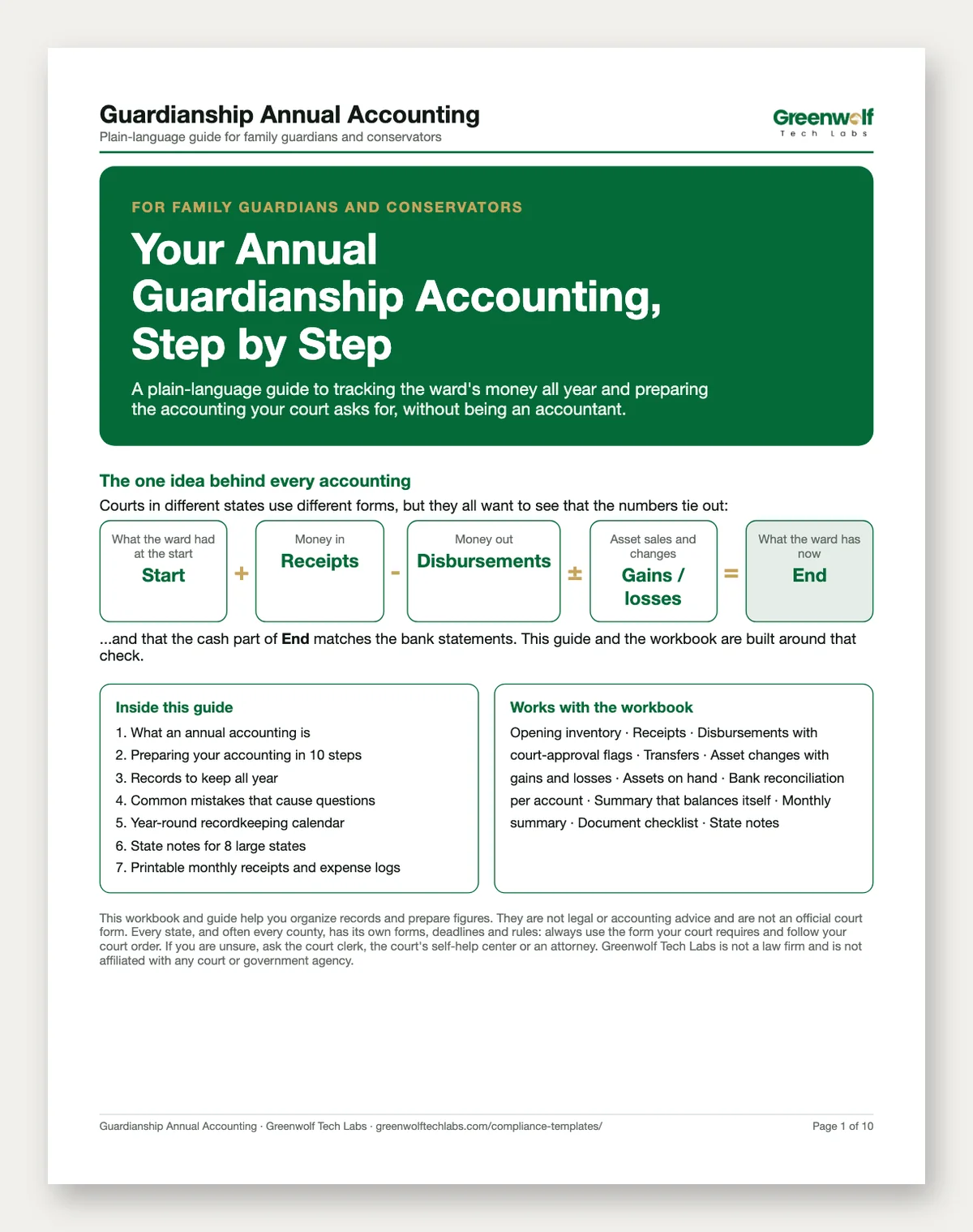
For family members serving as guardians or conservators
Guardianship and Conservatorship Annual Accounting Workbook
$49USD · one-time purchase · instant download
Keep the ward's money records straight all year, then let the workbook balance your annual accounting and check every account against its bank statement before you fill in your court's form.
- Opening inventory, receipts and disbursements logs with category dropdowns
- Court-approval flags for guardian fees, attorney fees and any payment you mark
- Asset changes that work out gains and losses on sales for you
- Summary that balances start + receipts - disbursements +/- gains and losses against what is on hand, with 9 checks
- Bank reconciliation per account, monthly summary, document checklist and state notes for 8 large states
- 10-page plain-language guide with printable monthly receipts, expense and account-check pages
You get: Excel workbook · Google Sheets-ready · 10-page printable PDF guide
Secure checkout by Razorpay. Cards accepted worldwide, charged in US dollars. Files arrive on screen and by email. Refund policy
02
What is guardianship accounting?
Guardianship accounting is the report a court-appointed guardian or conservator of the estate files, usually yearly, showing what the ward owned at the start, every dollar received, every dollar spent, any gains or losses on assets, and what is on hand at the end, backed by bank statements and receipts.
The structure is nearly the same in every state, even though the forms differ. California's mandatory Summary of Account (GC-400(SUM)) adds the property on hand at the start, receipts, gains on sales and other property received, and balances them against disbursements, losses, distributions and the property on hand at the end. Texas says the annual account must let the court see the true condition of the estate by adding receipts to the balances carried forward and subtracting disbursements (Estates Code 1163.002). Conservatorship accounting works the same way; only the title changes from state to state (guardian of the estate, guardian of the property, conservator).
Most courts also want proof. Florida requires a copy of the year-end statement for each of the ward's cash accounts and requires the guardian to keep a receipt, canceled check or other proof of payment for every expenditure (Fla. Stat. 744.3678). Texas asks for a voucher for each payment and an official statement from each bank covering the last day of the period (Estates Code 1163.003).
Last reviewed: 25 October 2026. State rules below were checked against official statutes and court pages; your court order and local rules come first.
03
Free printable guardianship expense log (PDF)
Download the free monthly guardianship expense log (PDF), one page from the kit's guide. It has spaces for the ward, case number and month, and columns for date, account, paid to, category, what it was for, amount, check number, receipt on file and court approval, with a page total. Print one per month and file the receipts behind it, and your disbursements schedule is mostly done by year end.
The full workbook adds the Excel and Google Sheets file that balances the whole accounting with 9 checks, the receipts log, asset changes with gains and losses worked out, a bank reconciliation for each account, the monthly account check page and state notes.
04
Annual accounting vs guardian annual report: what is the difference?
Many guardians are asked for two different documents, and mixing them up is a common reason a filing is returned. The annual accounting is about money. The guardian annual report (sometimes called a personal status report, guardianship plan or report on the ward) is about the person: where they live, their health and their care.
| Annual accounting | Guardian annual report | |
|---|---|---|
| Who files it | Guardian of the estate or property, or conservator | Guardian of the person |
| What it covers | Starting property, receipts, disbursements, gains and losses, property on hand at the end | Residence, medical and mental health, social needs and services, plans for the coming year |
| Proof | Bank statements, receipts or vouchers, as the court requires | Often a recent physician's report |
| South Dakota example | UJS-141 Conservator's Annual Accounting | UJS-142 Guardian's Annual Report (UJS) |
| Florida example | Annual accounting by April 1 for the prior calendar year (744.367(2)) | Annual guardianship plan within 90 days after the anniversary month (744.367(1), 744.3675) |
If you are guardian of both the person and the estate, you usually file both. In New York, an Article 81 guardian's single annual report includes the account information when the guardian manages property (Mental Hygiene Law 81.31). Florida's annual plan for an adult ward includes a report from a physician or qualifying nurse practitioner who examined the ward within 90 days before the reporting period. This workbook covers the accounting; use your court's form for the personal report.
05
State deadlines for guardianship accounting
Your court order controls, and many courts set their own dates. These come from state law and official court pages, checked October 2026:
| State | When the accounting is due | Source |
|---|---|---|
| California | One year after appointment, then at least every two years unless the court orders more often | Probate Code 2620 |
| Florida | On or before April 1 for the prior calendar year, or by the first day of the fourth month after a court-set fiscal year ends | Fla. Stat. 744.367(2) |
| Texas | Within 60 days after the first anniversary of qualifying, then yearly until the estate closes | Estates Code 1163.001, 1163.002 |
| New York | Every year in May for Article 81 guardians, or as the court orders | Mental Hygiene Law 81.31 |
| Pennsylvania | At least once in the first 12 months, then at least yearly | 20 Pa.C.S. 5521(c) |
| Virginia (conservators) | First statement within 6 months of qualifying covering the first 4 months; then each 12-month period within 4 months after it ends, filed with the commissioner of accounts | Va. Code 64.2-1305 |
| Arizona (conservators) | Annually, under rules adopted by the supreme court, and on termination | A.R.S. 14-5419 |
| Minnesota (conservators) | Annually unless the court directs otherwise, with a copy to the person and interested persons | Minn. Stat. 524.5-420 |
| South Dakota | Within 60 days after the first anniversary of appointment, then annually | South Dakota UJS |
Other states have their own rules, and many counties add local forms. Ask the clerk or the court's self-help center which guardianship annual report form and accounting form to use and how the deadline is counted.
06
How to do a guardianship accounting in 6 steps
- Find your form and period. Read your order of appointment and get your court's guardian accounting form. The period usually starts the day after the last approved accounting ended, or on your appointment date for the first one.
- Write down the starting figures. Use your inventory or the ending figures from the last accounting the court approved. They must match exactly.
- Log money in and money out. Go through every statement for every account. Record each deposit as a receipt and each payment as a disbursement, with a receipt behind it. Transfers between the ward's own accounts are neither.
- Record asset changes separately. When something is sold, it leaves the asset list at its carried value, cash goes up by the sale price, and the difference is a gain or loss. Property received, such as an inheritance, is added at its value.
- Reconcile each account. Your ending balance for each account, after allowing for uncleared checks and deposits, should equal the bank statement.
- Balance and copy to the form. Start plus receipts minus disbursements plus gains minus losses plus property received should equal what is on hand at the end. Then copy the totals onto your court's form, sign it as required and attach what the court asks for.
07
Worked example: an accounting that balances
This is the sample case from the workbook (a made-up ward, labelled as a sample):
| Line | Amount |
|---|---|
| Property on hand at start: cash $30,750.00 plus house, car and furniture $192,700.00 | $223,450.00 |
| + Receipts (Social Security, pension, interest, tax refund) | $6,545.60 |
| - Disbursements (care, medicine, utilities, insurance, guardian fee, bond) | $9,833.15 |
| + Gain on sale of car (sold for $7,200.00, carried at $6,500.00) | $700.00 |
| + Property received (inherited ring) | $900.00 |
| = Property on hand at end | $221,762.45 |
Check 1, the totals: 223,450.00 + 6,545.60 - 9,833.15 + 700.00 + 900.00 = 221,762.45.
Check 2, the cash: 30,750.00 + 6,545.60 - 9,833.15 + 7,200.00 (car sale price) = $34,662.45, which must match the bank statements at period end.
Check 3, the other assets: 192,700.00 - 6,500.00 (car at carried value) + 900.00 (ring) = $187,100.00. Cash $34,662.45 plus other assets $187,100.00 = $221,762.45, the same as Check 1.
Notice that the car sale is not a receipt. Counting the full $7,200.00 as income would overstate the ward's receipts and the accounting would not tie out. The workbook's Summary tab runs these checks for you and says OK or what is wrong.
08
Documents to attach or keep
| Document | Why the court wants it | Example rule |
|---|---|---|
| Statement for each account covering the last day of the period | Proves the ending cash | Fla. Stat. 744.3678(2); Texas Estates Code 1163.003 |
| Receipts, invoices or canceled checks for each payment | Proves each disbursement was for the ward | Florida: keep proof of every expenditure (744.3678(3)); Texas: voucher for each item (1163.003) |
| Inventory or last approved accounting | Proves the starting figures | California GC-400(SUM) starts from property on hand at the beginning; Texas carries balances forward (1163.002) |
| Court orders approving fees, sales or a budget | Shows payments that needed approval had it | Your order of appointment |
| Closing statements, bills of sale, appraisals | Supports gains, losses and asset values | Good practice; many courts ask for them with a sale |
| Benefit letters (Social Security, pension, VA) | Shows what the ward should have received | Good practice |
Some courts want these attached; others want them kept and available on request. Florida says the receipts need not be filed but must be kept and produced if the court asks.
09
Common court objections to guardianship accountings
10
Why a workbook helps family guardians
Most family guardians are not accountants, and the hard part is rarely the court form. It is a year of statements, receipts and one-off events (a car sold, a transfer from savings, a fee the court approved) that have to add up at the end. This workbook keeps each kind of entry in its own place so nothing is counted twice: a transfer between the ward's accounts is not income, and the price of an asset sold is not a receipt. It then reconciles each account to its statement and tells you in plain words what still needs attention, such as a payment with no receipt or a fee waiting for court approval.
11
What is inside
Setup and Opening Inventory
Ward, guardian, court, case number and accounting period, then every account and asset with its value on the first day.
Receipts and Disbursements
Dated logs with account and category dropdowns, principal or income, receipt-on-file and court-approval columns, and a check column that flags problems as you type.
Asset Changes and Assets on Hand
Sales, purchases, property received or given away. Gains and losses are calculated, and the ending list of assets updates itself.
Bank Reconciliation and Summary
Each account's balance in your records against its statement, then a summary that balances and runs 9 checks before you file.
Monthly Summary
Twelve months of receipts, disbursements, cash on hand and spending by category, so problems show up early.
Guide, checklist and state notes
A 10-page plain-language PDF, a document checklist and official links for 8 large states, plus printable monthly logs.
12
How to use it
Set up
Enter the case details and the period, then the starting balance of each account and the value of each other asset.
Log each month
From each statement, record money in and money out, and file the receipts. Transfers and asset sales go on their own tabs.
Reconcile
At period end, type each statement's ending balance and any uncleared checks. Every account should say Reconciled.
Copy to your court's form
When every check on the Summary says OK, copy the totals onto the form your court requires and attach what it asks for.
13
Related record kits
See every kit on the compliance templates and record kits page, including the NPIP flock record kit for poultry breeders and the NSPIRE inspection checklist for landlords.
14
Guardianship accounting questions
What goes in a guardianship annual accounting?
Is this an official court form?
When is the guardian annual report due?
What is the difference between a guardian annual report and an annual accounting?
Where do I get the guardianship annual report form?
Do I list the sale of the ward's car or house as a receipt?
Can I pay myself a guardian fee from the ward's money?
Does it work in Google Sheets?
Does it work for a conservatorship or a minor's guardianship?
15
Important
This workbook and guide help you organize records and prepare figures. They are not legal or accounting advice and are not an official court form. Every state, and often every county, has its own forms, deadlines and rules, and your court order comes first. State information was checked against official sources on 10/24/2026 and can change. If you are unsure, ask the court clerk, the court's self-help center or an attorney. Greenwolf Tech Labs is not a law firm and is not affiliated with any court or government agency.
Part of our Compliance Templates hub. Start with our compliance templates.
Compliance Templates
More on compliance templates
Fridge Temperature Log: Printable Sheets and Workbook
Free printable fridge temperature log (PDF) plus a freezer and food temperature log workbook in °F or °C. FDA 41 °F and FSA 8 °C rules explained.
Vaccine Temperature Log: Printable Sheets and Workbook
Free vaccine temperature log (PDF) and a vaccine fridge log workbook: daily min/max checks, excursion flags and data logger calibration, per the CDC toolkit.
Controlled Substance Log and Narcotic Count Sheet
Controlled substance log and free narcotic count sheet (PDF): running balance, witnessed waste and a DEA biennial inventory sheet under 21 CFR 1304.
Fire Door Inspection Checklist, Regulations and Register (UK)
Free fire door inspection checklist (PDF) and UK fire door regulations explained: who checks, 3-monthly and 12-monthly checks, gaps, seals and records.
First Aid Kit Checklist: Workplace Contents List and Monthly Inspection
Free first aid kit checklist (PDF) with workplace contents lists for the US (ANSI Class A and B), UK and Australia, plus a monthly inspection log.
Tell us where the week goes
A senior consultant will map where the time goes, name what is worth automating and what it takes. No obligation after it.