

Templates and trackers
Fridge Temperature Log: Printable Sheets and Workbook
Free printable fridge temperature log (PDF) plus a freezer and food temperature log workbook in °F or °C. FDA 41 °F and FSA 8 °C rules explained.
For restaurants, cafes, caterers, schools and care kitchens
Fridge and Freezer Temperature Log
$12USD · one-time purchase · instant download
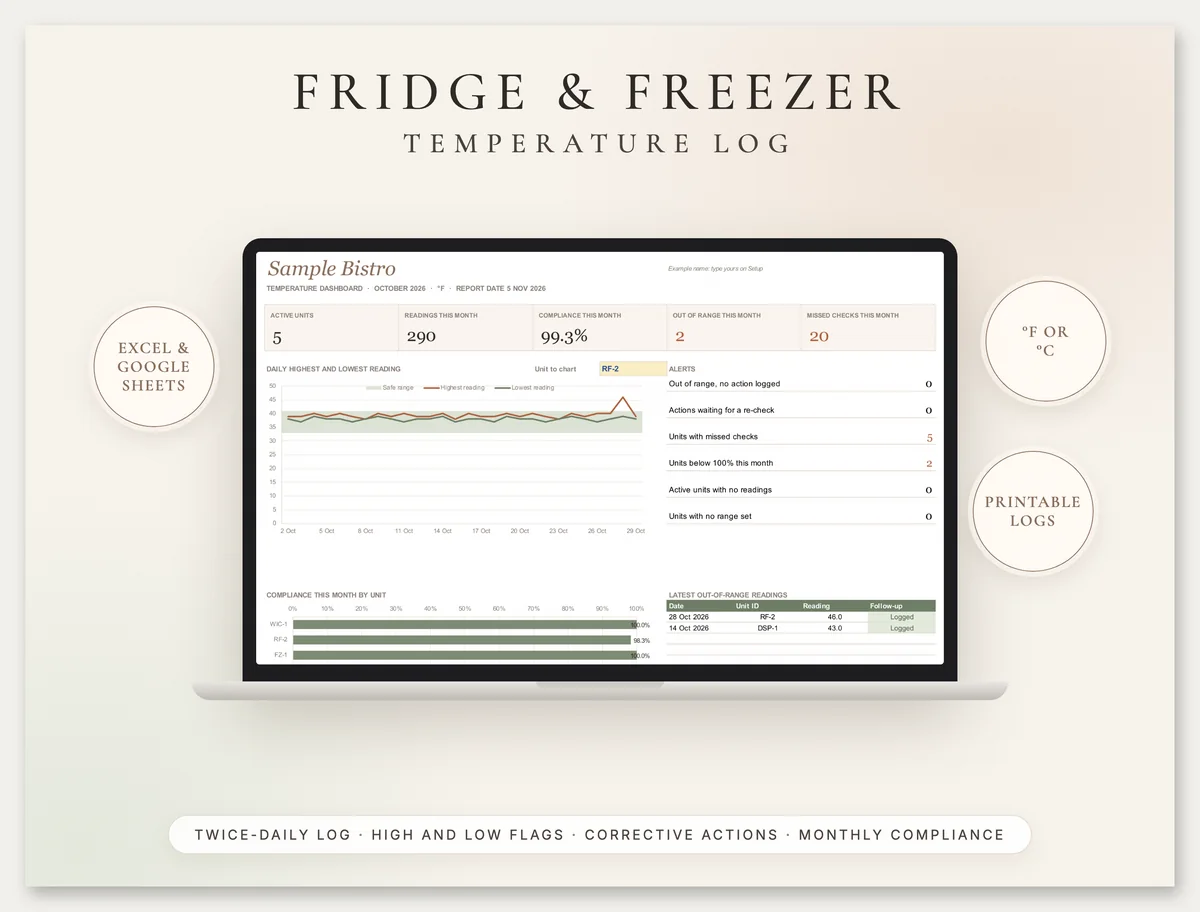
List every fridge, freezer and walk-in once, log AM and PM readings, and let the workbook flag every high or low reading, count missed checks and work out each unit's compliance for the month.
- One switch for Fahrenheit or Celsius, with default limits of 41 °F (5 °C) for fridges and 0 °F (-18 °C) for freezers, editable per unit
- Twice-daily log for up to 60 units that flags HIGH or LOW against each unit's own range
- Corrective action log with cause, action, what happened to the food and a re-check that confirms the unit is back in range
- Monthly compliance % and missed checks per unit, plus a 12-month view by unit
- Dashboard with the latest reading for every unit and the latest out-of-range readings
- Printable monthly AM and PM log sheets in °F on US Letter and °C on A4, a weekly multi-unit sheet and a corrective action record
You get: Excel workbook · Google Sheets-ready · 5-page printable PDF in °F (US Letter) · 5-page printable PDF in °C (A4)
Secure checkout by Razorpay. Cards accepted worldwide, charged in US dollars. Files arrive on screen and by email. Refund policy
02
What is a fridge temperature log?
A fridge temperature log is a dated record of the temperature inside each refrigerator, freezer or walk-in, read at set times every day, with the initials of the person who checked and what was done whenever a reading was outside the safe range. It is the evidence that cold food was kept cold.
Food businesses keep one because cold holding is one of the main controls in any food safety plan. In the US, the FDA Food Code 2026 says time/temperature control for safety (TCS) food must be held at 41 °F (5 °C) or less. In England, Wales and Northern Ireland, chilled food must by law be kept at 8 °C or below, and the Food Standards Agency recommends setting fridges at 5 °C or below and checking them at least once a day. A log turns those numbers into a daily habit an inspector can see.
This page covers the temperatures in both countries, how to take a reading that means something, what to do when a fridge runs warm, and a worked month of readings. Every rule links to the FDA or FSA source.
Last reviewed: 30 October 2026.
03
Free printable fridge temperature log (PDF)
Download one page from the kit for free: the monthly fridge temperature log sheet in °F (PDF, 1 page, US Letter). It has a row for every day of the month with AM and PM columns for time, temperature and initials, an out-of-range tick box, an action column and a manager sign-off. Print one per fridge per month and pin it to the door.
The full kit adds the same sheet in °C on A4, a monthly freezer log, a weekly sheet for up to 8 units, a corrective action record, and the Excel and Google Sheets workbook that flags out-of-range readings, counts missed checks and works out each unit's compliance for the month.
04
Safe fridge and freezer temperatures (US and UK)
Keep fridges at 41 °F (5 °C) or below in the US and set them at 5 °C or below in the UK, where 8 °C is the legal maximum for chilled food. Keep freezers at 0 °F (-18 °C) or below.
| Unit | US (FDA) | UK (FSA) | Source |
|---|---|---|---|
| Fridge, walk-in cooler, prep fridge | TCS food held at 41 °F (5 °C) or less | Set at 5 °C or below so food stays at 8 °C or below | Food Code 2026, 3-501.16(A)(2); Safer food, better business |
| Chilled display | 41 °F (5 °C) or less | 8 °C or below is a legal requirement in England, Wales and Northern Ireland; recommended in Scotland | GOV.UK chilling and freezing |
| Freezer | 0 °F (-18 °C) | -18 °C or below | FDA: Are You Storing Food Safely?; Safer food, better business |
| Raw shell eggs (not pasteurized) | Refrigerated equipment with ambient air at 45 °F (7 °C) or less | Follow the supplier's storage instructions | Food Code 3-501.16(B) |
The Food Code is a model code: each state, county or city adopts it, sometimes an older edition, sometimes with changes. Your local health department's version is the one inspected against. In the UK, some foods must be kept colder than 8 °C, so the FSA says to follow the manufacturer's storage guidance as well.
05
How often to check fridge temperatures
The FSA says to check fridges and chilled display equipment at least once a day, starting with your opening checks. Most kitchens log twice a day, at opening and closing, so a fault overnight or during service shows up within hours.
The FDA Food Code does not set a fixed number of daily checks for every business. It requires a thermometer in every cold holding unit for TCS food that is easy to read (4-204.112(B)), with its sensor placed to read the warmest part of the unit (4-204.112(A)), accurate to plus or minus 1.5 °C or 3 °F (4-203.12). How often you check is set by your HACCP plan, your active managerial control procedures or your local code. Twice a day is the routine this kit is built around; change the setting to 3 or 4 if your plan asks for more.
Walk-ins and prep fridges on the cook line are opened hundreds of times a shift and drift most. A reach-in used only for drinks can be checked less, but write down why in your plan.
06
How to take a fridge temperature reading
Use a thermometer you trust
A fridge thermometer or a calibrated probe. The FSA says to check now and then that the unit's own display or dial is accurate against one.
Read the warmest spot
The Food Code wants the sensor where it measures the warmest part of a fridge. That is usually the top front, near the door, not the back wall.
Read at the same times
Opening and closing, before deliveries and service rushes push the temperature up. Write the time, reading and your initials.
Check the food if the air is warm
The FSA suggests probing between packs of chilled food. Air rises fast when the door opens; food warms slowly.
Act and record
Any reading above the limit gets a corrective action with a reference, a cause, what happened to the food and a re-check.
07
What to do when a fridge temperature is too high
Re-check the reading, find the cause, protect the food, decide what happens to the food under your food safety plan, then fix the unit and record all of it. The FSA's Safer food, better business pack says that if a fridge or display breaks down you should use other equipment or move food to a cold area, and if you cannot, or you do not know how long it has been broken, contact the environmental health team at your local council. It also says food that needs refrigeration and has not been kept chilled for more than four hours must be thrown away.
| Likely cause | What it looks like | Usual fix |
|---|---|---|
| Door left open or ajar | One high reading, back in range on re-check | Close it, check the seal and hinge, re-check in 30 to 60 minutes |
| Defrost cycle | High air reading at the same time each day, food still cold | Probe the food, move your check time, note it on the log |
| Overloading or blocked vents | Slow drift up during prep and deliveries | Leave space for air to move, load in batches |
| Warm food put in to cool | Sudden rise after cooking | Cool food by your plan's method before it goes in |
| Failing compressor or seal | Readings climb day by day | Engineer call, move food to another unit |
In the US, the rules for TCS food that has been above 41 °F come from your state or local code and your own procedures, not from a log template. Write the decision down either way.
08
Worked example: one prep fridge, one month
Sample data, for illustration only. A bistro logs three units in °F: a walk-in cooler (WIC-1), a prep fridge on the line (RF-2), a chest freezer (FZ-1), a chilled display (DSP-1) and a walk-in freezer (WIF-1), at 7:30 AM and 4:30 PM, from 1 to 29 October.
- Readings: 5 units x 2 checks x 29 days = 290 readings. The walk-in reads 36 to 39 °F, the chest freezer -3 to 0 °F (0 °F is at the limit, so it counts as OK).
- The flag: on 28 October at 4:30 PM, RF-2 reads 46 °F. The limit is 41 °F, so the Result column shows HIGH and Follow-up shows Log action until a reference is typed in.
- The action: CA-001 records a door left ajar, food probed at 42 °F and moved to the walk-in, and a re-check at 5:15 PM of 39 °F. Back in range shows Yes.
- The month: RF-2 has 58 readings, 57 in range: compliance 57 / 58 = 98.3%. With one more high reading on the display unit (43 °F on 14 October, CA-002), the workbook as a whole has 288 of 290 in range = 99.3%. If today is 30 October and nobody has logged today yet, each unit shows 2 missed checks (30 days x 2 checks = 60 expected, 58 taken).
An inspector looking at this record sees the problem, the time it was found, what happened to the food and proof the unit recovered, which is what a log is for.
09
Common fridge log mistakes
10
What is inside
Units and Setup
Up to 60 units with type, thermometer and logging start date. One switch for °F or °C; default limits by type that you can change.
Temp Log
3,000 rows of readings. Result shows HIGH, LOW or OK against each unit's range, and Follow-up shows any flag without an action.
Corrective Actions and compliance
Cause, action, food and re-check for each problem. Monthly compliance %, missed checks and a 12-month view per unit.
Dashboard and printables
Latest reading per unit and the latest flags, plus printable monthly AM and PM sheets in °F (Letter) and °C (A4).
11
How to use the workbook
Set it up
Choose °F or °C, checks per day and the month to report on. List your units with their type.
Log twice a day
Type readings straight in, or log on the printed sheet and type them in weekly.
Act on flags
Every HIGH or LOW gets a corrective action and its reference in the log.
Review monthly
Print Monthly Compliance and the Dashboard, sign them off and file them with your food safety plan.
12
Related templates
Browse all our compliance templates and record kits. Clinics that store vaccines need tighter ranges and a different response to excursions: see the vaccine temperature log, built on the CDC storage and handling toolkit.
13
Fridge temperature log questions
What temperature should a commercial fridge be?
What temperature should a freezer be on a temperature log?
How often should fridge temperatures be recorded?
Is a fridge temperature log a legal requirement?
What should I do if my fridge is above 41 °F or 8 °C?
How long should I keep temperature logs?
Can I use this in Celsius?
14
Important
This log helps you record and review fridge and freezer temperatures. It is not food safety or legal advice and does not replace your HACCP plan, Safer food, better business pack or the advice of your local health department or environmental health team. Rules differ by state, country and food type: check the current FDA Food Code as adopted where you are, and current FSA guidance. Greenwolf Tech Labs is not affiliated with the FDA, the FSA or any government agency. See our terms and refund policy.
Part of our Compliance Templates hub. Start with our compliance templates.
Compliance Templates
More on compliance templates
Vaccine Temperature Log: Printable Sheets and Workbook
Free vaccine temperature log (PDF) and a vaccine fridge log workbook: daily min/max checks, excursion flags and data logger calibration, per the CDC toolkit.
Controlled Substance Log and Narcotic Count Sheet
Controlled substance log and free narcotic count sheet (PDF): running balance, witnessed waste and a DEA biennial inventory sheet under 21 CFR 1304.
Guardianship Accounting and Annual Report Workbook
Guardianship accounting explained: what the annual accounting and guardian annual report need, state deadlines, a worked example that balances and a free form.
OSHA 300 Log in Excel: 300, 300A and 301 Recordkeeping
OSHA 300 log in Excel with an automatic 300A summary, 301 details and TRIR and DART rates, plus 1904 rules: what to record, 7 days, posting and ITA.
PAT Testing Register: Record Sheet, Log and Intervals (UK)
Free PAT user check form (PDF) and a PAT testing register: appliance list, test log, next-due dates from HSE intervals, failed items. UK, A4.
Tell us where the week goes
A senior consultant will map where the time goes, name what is worth automating and what it takes. No obligation after it.