

Templates and trackers
Forklift Inspection Checklist (OSHA Daily, Free PDF)
Free forklift inspection checklist (PDF) for electric and LPG trucks, plus OSHA 1910.178 rules: daily checks, out of service and 3-year evaluations.
For warehouse, distribution and yard supervisors
Forklift Inspection Checklist Kit
$15USD · one-time purchase · instant download
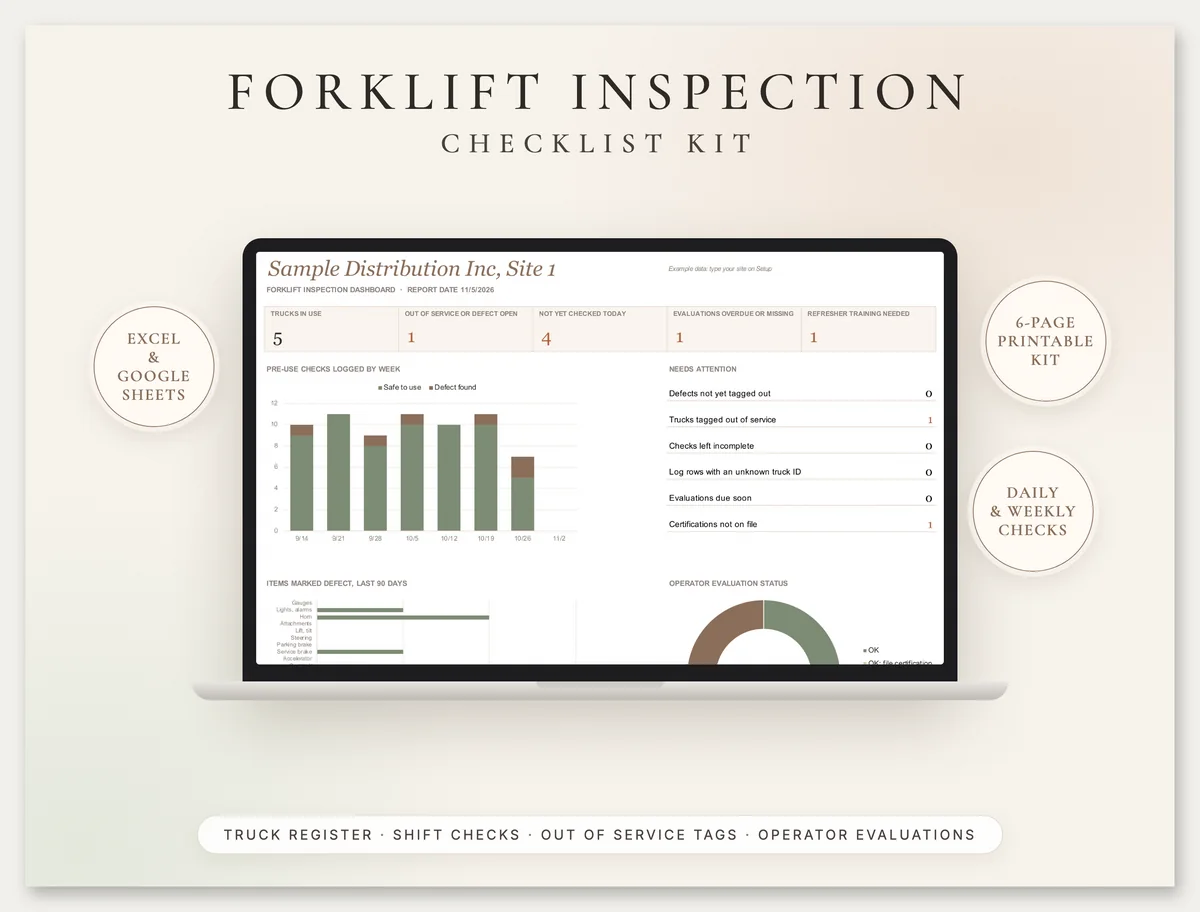
Print the daily checklist for electric or engine-powered trucks, log every pre-use examination in one workbook, and see at the start of each shift which trucks are out of service, which have not been checked today and which operators are due their 3-year evaluation.
- Printable forklift daily checklists for electric trucks and for LPG, diesel and gasoline trucks, key-off and key-on checks
- Weekly checklist grid, do-not-operate tags and a defect report for taking a truck out of service
- Shift checklist log for 3,000 checks: 21 items marked OK, Defect or N/A, with a Safe to use or Defect: do not use result
- Truck register for 200 trucks that shows Checked today, Check before use or Out of service for each one
- Operator tracker with training dates, next evaluation due every 3 years, certification on file and refresher triggers
- Dashboard: trucks out of service, not checked today, evaluations overdue and the items that fail most
You get: Excel workbook · Google Sheets-ready · 6-page printable PDF (US Letter)
Secure checkout by Razorpay. Cards accepted worldwide, charged in US dollars. Files arrive on screen and by email. Refund policy
02
What is a forklift inspection checklist?
A forklift inspection checklist is the list an operator works through before using a forklift or other powered industrial truck: visual checks with the key off (leaks, tires, forks, chains, guards, battery or LP tank, fluids, plates) and operational checks with it running (brakes, steering, controls, horn, lights), each marked OK or needs repair.
OSHA requires the examination itself. Under 29 CFR 1910.178(q)(7), industrial trucks must be examined before being placed in service, at least daily, and after each shift where they are used round the clock, and must not be placed in service if the examination shows any condition adversely affecting safety. OSHA publishes sample daily checklists for electric and internal combustion trucks to help employers do this, and the printable pages in this kit follow the same structure.
This page covers what the standard says about daily checks, removing a truck from service, the 3-year operator evaluation and refresher training, what to check on electric and engine-powered trucks, and how to keep a record that shows it was done.
Last reviewed: 30 October 2026.
03
Free printable forklift daily checklist (PDF)
Download the electric truck page from the kit free: forklift daily inspection checklist (PDF, 1 page, US Letter). It has 17 motor-off visual checks and 13 motor-on operational checks with OK and Needs repair boxes, a record of fluid added (battery water, hydraulic oil, drive and hoist hour meters), a result line and an operator signature.
The full kit adds the LPG, diesel and gasoline truck checklist, a weekly checklist grid, cut-out do-not-operate tags, a defect report, an operator training and evaluation record, and the Excel and Google Sheets workbook that tracks every check, defect and evaluation date.
04
OSHA forklift inspection requirements: 29 CFR 1910.178
The OSHA powered industrial truck standard for general industry sets three duties that a forklift checklist supports: examine before use, take unsafe trucks out of service, and keep operators trained and evaluated.
| Paragraph | What it requires |
|---|---|
| 1910.178(q)(7) | Examine trucks before placing them in service. Do not place a truck in service if the examination shows any condition adversely affecting safety. At least daily; after each shift where trucks are used round the clock. Report defects immediately and have them corrected. |
| 1910.178(p)(1) | A truck found at any time to need repair, to be defective or in any way unsafe is taken out of service until restored to safe operating condition. |
| 1910.178(q)(1) | Any truck not in safe operating condition is removed from service. All repairs are made by authorized personnel. |
| 1910.178(p)(2) to (p)(5) | Do not fill fuel tanks with the engine running; clean up spills; do not operate with a fuel system leak; no open flames when checking battery electrolyte or fuel level. |
| 1910.178(q)(8), (q)(9) | Remove a truck from service if the exhaust emits hazardous sparks or flames, or a part overheats, until the cause is eliminated. |
| 1910.178(a)(4) to (a)(6) | No modifications affecting capacity or safe operation without the manufacturer's prior written approval; mark non-factory attachments; keep nameplates and markings in place and legible. |
The standard does not say the daily examination must be written down. A dated, signed checklist is still the simplest way to show that it happened, which truck it covered and what was found. 1910.178 applies to general industry; construction and other sectors have their own standards, so check which applies to your site.
05
Forklift daily checklist: electric vs LPG, diesel and gasoline trucks
The checks are the same idea for every truck, but the power source changes several items. OSHA's sample operator daily checklists split them into key-off visual checks and key-on operational checks.
| Check | Electric truck | LPG, diesel or gasoline truck |
|---|---|---|
| Leaks | Hydraulic oil, battery | Fuel, hydraulic oil, engine oil, radiator coolant |
| Power source | Battery water or electrolyte level and charge, cables and connector, cell caps, battery restraint | LP tank: rust, corrosion, damage, locator pin and bracket; LP hose not frayed or kinked; diesel fuel sedimentor |
| Fluids | Hydraulic, transmission (if equipped), brake | Engine oil, transmission, hydraulic, brake, radiator coolant (engine cold) |
| Engine items | None | Belts, air cleaner or restriction indicator, hood latch |
| Structure (both) | Tires, forks with top clip retaining pin and heel, load backrest, hoses, mast chains, cables and stops, overhead guard, finger guards, safety warnings, capacity or nameplate matching the truck and attachments, operator's manual, seat belt | |
| Operational | Accelerator, brakes, parking brake, steering, drive, tilt, hoist and lowering, attachments, horn, lights and alarms, hour meter, battery discharge indicator | Accelerator or direction pedal, brakes, parking brake, steering, drive, tilt, hoist and lowering, attachments, horn and lights, cab heater, defroster and wipers, gauges (oil pressure, temperature, fuel, hour meter, ammeter) |
OSHA notes on its checklists that unusual noises must be investigated immediately, that a qualified mechanic should correct all problems, and that the lists are a guide only and should be adapted to each truck type and the manufacturer's instructions. Its generic checklist adds practical tells: a brake pedal that sinks to the floor, a parking brake that lets the truck move, and a propane odor (close the tank valve and report it).
06
How to do a forklift pre-use inspection in 6 steps
Walk round with the key off
Look under and around the truck for leaks. Check tires, forks, the top clip retaining pin and heel, load backrest, mast chains, hoses, cables and stops, overhead guard and finger guards.
Plates, warnings and manual
The capacity or nameplate must be legible and match the model, serial number and any attachment. Safety decals in place; operator's manual in its holder.
Power source and fluids
Electric: battery charge, electrolyte, cables, connector and restraint. LPG: tank, bracket, locator pin and hose. Diesel or gasoline: engine oil, coolant (cold), belts. Then hydraulic and brake fluid.
Seat belt and controls, key on
Fasten the seat belt or restraint. Test the horn, lights and alarms, gauges or battery indicator and hour meter.
Operational checks
In a clear area: accelerator and direction control, service brake (firm pedal), parking brake holds, steering free play, then lift, lower, tilt and any attachment, listening for unusual noises.
Result and record
All OK: sign and use the truck. Anything needs repair: do not use it. Tag it out of service, remove the key, tell your supervisor and log the defect.
07
Operator training and the 3-year forklift evaluation
Under 29 CFR 1910.178(l)(4)(iii), an evaluation of each powered industrial truck operator's performance must be conducted at least once every three years. Training and an evaluation are also required before anyone operates a truck, except under supervision for training.
| Requirement | Detail | Paragraph |
|---|---|---|
| Initial training | Formal instruction, practical training and an evaluation of performance in the workplace, by someone with the knowledge, training and experience to train and evaluate. Topics include any vehicle inspection and maintenance the operator will do. | (l)(1) to (l)(3) |
| Evaluation | At least once every three years | (l)(4)(iii) |
| Refresher training | When the operator is seen operating unsafely, is in an accident or near-miss, gets an evaluation showing unsafe operation, is assigned a different type of truck, or a workplace condition changes | (l)(4)(ii) |
| Certification | Operator's name, date of training, date of evaluation, and identity of the person(s) who trained or evaluated | (l)(6) |
The Operators tab in the workbook adds 36 months to each last evaluation, flags Due soon (60 days by default) and Overdue, reminds you to file the certification, and shows Refresher training needed as soon as you record a trigger without a completion date.
08
Worked example: a week of forklift checks at a five-truck warehouse
Sample scenario, for illustration only. A distribution site runs an LPG counterbalance (FL-01), an electric counterbalance (FL-02), a reach truck (FL-03), a rider pallet truck (FL-04) and a diesel rough terrain truck in the yard (FL-05), on one day shift.
- Tuesday: FL-01 and FL-02 are checked and logged Safe to use. Seven checks are logged across the week.
- Wednesday: the reach truck operator finds a kinked left mast chain. The item is marked Defect, the result reads Defect: do not use, and the supervisor tags FL-03 out of service (FO-001). FL-03 shows Out of service until a repair and return-to-service date are entered.
- Thursday: FL-02's horn does not sound. It is tagged out, a technician replaces the horn button the same day, the supervisor returns it to service and the defect closes. Friday's check is still needed before use.
- Friday morning: the dashboard shows 1 truck out of service and 3 not yet checked today. Operator A's last evaluation was 14 September 2023, so the next was due 14 September 2026 and shows Overdue. Operator C had a near-miss, so refresher training is flagged.
Over 90 days the item table shows which checks fail most often, which is useful when you plan maintenance or retrain operators. The sample rows in the workbook follow this same week.
09
Common forklift inspection mistakes
10
What is inside
Printable kit (6 pages)
Rules page, electric daily checklist, LPG/diesel/gasoline daily checklist, weekly grid, do-not-operate tags with defect report, operator training and evaluation record.
Shift Checklist Log
3,000 rows, 21 items each, OK, Defect or N/A. Any Defect gives Defect: do not use. Hour meter recorded with each check.
Truck Register and Defects
200 trucks with live status, plus an out-of-service tracker with who tagged it, who repaired it and who returned it to service.
Operators and Dashboard
3-year evaluation due dates, certification and refresher triggers, and a dashboard to check at the start of each shift.
11
How to use the kit
Set up
Enter the site, say whether trucks run round the clock and check the 36-month evaluation interval.
List trucks and operators
Add each truck with its power type and capacity, and each operator with training and evaluation dates.
Check every shift
Operators use the printed checklist for their truck type; a supervisor enters the results or operators type them in directly.
Act on the dashboard
Tag out and repair defective trucks, chase unchecked trucks and book evaluations before they fall due.
12
Related templates and services
Browse all our compliance templates and record kits, each a printable form plus a register that tracks due dates and open items. If you want forklift checks on a phone or tablet with photos and instant alerts to the supervisor, we also build custom inspection apps in AppSheet.
13
Forklift inspection questions
How often does OSHA require forklift inspections?
Does OSHA require a written forklift checklist?
What should a forklift daily checklist include?
What happens if a forklift fails the inspection?
How often do forklift operators need to be evaluated?
Is there a different checklist for electric and propane forklifts?
Does the workbook work in Google Sheets?
14
Important
This kit helps you carry out and record forklift examinations, defects and operator evaluations. It is not legal or safety-engineering advice and does not replace your truck manufacturer's instructions, a qualified mechanic or a competent trainer. It does not train or certify operators. Rules quoted are from 29 CFR 1910.178 as read on eCFR on 30 October 2026, and OSHA's sample checklists; state plans can set additional rules. Greenwolf Tech Labs is not affiliated with OSHA or any government agency. See our terms and refund policy.
Part of our Compliance Templates hub. Start with our compliance templates.
Compliance Templates
More on compliance templates
Fire Door Inspection Checklist, Regulations and Register (UK)
Free fire door inspection checklist (PDF) and UK fire door regulations explained: who checks, 3-monthly and 12-monthly checks, gaps, seals and records.
First Aid Kit Checklist: Workplace Contents List and Monthly Inspection
Free first aid kit checklist (PDF) with workplace contents lists for the US (ANSI Class A and B), UK and Australia, plus a monthly inspection log.
NSPIRE Inspection Checklist for Section 8 and HQS Units
Free NSPIRE inspection checklist PDF for Section 8 and HQS units: what fails, fix times by severity, smoke and CO rules and the Feb 1, 2027 voucher date.
Pre-Trip Inspection Checklist and DVIR Form (FMCSA)
Free pre-trip inspection checklist (PDF) for trucks and vans, plus DVIR rules under 49 CFR 396.11: what to check, no-defect reports, repairs and retention.
OSHA 300 Log in Excel: 300, 300A and 301 Recordkeeping
OSHA 300 log in Excel with an automatic 300A summary, 301 details and TRIR and DART rates, plus 1904 rules: what to record, 7 days, posting and ITA.
Tell us where the week goes
A senior consultant will map where the time goes, name what is worth automating and what it takes. No obligation after it.