

Templates and trackers
Pre-Trip Inspection Checklist and DVIR Form (FMCSA)
Free pre-trip inspection checklist (PDF) for trucks and vans, plus DVIR rules under 49 CFR 396.11: what to check, no-defect reports, repairs and retention.
For drivers, owner-operators and fleet managers
Pre-Trip Inspection Checklist and DVIR Kit
$19USD · one-time purchase · instant download
Print the pre-trip checklist for the cab, log every driver vehicle inspection report in one workbook, and let it track which defects still need a repair certification, which units should stay parked and when each annual inspection is due.
- Printable pre-trip inspection checklists for tractor-trailers and for straight trucks and vans, grouped in walkaround order
- DVIR form with all 11 items from 49 CFR 396.11, the carrier repair certification and the next driver's review
- DVIR log for up to 2,000 reports: OK, Defect or N/A per item, defect count, whether a written DVIR is needed and a 3-month keep-until date
- Defects and repairs tracker with a do-not-dispatch flag until each safety defect is certified repaired
- Vehicle register for 300 units with annual inspection due dates and a dispatch status for every truck and trailer
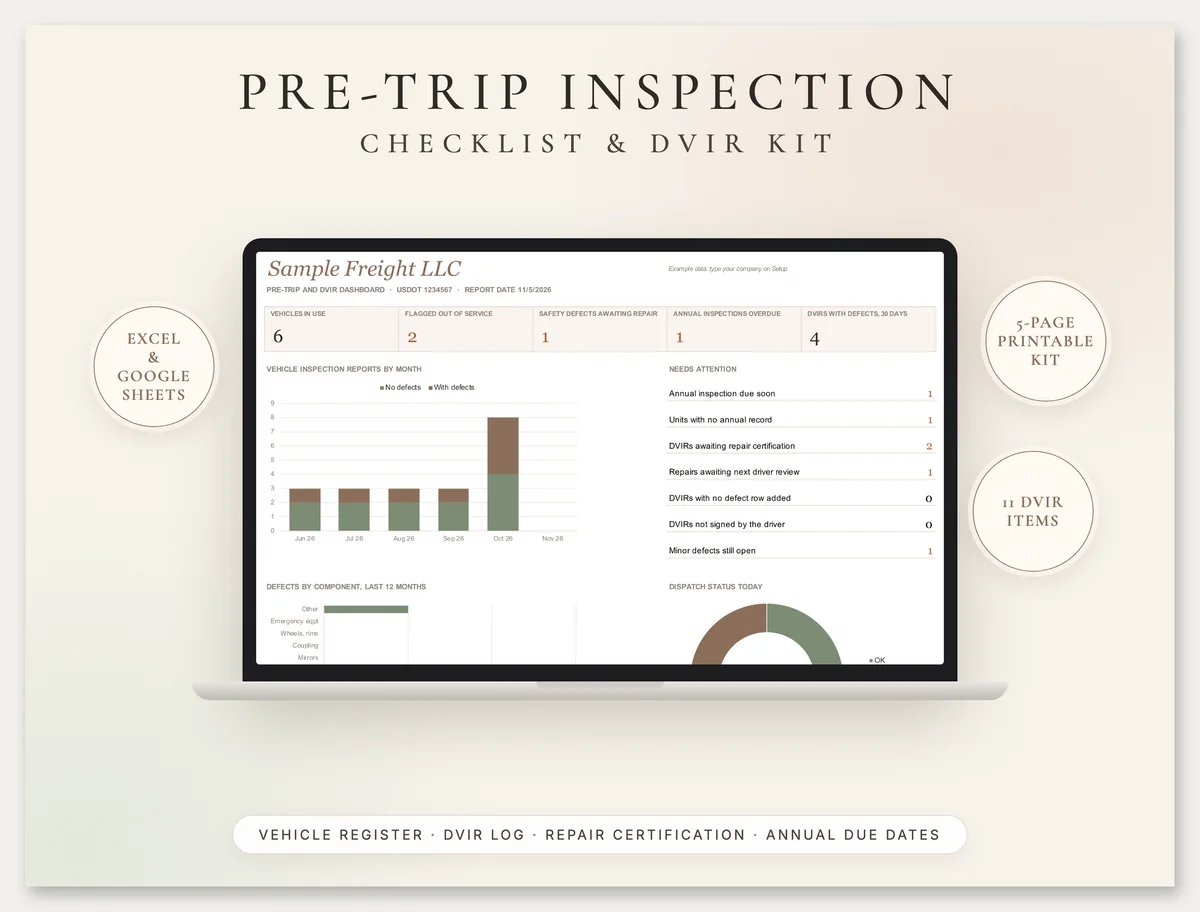
- Dashboard: units flagged out of service, safety defects waiting for repair, annual inspections overdue and defects by component
You get: Excel workbook · Google Sheets-ready · 5-page printable PDF (US Letter)
Secure checkout by Razorpay. Cards accepted worldwide, charged in US dollars. Files arrive on screen and by email. Refund policy
02
What is a pre-trip inspection checklist?
A pre-trip inspection checklist is a list a commercial driver works through before driving to confirm the vehicle is safe: brakes, steering, lights, tires, wheels, coupling devices, mirrors, wipers, horn and emergency equipment. Any defect it turns up goes on a driver vehicle inspection report (DVIR) for repair.
The federal rule behind it is short. Under 49 CFR 396.13, before driving a commercial motor vehicle the driver must be satisfied it is in safe operating condition, review the last DVIR and sign it. Under 49 CFR 392.7, no commercial motor vehicle may be driven unless the driver is satisfied that 11 named parts and accessories are in good working order. The regulations do not prescribe a pre-trip form; a checklist is simply the reliable way to cover every item, every time.
This page explains the DVIR rules as they read today, including the no-defect change, what to check on a tractor-trailer and on a straight truck or van, how the repair certification and next-driver review work, and how long to keep each record. Every rule links to the regulation on eCFR.
Last reviewed: 30 October 2026.
03
Free printable pre-trip inspection checklist (PDF)
Download the tractor-trailer page of the kit free: pre-trip inspection checklist (PDF, 1 page, US Letter). It has 46 items in nine walkaround groups (engine compartment, in cab, lights, steering and suspension, brakes, wheels and tires, coupling devices, trailer and cargo, emergency equipment), OK and Defect boxes, a result line that points to the DVIR number and a driver signature line.
The full kit adds a straight truck and van checklist, a DVIR form with the carrier certification and next-driver review boxes, a defect and repair log, and the Excel and Google Sheets workbook that tracks every report, defect and annual inspection due date.
04
DVIR rules explained: 49 CFR 396.11 and 396.13
A driver vehicle inspection report is the written report a driver prepares at the end of the day's work on each vehicle driven, listing any defect or deficiency found or reported that would affect safe operation or cause a breakdown. Since the no-defect rules changed, no report is needed when nothing was found or reported.
| Rule | What it requires |
|---|---|
| 396.11(a)(1) | Every motor carrier must require its drivers to report, and every driver must prepare a report in writing at the completion of each day's work on each vehicle operated. The report covers at least 11 parts and accessories (listed below). |
| 396.11(a)(2) | The report identifies the vehicle and lists any defect or deficiency discovered by or reported to the driver. One report per vehicle if the driver used more than one. Drivers are not required to prepare a report if no defect or deficiency is discovered or reported. The driver signs; on a two-driver team one signature is enough if both agree on the defects. |
| 396.11(a)(3) | Before the vehicle is driven again, the carrier or its agent repairs any listed defect likely to affect safe operation, and certifies on the report that the defect was repaired or that repair is unnecessary. |
| 396.11(a)(4) | The carrier keeps the DVIR, the certification of repairs and the certification of the driver's review for three months from the date the report was prepared. |
| 396.11(a)(5) | The section does not apply to a private motor carrier of passengers (nonbusiness), a driveaway-towaway operation, or a carrier operating only one commercial motor vehicle. |
| 396.13 | Before driving, the driver must be satisfied the vehicle is safe, review the last DVIR if one was required, and sign it to acknowledge the review and that the required repairs were certified. No signature is needed for defects on a towed unit no longer in the combination. |
The no-defect DVIR change. A final rule published on 18 December 2014 (79 FR 75437) removed the requirement for drivers of property-carrying vehicles to submit, and carriers to keep, a DVIR when no defect was found or reported. A second rule (85 FR 50787, effective 17 September 2020) did the same for passenger-carrying vehicles. A DVIR with defects is still required for both. Since 23 March 2026 the regulation also says in so many words that DVIRs may be created and kept electronically (91 FR 7893).
Who the rules cover. Part 396 applies to commercial motor vehicles in interstate commerce, defined in 49 CFR 390.5 as vehicles with a gross vehicle or combination weight rating or weight of 10,001 pounds or more, vehicles designed or used to carry more than 8 passengers (including the driver) for compensation or more than 15 not for compensation, and vehicles carrying placarded hazardous materials. Many states adopt the same rules for intrastate carriers, sometimes with changes, so check your state.
05
The 11 items every DVIR must cover
49 CFR 396.11(a)(1) lists the minimum parts and accessories a DVIR covers. The same 11 items are the ones a driver must be satisfied are in good working order before driving under 392.7(a).
| # | Item | What drivers typically look at |
|---|---|---|
| 1 | Service brakes, including trailer brake connections | Stopping power, air or hydraulic leaks, hoses, glad hands, slack adjusters and chambers |
| 2 | Parking brake | Holds the vehicle on the grade where you park |
| 3 | Steering mechanism | Free play, steering box, linkage, missing nuts, bolts or cotter pins |
| 4 | Lighting devices and reflectors | Headlights, turn signals, brake, tail, clearance and marker lights, reflective tape |
| 5 | Tires | Inflation, cuts, bulges, exposed cord; tread at least 4/32 inch on front tires of trucks, tractors and buses and 2/32 inch on others (393.75) |
| 6 | Horn | Works |
| 7 | Windshield wipers | Blades and washers work |
| 8 | Rear vision mirrors | Clean, secure, adjusted, not cracked |
| 9 | Coupling devices | Fifth wheel jaws locked around the kingpin, release arm locked, air and electrical lines, landing gear |
| 10 | Wheels and rims | Cracks, bent rims, missing or loose lug nuts, rust trails, leaking hub seals |
| 11 | Emergency equipment | A charged, mounted fire extinguisher (5 B:C, or two 4 B:C; 10 B:C if placarded) and three reflective triangles or fusees where allowed (393.95) |
A good pre-trip goes further than the 11 items: fluid levels, belts, suspension, frame, doors and cargo securement all affect whether the vehicle is safe. The kit's checklists include these in walkaround order.
06
How to do a pre-trip inspection in 6 steps
Review the last DVIR
If the last report listed defects, check the carrier has certified each one repaired or repair unnecessary, then sign the report. That is the 396.13 review.
Engine compartment, engine off
Check oil, coolant, power steering and washer levels, look for leaks underneath, and check belts, hoses and wiring for cracks, fraying or chafing.
In the cab with the engine running
Gauges normal, air pressure builds and the low air warning works (air brakes), parking brake holds, service brake stops the vehicle, steering free play, horn, wipers, mirrors and seat belt.
Lights and walkaround
Turn on headlights and 4-way flashers, then walk round: lights and reflectors, steering and suspension parts, brake chambers and hoses, every wheel, rim and tire.
Coupling, trailer and cargo
Fifth wheel jaws locked around the kingpin with no gap, lines connected and not chafing, landing gear up, tandem pins engaged, doors secure and cargo secured. Do a tug test.
Emergency equipment and record
Fire extinguisher charged and mounted, triangles on board. Tick the result. Any defect goes on a DVIR; anything that affects safe operation means the vehicle does not leave until it is repaired.
07
CDL pre-trip inspection checklist vs the daily DVIR
The CDL pre-trip inspection is part of the skills test for a commercial driver's license; the DVIR is a daily record for working drivers. They overlap but are not the same thing.
Under 49 CFR 383.113(a), CDL applicants must be able to identify each safety-related part of the vehicle and explain what needs to be inspected, covering the engine compartment, cab and engine start, steering, suspension, brakes, wheels, the side and rear of the vehicle, and special features of a tractor trailer, school bus or coach. Applicants for air brake vehicles must also show the air brake checks. The test is run by your state, and the state CDL manual sets the exact sequence and wording examiners expect.
The checklists in this kit follow the same walkaround order, so they double as a study aid, but they are not an official test script. For the test itself, use your state CDL manual. For daily work, use the checklist to inspect and the DVIR to report.
08
Repair certification, next-driver review and record retention
A DVIR with defects starts a loop that only closes when three signatures are on file: the driver who reported it, the carrier who certified the repair, and the next driver who reviewed it.
| Record | Who signs | How long to keep | Rule |
|---|---|---|---|
| DVIR listing defects | Reporting driver | 3 months from the date prepared | 396.11(a)(2), (a)(4) |
| Certification: repaired or repair unnecessary | Carrier or its agent, before the vehicle is driven again | 3 months | 396.11(a)(3) |
| Next driver's review | Next driver, before driving | 3 months | 396.13(c) |
| Annual (periodic) inspection report | Qualified inspector | 14 months; proof of inspection on the vehicle | 396.17, 396.21 |
| Inspection, repair and maintenance records | Carrier | 1 year where the vehicle is housed or maintained, plus 6 months after it leaves your control | 396.3 |
The workbook's Defects and Repairs tab keeps each defect open, and the vehicle flagged Out of service: repair needed, until you choose Repaired or Repair unnecessary and enter who certified it and when. The status then shows Closed: awaiting driver review until the next driver's name is entered. That flag is your own do-not-dispatch control; it is not the official out-of-service order that an inspector can place under 49 CFR 396.9.
09
Worked example: one week of DVIRs for a six-unit fleet
Sample scenario, for illustration only. A small carrier runs two tractors, two trailers, a 26 ft box truck and a cargo van over 10,001 pounds.
- Monday: the driver of T-101 with trailer TR-201 finds nothing on the post-trip. No defect means no DVIR is required. The log row shows Not required and no keep-until date.
- Tuesday: the same driver reports a right rear marker lamp out on TR-201 (DVIR DV-0018). The shop replaces the bulb on Wednesday and certifies it repaired. On Thursday the next driver reviews and signs, and the defect closes. The DVIR's keep-until date is 27 January 2027, three months after 27 October.
- Tuesday: T-102's driver reports an audible air leak at the trailer glad hand on TR-202. Service brakes and trailer brake connections affect safe operation, so TR-202 shows Out of service: repair needed on the dashboard until a repair is certified.
- Wednesday: on the box truck's pre-trip the driver finds a sidewall bulge. The tire is replaced the same day and certified; the status reads Closed: awaiting driver review until the next driver signs.
- Annual inspections: T-102 was last inspected on 4 October 2025, so its 12-month inspection fell due on 4 October 2026. The register shows Out of service: annual overdue, and the van, with no inspection on file, shows Check: no annual record.
By Friday the dashboard shows 6 vehicles in use, 2 flagged out of service, 1 safety defect waiting for repair and 4 DVIRs with defects in the last 30 days. The sample rows in the workbook follow this same week, so you can see each status before you enter your own.
10
Common DVIR and pre-trip mistakes
11
What is inside
Printable kit (5 pages)
Rules on one page, tractor-trailer checklist, straight truck and van checklist, DVIR form with certification and review boxes, defect and repair log.
DVIR Log
Up to 2,000 reports with OK, Defect or N/A for the 11 items in 396.11. Works out the defect count, whether a written DVIR is needed and a keep-until date.
Defects and Repairs
Each defect, whether it affects safe operation, the repair, the carrier certification and the next driver's review, with days open.
Vehicle Register and Dashboard
300 units with annual inspection due dates, open defects and a dispatch status, plus a one-page dashboard to check before dispatch.
12
How to use the kit
Set up
Enter your company, USDOT number and drivers. The 3-month DVIR retention and 12-month annual interval are preset and editable.
List your vehicles
Add every power unit and trailer with its last annual inspection date.
Inspect and report
Drivers use the printed checklist before driving and the DVIR form when they find or are told of a defect.
Log, repair, certify
Enter DVIRs and defects. Certify repairs, record the next driver's review and check the dashboard each morning.
13
Related templates and services
Browse all our compliance templates and record kits. Every kit there pairs a printable form with a register that tracks due dates and open items, the same pattern as this one. If you want DVIRs on a phone with photos and automatic alerts, we also build custom inspection apps in AppSheet.
14
Pre-trip inspection and DVIR questions
Is a DVIR required every day?
How long do you have to keep a DVIR?
What must be on a DVIR?
Is a pre-trip inspection required by law?
Who signs off a DVIR repair?
Can a DVIR be electronic?
Does the workbook work in Google Sheets?
15
Important
This kit helps you carry out and record vehicle inspections. It is not legal advice and does not replace your vehicle manufacturer's instructions, your state CDL manual or a qualified mechanic. The rules quoted are the federal rules for interstate commercial motor vehicles as read on eCFR on 30 October 2026; states can add their own, and rules change. The out-of-service flag in the workbook is an internal dispatch control, not an official out-of-service order. Greenwolf Tech Labs is not affiliated with FMCSA or any government agency. See our terms and refund policy.
Part of our Compliance Templates hub. Start with our compliance templates.
Compliance Templates
More on compliance templates
Fire Door Inspection Checklist, Regulations and Register (UK)
Free fire door inspection checklist (PDF) and UK fire door regulations explained: who checks, 3-monthly and 12-monthly checks, gaps, seals and records.
First Aid Kit Checklist: Workplace Contents List and Monthly Inspection
Free first aid kit checklist (PDF) with workplace contents lists for the US (ANSI Class A and B), UK and Australia, plus a monthly inspection log.
Forklift Inspection Checklist (OSHA Daily, Free PDF)
Free forklift inspection checklist (PDF) for electric and LPG trucks, plus OSHA 1910.178 rules: daily checks, out of service and 3-year evaluations.
NSPIRE Inspection Checklist for Section 8 and HQS Units
Free NSPIRE inspection checklist PDF for Section 8 and HQS units: what fails, fix times by severity, smoke and CO rules and the Feb 1, 2027 voucher date.
JSA Template: Job Hazard Analysis Form, Examples and Risk Matrix
Free JSA template (PDF) and job hazard analysis form, built on OSHA 3071: steps, hazards, controls, a 5x5 risk matrix and 5 worked JHA examples.
Tell us where the week goes
A senior consultant will map where the time goes, name what is worth automating and what it takes. No obligation after it.