

Templates and trackers
JSA Template: Job Hazard Analysis Form, Examples and Risk Matrix
Free JSA template (PDF) and job hazard analysis form, built on OSHA 3071: steps, hazards, controls, a 5x5 risk matrix and 5 worked JHA examples.
For supervisors, safety coordinators and contractors
JSA Template and Job Hazard Analysis Kit
$15USD · one-time purchase · instant download
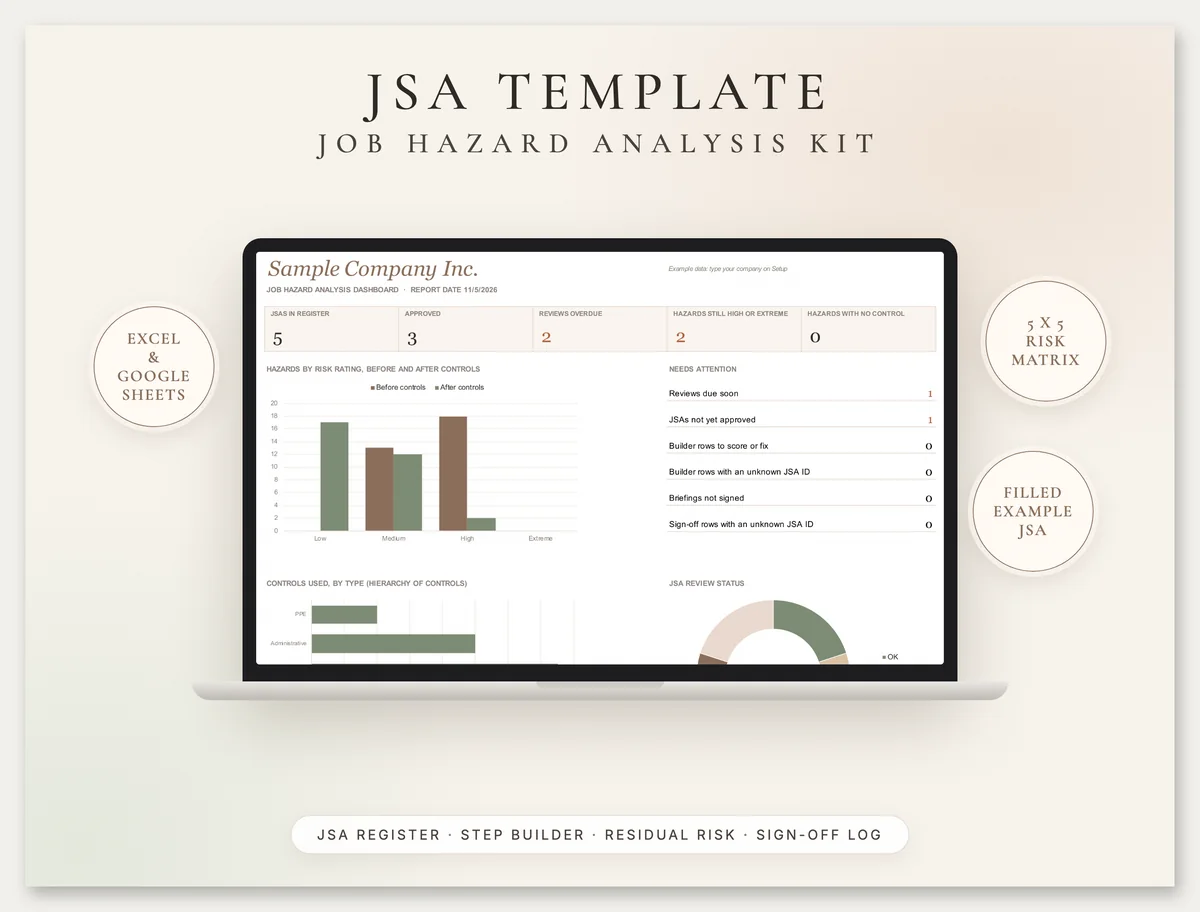
Build each job safety analysis step by step, score every hazard before and after controls, and let the register tell you which JSAs are due for review, which hazards are still high and who has been briefed.
- JSA builder: job steps, hazards, consequences, controls, control type and person responsible, one row per hazard
- Editable 5x5 risk matrix: likelihood x severity with Low, Medium, High and Extreme bands you can rename and re-score
- Residual risk after controls, with a check that flags missing controls and anything still High or Extreme
- JSA register with approval, next review date, overdue flags and counts of steps, hazards and briefings
- Briefing sign-off log and a dashboard of reviews due, risk before and after, and controls by hierarchy level
- 5 worked examples from OSHA guidance plus a 4-page printable kit: blank JSA form, risk matrix guide, filled example, sign-off sheet
You get: Excel workbook · Google Sheets-ready · 4-page printable PDF (US Letter)
Secure checkout by Razorpay. Cards accepted worldwide, charged in US dollars. Files arrive on screen and by email. Refund policy
02
What is a JSA (job safety analysis)?
A job safety analysis (JSA), also called a job hazard analysis (JHA), is a written breakdown of one job into its steps, the hazards in each step and the controls that will prevent harm. OSHA describes it as a technique that focuses on job tasks to identify hazards before they occur.
OSHA's guide, publication 3071 (Job Hazard Analysis), frames the analysis around the relationship between the worker, the task, the tools and the work environment. The output is a form the crew can read before the job starts: step, hazard, control. A good JSA template adds two things that make it useful over time: a risk score so you can see which hazards matter most, and a review date so the analysis keeps up with changes to the job.
JSA and JHA mean the same thing in practice; some companies use JSA for the field form and JHA for the analysis behind it. This page uses both. A JSA is not a legal form in itself; it is how many employers organize the hazard assessment their safety program and the OSHA standards for their industry expect.
Last reviewed: 30 October 2026.
03
Free JSA template and job hazard analysis form (PDF)
Download the blank form for free: JSA template (PDF, 1 page, US Letter). It has the header fields most crews need (job, JSA number, location, date, prepared and approved by, required PPE, tools), nine rows for steps with hazard, risk before controls, controls, control type, risk after controls and who is responsible, the five OSHA 3071 questions printed as a prompt, and sign-off lines.
The full kit adds the Excel and Google Sheets workbook, a risk matrix and hierarchy of controls guide, a filled example for a bench grinder and a briefing sign-off sheet.
04
How OSHA says to do a job hazard analysis
OSHA 3071 sets out five steps to begin: involve your employees, review your accident history, conduct a preliminary job review, list, rank and set priorities for hazardous jobs, and outline the steps or tasks. Then, for each step, it asks five questions.
| OSHA 3071 question | Where it goes on the JSA |
|---|---|
| What can go wrong? | Hazard column |
| What are the consequences? | Consequence column and the severity score |
| How could it arise? | Hazard wording: the trigger, such as clearing a snag while the pulley runs |
| What are other contributing factors? | Hazard and controls; for example, a hazard that happens too fast for a person to react needs a guard, not training |
| How likely is it that the hazard will occur? | Likelihood score; near misses or past cases mean high likelihood |
OSHA also says which jobs to analyze first: jobs with the highest injury or illness rates, jobs that could cause severe or disabling injury even with no history of accidents, jobs where one simple human error could cause a severe injury, jobs that are new or have changed, and jobs complex enough to need written instructions. If you find a hazard that is an immediate danger to life or health, act at once rather than waiting for the analysis to be finished.
Watch the worker do the job and write each step as it happens, in enough detail to describe the action without making the list so long it becomes unusable. Make clear you are analyzing the job, not judging the worker.
05
Hierarchy of controls and the risk matrix
The NIOSH hierarchy of controls ranks controls from most to least effective: elimination, substitution, engineering controls, administrative controls, and personal protective equipment (NIOSH). OSHA 3071 uses the same order in its appendix and accepts PPE where engineering controls are not feasible, are still being put in place or do not fully remove the hazard. In practice most hazards end up with a combination.
| Control type | What it means | Example from the kit |
|---|---|---|
| Elimination | Remove the hazard at the source | Do the work from the ground with an extension pole |
| Substitution | Use a safer alternative | Buy ready-to-use cleaner so nobody decants concentrate |
| Engineering | Change the equipment or workplace to prevent contact | Grinder work rest within 1/8 in; pallet on a lift table |
| Administrative | Change how people work | Remove cones in reverse order, facing traffic; SDS read before decanting |
| PPE | Equipment worn by the worker | Face shield and safety glasses; high-visibility garments |
The risk matrix scores each hazard as likelihood (1 to 5) times severity (1 to 5). In the kit, 1 to 4 is Low, 5 to 9 Medium, 10 to 16 High and 17 to 25 Extreme, and a hazard still High or Extreme after controls is flagged for review before work starts. A matrix is common practice rather than an OSHA requirement, so the scales, names and bands are all editable to match your own program.
06
How to fill in a JSA form in 6 steps
Pick the job
Start with the jobs OSHA 3071 lists as priorities: high injury rates, severe outcomes, one error away from harm, new or changed, or complex.
Break it into steps
Watch the job with the worker and write each step in order, usually 3 to 10 steps. Describe the action, not every movement.
List hazards per step
Ask what can go wrong, the consequence, how it could arise, what contributes and how likely it is. One row per hazard.
Score the risk
Likelihood x severity before controls. This tells you which hazards to deal with first.
Add controls, highest first
Elimination, substitution, engineering, administrative, then PPE. Score the residual risk; anything still High means more controls.
Approve, brief and review
Approve the JSA, brief the crew and get signatures, then review it on schedule, after any incident and whenever the job changes.
07
Job hazard analysis example: bench grinder
Worked example, from the grinding iron castings job in OSHA 3071 and the abrasive wheel rules in 29 CFR 1910.215. A worker takes 15 lb castings from a box, grinds off the burr and places them in a box on the other side, 20 to 30 castings an hour. The job has 4 steps and 8 hazards.
| Step | Hazard | Before | Controls | After |
|---|---|---|---|---|
| 1. Pick up casting from the box | 15 lb casting dropped on foot | 3 x 3 = 9 (Medium) | Move castings from the box onto a table next to the grinder; steel-toe shoes (OSHA 3071 example) | 1 x 3 = 3 (Low) |
| 1. Pick up casting from the box | Sharp burrs and edges | 4 x 3 = 12 (High) | Pick up castings with a clamp or device; cut-resistant gloves that fit tightly so they cannot catch in the wheel (OSHA 3071) | 2 x 2 = 4 (Low) |
| 1. Pick up casting from the box | Reaching, twisting and lifting from the floor | 3 x 3 = 9 (Medium) | Place castings at waist height on an adjustable platform; reconfigure the station to stop twisting (OSHA 3071) | 1 x 3 = 3 (Low) |
| 2. Check and set up the grinder | Wheel bursts at speed | 2 x 5 = 10 (High) | Inspect and ring-test every wheel before mounting; spindle speed not above the speed marked on the wheel (1910.215(d)(1)); guards on | 1 x 5 = 5 (Medium) |
| 2. Check and set up the grinder | Hand drawn in between wheel and work rest | 3 x 4 = 12 (High) | Work rest at most 1/8 in from the wheel, adjusted with the wheel stopped (1910.215(a)(4)); tongue guard within 1/4 in (1910.215(b)(9)) | 1 x 4 = 4 (Low) |
| 3. Grind off the burr | Sparks and particles thrown at the face | 4 x 4 = 16 (High) | Eye shield on the grinder; safety glasses plus face shield | 2 x 3 = 6 (Medium) |
| 3. Grind off the burr | Noise from grinding 20 to 30 castings an hour | 3 x 2 = 6 (Medium) | Hearing protection where noise monitoring shows it is needed | 2 x 2 = 4 (Low) |
| 4. Place finished casting in the box | Hot casting | 3 x 2 = 6 (Medium) | Let castings cool on the table; leather gloves | 2 x 1 = 2 (Low) |
The highest score before controls is 16 (flying particles, likely x major) and the highest after controls is 6. The wheel burst hazard scores 2 x 5 = 10 (High) before controls and 5 (Medium) after: severity stays at 5, so the controls work by making it rare. Paragraph references: 1910.215 (a)(4) work rest, (b)(9) tongue guard, (d)(1) wheel inspection and speed.
Across all five worked examples in the kit, 18 of 31 hazards score High or Extreme before controls and 2 after; those remaining hazards are on the roadside traffic JSA, which is why its status is Under review on the dashboard.
08
Four more JSA examples in the kit
- Extension ladder (gutter cleaning). Inspection for visible defects and tagging defective ladders out of service, a base set out about 1 ft for every 4 ft of working length, rails at least 3 ft above the landing and one hand on the ladder while climbing (29 CFR 1926.1053 (b)(1), (b)(5)(i), (b)(15), (b)(16), (b)(21)), plus a non-conductive ladder near power lines.
- Manual handling (cartons to racking). The OSHA 3071 lifting controls: bring loads to waist height on a lift table or adjustable platform, stop twisting, keep heavy cartons on middle shelves.
- Working near traffic (roadside inspection). A temporary traffic control plan to MUTCD Part 6, flaggers and warning garments that conform to Part 6 (29 CFR 1926.201(a)), buffer space, a shadow vehicle and removing devices in reverse order.
- Chemical transfer (corrosive cleaner). SDS accessible during the shift and labels on every secondary container (29 CFR 1910.1200 (g)(8), (f)(6)), a drum pump on a spill pallet, and quick drench or flushing facilities where corrosives can reach the eyes or body (1910.151(c)).
Each example is a starting point. OSHA notes its own examples are for illustration only and do not include every step, hazard and protection for your industry.
09
Common JSA mistakes
10
What is inside
JSA Builder
One row per hazard: step, hazard, consequence, likelihood x severity, controls, control type, residual score and a check that flags gaps.
JSA Register
Up to 300 JSAs with approval, next review due, review status, highest scores, hazards still high and workers briefed.
Risk Matrix and Dashboard
Editable 5x5 matrix, hazards plotted before and after controls, ratings and controls by type, and the JSAs that need attention.
Printable kit and 5 examples
Blank JSA form, matrix and hierarchy guide, filled bench grinder example, sign-off sheet, and five worked JSAs in the workbook.
11
How to use the workbook
Set your scales
Check the likelihood and severity names, the bands and the 12-month review interval on Setup.
Register the job
Add the job to the JSA Register with a status of Draft.
Build it
Enter steps and hazards in the JSA Builder, score them, add controls and score the residual risk.
Approve and brief
Approve, print the form, brief the crew and log each signature. The register tracks the review date.
12
JSA and job hazard analysis questions
What is the difference between a JSA and a JHA?
Is a JSA required by OSHA?
What are the main steps of a job hazard analysis?
How often should a JSA be reviewed?
What should a JSA form include?
Who should prepare a job hazard analysis?
Does the JSA template work in Google Sheets?
13
Important
This JSA template and workbook help you organize, score and record job hazard analyses. They are not legal or safety-engineering advice, and the worked examples are illustrations that do not include every step, hazard and control for your job. Compliance with the OSHA standards for your industry is mandatory and state-plan states can have different rules, so check the current standards and involve a competent safety professional for complex or high-risk work. The risk matrix is a common practice tool, not an OSHA requirement. Greenwolf Tech Labs is not affiliated with OSHA or NIOSH. See our terms and refund policy.
Part of our Compliance Templates hub. Start with our compliance templates.
Compliance Templates
More on compliance templates
Food Cost Calculator and Recipe Costing Template (Excel)
Food cost calculator and recipe costing template for Excel and Google Sheets: yield, plate cost, food cost % formula, menu pricing and menu engineering.
Pre-Trip Inspection Checklist and DVIR Form (FMCSA)
Free pre-trip inspection checklist (PDF) for trucks and vans, plus DVIR rules under 49 CFR 396.11: what to check, no-defect reports, repairs and retention.
Rent Roll Template (Excel and Google Sheets) with Example
Rent roll template for Excel and Google Sheets with a worked example: what a rent roll is, the fields lenders require, occupancy and arrears aging.
RFI Log Template, Submittal Log and Change Order Log (Excel)
RFI log template with submittal log and change order log for Excel and Google Sheets: due dates, ball in court, at-risk submittals and contract sum.
VEVRAA and Section 503 Affirmative Action Plan Template (2026)
VEVRAA explained for federal contractors: who needs a plan, the 5.1% hiring benchmark, 2026 rule changes, VETS-4212 and an AAP template with a free calendar.
Tell us where the week goes
A senior consultant will map where the time goes, name what is worth automating and what it takes. No obligation after it.