

Templates and trackers
Rent Roll Template (Excel and Google Sheets) with Example
Rent roll template for Excel and Google Sheets with a worked example: what a rent roll is, the fields lenders require, occupancy and arrears aging.
For landlords, property managers, investors and brokers
Rent Roll Template (Excel and Google Sheets)
$15USD · one-time purchase · instant download
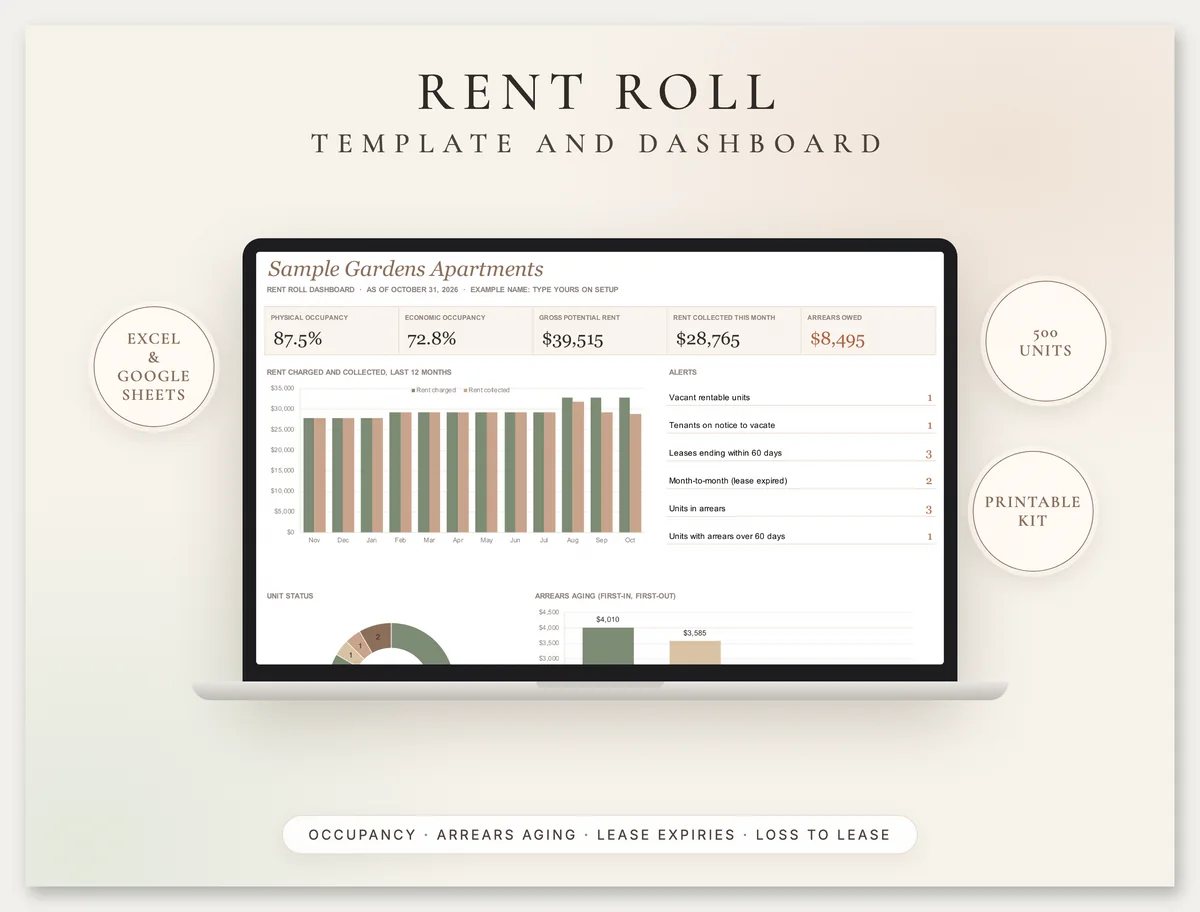
Keep one dated row for every unit with the tenant, lease dates, market and contract rent, concessions, deposits and status, and log charges and payments in a ledger. The workbook works out balances, arrears aging, lease expiries, physical and economic occupancy and loss to lease for you.
- Rent roll for up to 500 units with every field Freddie Mac lists for a multifamily rent roll, from unit type and square feet to subsidies and furnished status
- Lease expiry flags at 60 and 90 days (editable) and automatic month-to-month status when a lease end date has passed
- Tenant ledger for 5,000 charges, payments and credits with a running balance per unit
- Arrears aging per unit in 0-30, 31-60, 61-90 and 90+ day buckets, first-in, first-out
- Dashboard with physical vs economic occupancy, gross potential rent, loss to lease, vacancy loss and non-revenue units
- 4-page printable kit: lender checklist, rent roll form, tenant ledger card, lease expiry and arrears report
You get: Excel workbook · Google Sheets-ready · 4-page printable PDF (US Letter)
Secure checkout by Razorpay. Cards accepted worldwide, charged in US dollars. Files arrive on screen and by email. Refund policy
02
What is a rent roll?
A rent roll is a dated schedule of every unit in a rental property showing who occupies it, the lease start and end dates, the rent and other charges, the security deposit held and any balance owed. Lenders, buyers and appraisers use it to check that the income a property claims is real.
Owners use the rent roll to run the building month to month: which leases are about to end, which units are vacant, who is behind and how far current rents sit below market. When the property is refinanced or sold, the same document becomes evidence. The lender's analyst rebuilds the income from it, an appraiser compares it with market rents, and a buyer's due diligence team ties it back to leases and bank deposits.
This page explains what goes in a rent roll, what agency multifamily lenders say they check, how occupancy, gross potential rent and loss to lease are calculated, and how to age arrears. The lender requirements quoted here come from the published Freddie Mac and Fannie Mae multifamily guides, linked below.
Last reviewed: 30 October 2026.
03
Free printable rent roll template (PDF)
Download the rent roll form from the kit for free: rent roll template (PDF, 1 page, US Letter). It has 17 unit rows with unit, type, square feet, status and use, tenant, move-in, lease start and end, market and contract rent, concessions and other charges, deposit and balance owed, an occupancy summary and an owner certification line.
The paid kit adds the Excel and Google Sheets workbook, which calculates balances and aging from a ledger, flags leases ending in 60 and 90 days, spots month-to-month tenants and builds the occupancy and rent analysis a lender or buyer will ask about, plus a printable tenant ledger card and a lease expiry and arrears report.
04
What lenders and buyers look for in a rent roll
Freddie Mac's Multifamily Seller/Servicer Guide lists 18 items a rent roll must show for each unit, requires it to be dated within 30 days of the underwriting package and certified by the borrower. Fannie Mae requires its lenders to audit the rent roll against the signed leases and against rent deposits.
| Requirement | What it says | Source |
|---|---|---|
| Fields for each unit | As-of date, tenant name, unit number, unit type (bedrooms and bathrooms), square footage, occupancy status, employee, model, corporate and office units identified, monthly contract rent, concessions, arrearages, subsidies, rent control or stabilization, original occupancy date, lease start, lease expiration and renewal options, month-to-month status, security deposit held, furnished or unfurnished | Freddie Mac Guide 55.2 |
| Freshness and certification | Dated within 30 days of the underwriting package submission; certified on Form 1112, the borrower and key borrower principal blanket certification | Freddie Mac Guide 55.2 |
| Accuracy | The seller represents that a rent roll delivered to Freddie Mac states the number of units, beds or pad sites correctly and discloses gross potential rents and actual leased unit rents within a 7.5% tolerance | Freddie Mac Guide 5.2(a) |
| Lease audit | Before commitment the lender reconciles the rent roll with the signed leases, reviewing every lease at 5 to 9 units, the greater of 5 units or 10% at 10 to 100 units, 10% at 101 to 300, 40 leases at 301 to 900 and 50 above 900, and more if it finds discrepancies | Fannie Mae Guide Part II, 401.01 |
| Rent collections | The lender checks a cash ledger, receipts journal or at least 3 months of bank statements, gets an accounts receivable or past due rent report from the site manager and records a lease audit against the rent roll | Fannie Mae Guide Part II, 401.03 |
Small-balance, bank and private lenders and most buyers ask for the same core information even when their form differs. In practice they look for concessions buried in contract rents, a cluster of leases expiring at once, month-to-month tenants, units occupied by staff or used as models, and arrears that the rent roll does not mention. The template has a column or a calculation for each of these.
Requirements change, so check the current Freddie Mac Guide or Fannie Mae Multifamily Guide and ask your own lender for its format.
05
Occupancy, gross potential rent and loss to lease explained
Physical occupancy counts units with a tenant in place. Economic occupancy compares the rent actually collected with gross potential rent, the rent the property would earn if every unit were leased at market. The difference between the two is where the money goes: below-market leases, vacancy, concessions, non-revenue units and unpaid rent.
| Measure | How the template works it out |
|---|---|
| Physical occupancy | Units marked Occupied or Notice / total units |
| Gross potential rent (GPR) | Sum of market rent for every unit, occupied or not |
| Loss to lease | Market rent - contract rent, for occupied units |
| Vacancy loss | Market rent of vacant rentable units |
| Non-revenue units | Market rent of model, office and down units |
| Net scheduled rent | Contract rent of occupied units - monthly concessions |
| Economic occupancy | Rent collected in the month / GPR |
These are the common working definitions. Lenders and analysts vary in the detail, for example whether employee units or concessions are counted as vacancy, so the dashboard shows each line separately and you can rebuild any version a lender asks for. Market rent is your own estimate per unit; an appraisal or rent survey is the usual support for it.
06
Arrears aging: 0-30, 31-60, 61-90 and 90+ days
Arrears aging splits each tenant's unpaid balance by how long the unpaid charges have been outstanding. The template ages first-in, first-out: payments and credits clear the oldest charges first, so whatever is still owed is the most recent charges.
For each unit it adds every charge, payment and credit in the ledger up to the as-of date to get the balance. It then fills the 0-30 day bucket with charges dated in the last 30 days, up to the balance, then the 31-60 and 61-90 day buckets the same way, and puts what is left in 90+. A tenant who has paid in full shows Paid up; a prepaid tenant shows a credit balance.
Aging matters because old debt is harder to collect and lenders and buyers treat it differently from a late payment this month. Whether and when you can charge late fees or serve notice depends on your lease and your state and local landlord-tenant law, so the template tracks the numbers and leaves those decisions to you.
07
How to make a rent roll in 5 steps
Set the as-of date
A rent roll is a snapshot. Pick the date, usually a month end, and report every figure as of that day.
List every unit
Include vacant, down, model, employee and office units with type, square feet and market rent, so the unit count matches the property.
Copy the lease terms
From each signed lease: tenant names, move-in date, lease start and end, renewal option, contract rent, concessions, other charges and deposit.
Post the ledger
Enter rent charges, fees, payments and credits by unit and date. Balances and aging update on their own.
Reconcile and certify
Tie the rent roll to the leases and the month's deposits, fix any gaps, then sign and date it as true and complete.
08
Worked example: a 24-unit sample property
Sample data, included in the workbook as of 10/31/2026. Sample Gardens has 24 units: 21 with a tenant in place (one on notice), one vacant rentable unit, one unit down for renovation and one furnished model.
- Physical occupancy: 21 / 24 = 87.5%.
- Gross potential rent: $39,515 a month. Loss to lease $1,145, vacancy loss $1,850 and non-revenue units $3,770 bring it to $32,750 of scheduled contract rent; a $100 move-in concession leaves $32,650 net scheduled rent.
- Collections: $28,765 of rent was collected in October, so economic occupancy is 72.8%, well below physical occupancy because of vacancy, below-market leases and two tenants who did not pay in full.
- Arrears: unit 104 paid $1,000 of August's $1,850 and nothing since, with a $50 late fee each month. Its balance of $4,700 ages to $1,900 at 0-30 days, $1,900 at 31-60, $50 at 61-90 and $850 at 90+. Total arrears across the property are $8,495.
- Leases: 3 leases end within 60 days, 3 more in 61 to 90 days, and 2 tenants are month-to-month because their lease end date has passed.
A lender reading this rent roll would ask about the unit on notice with a large balance, the month-to-month tenant and the concession, and would underwrite on collected rent, not on scheduled rent.
09
Common rent roll mistakes
10
What is inside
Rent Roll
500 units with every Freddie Mac rent roll field, month-to-month detection, 60 and 90 day expiry flags, loss to lease and rent per square foot.
Ledger and aging
5,000 charges, payments and credits with a running balance per unit, and each unit's balance aged 0-30, 31-60, 61-90 and 90+ days.
Monthly Summary
Rent and other charges billed, payments, credits, rent collected, economic occupancy and collection rate for the last 12 months.
Dashboard and printable kit
Occupancy, GPR to collected rent bridge, arrears, unit type mix, expiring leases, plus a 4-page US Letter kit.
11
Related templates and services
Browse all our compliance templates and record kits. Landlords with Section 8 units can use the NSPIRE inspection checklist, built the same way. Property managers who want leads from listings followed up automatically can look at real estate lead automation, and portfolios that have outgrown spreadsheets can have a custom property management app built in AppSheet.
12
Rent roll questions
What is a rent roll?
What should a rent roll include?
Is a rent roll the same as a tenant ledger?
What is the difference between physical and economic occupancy?
How do lenders verify a rent roll?
How often should I update a rent roll?
Does it work in Google Sheets?
13
Important
This template helps you keep and analyze rent roll records. It is not legal, accounting or lending advice, and it does not make a property eligible for any loan. Lender requirements change and differ by program: confirm the current format with your lender. Late fees, notices and deposits are governed by your lease and your state and local law. Greenwolf Tech Labs is not affiliated with Fannie Mae, Freddie Mac or any lender. See our terms and refund policy.
Part of our Compliance Templates hub. Start with our compliance templates.
Compliance Templates
More on compliance templates
Food Cost Calculator and Recipe Costing Template (Excel)
Food cost calculator and recipe costing template for Excel and Google Sheets: yield, plate cost, food cost % formula, menu pricing and menu engineering.
RFI Log Template, Submittal Log and Change Order Log (Excel)
RFI log template with submittal log and change order log for Excel and Google Sheets: due dates, ball in court, at-risk submittals and contract sum.
Fridge Temperature Log: Printable Sheets and Workbook
Free printable fridge temperature log (PDF) plus a freezer and food temperature log workbook in °F or °C. FDA 41 °F and FSA 8 °C rules explained.
JSA Template: Job Hazard Analysis Form, Examples and Risk Matrix
Free JSA template (PDF) and job hazard analysis form, built on OSHA 3071: steps, hazards, controls, a 5x5 risk matrix and 5 worked JHA examples.
OSHA 300 Log in Excel: 300, 300A and 301 Recordkeeping
OSHA 300 log in Excel with an automatic 300A summary, 301 details and TRIR and DART rates, plus 1904 rules: what to record, 7 days, posting and ITA.
Tell us where the week goes
A senior consultant will map where the time goes, name what is worth automating and what it takes. No obligation after it.