

Templates and trackers
VEVRAA and Section 503 Affirmative Action Plan Template (2026)
VEVRAA explained for federal contractors: who needs a plan, the 5.1% hiring benchmark, 2026 rule changes, VETS-4212 and an AAP template with a free calendar.
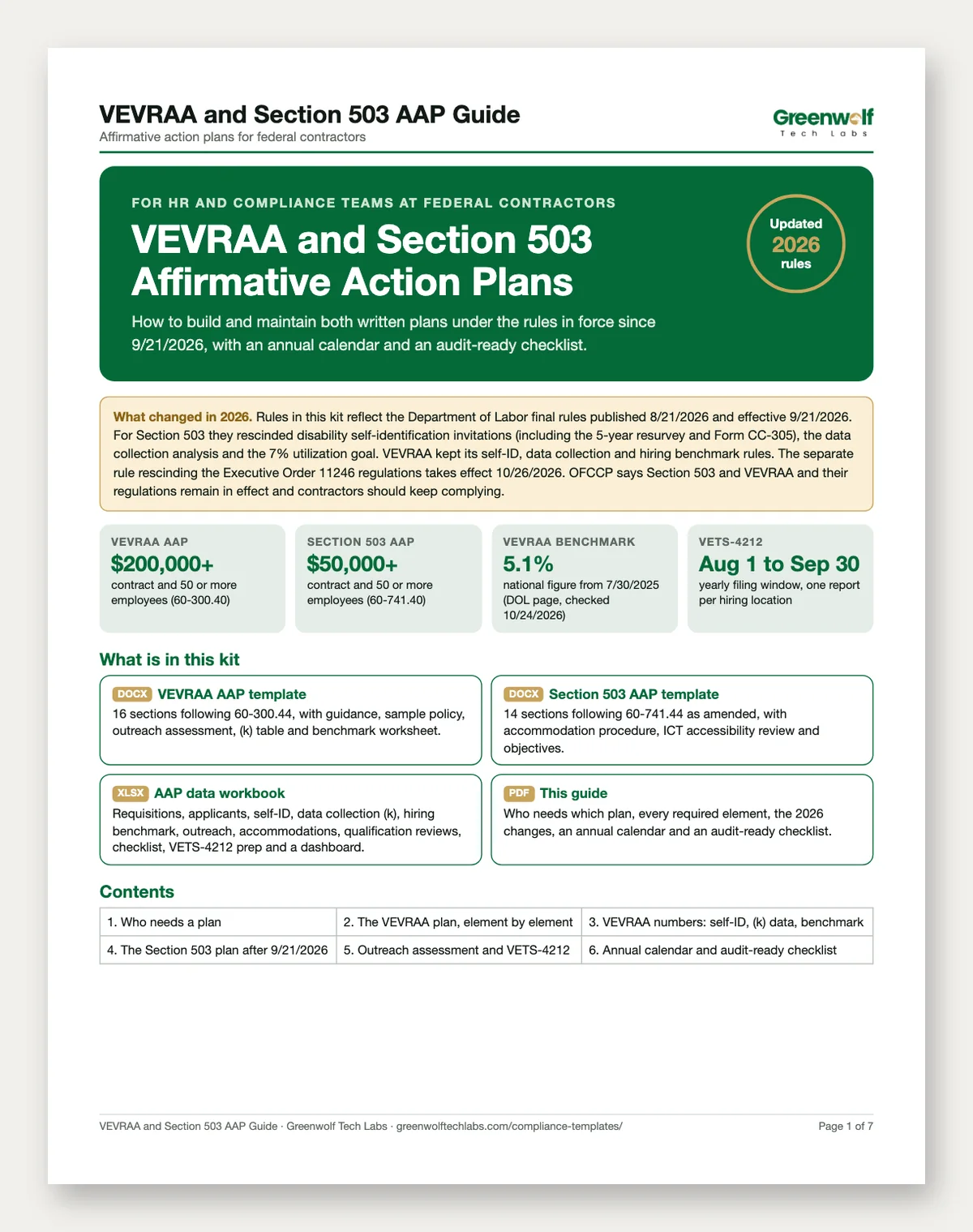
For HR and compliance teams at federal contractors
VEVRAA and Section 503 Affirmative Action Plan Kit
$149USD · one-time purchase · instant download
Write and maintain both affirmative action plans under the rules that took effect on 9/21/2026. Two editable Word AAPs with guidance and sample wording, a data workbook that calculates the VEVRAA numbers for you, and a guide with an annual calendar and audit-ready checklist.
- VEVRAA AAP template: 16 sections following 41 CFR 60-300.44, with a sample policy statement, outreach assessment, data collection table and hiring benchmark worksheet
- Section 503 AAP template rewritten for the 2026 rule: no self-ID, utilization goal or data collection analysis, plus an accommodation procedure and ICT accessibility review
- Workbook: requisitions with a concurrent job-listing check, applicants, self-ID log, 3-year data collection (k), national or five-factor benchmark
- Outreach effectiveness log, accommodation log, qualification standards review schedule, annual checklist and VETS-4212 prep from your roster
- 7-page guide: who needs which plan, what changed in 2026, an annual calendar and an audit-ready checklist
You get: 2 Word templates · Excel workbook (Google Sheets-ready) · 7-page PDF guide
Secure checkout by Razorpay. Cards accepted worldwide, charged in US dollars. Files arrive on screen and by email. Refund policy
02
What is VEVRAA?
VEVRAA, the Vietnam Era Veterans' Readjustment Assistance Act of 1974, requires federal contractors to not discriminate against protected veterans and to take affirmative action to hire and advance them. Contractors with 50 or more employees and a contract of $200,000 or more must keep a written VEVRAA affirmative action plan.
VEVRAA is enforced by the Department of Labor's Office of Federal Contract Compliance Programs (OFCCP), and its rules are in 41 CFR part 60-300. It protects four groups of veterans (60-300.2): disabled veterans; recently separated veterans, within three years of discharge or release from active duty; active duty wartime or campaign badge veterans; and Armed Forces service medal veterans.
Its sister law, Section 503 of the Rehabilitation Act, requires affirmative action for individuals with disabilities (41 CFR part 60-741). Most contractors keep the two plans side by side, which is why this kit covers both. In 2026 the Department of Labor rewrote the Section 503 rules and rescinded the Executive Order 11246 regulations, so many contractors are checking what is left. The short answer: VEVRAA's requirements stay in force, with a higher dollar threshold.
Last reviewed: 25 October 2026. Every rule below links to the current eCFR text or the Federal Register; check them again before you finalize a plan.
03
Free printable VEVRAA and Section 503 annual compliance calendar (PDF)
Download the free annual AAP compliance calendar (PDF), page 6 of the kit's guide. It lays out a calendar-year plan month by month, from updating both AAPs and setting the hiring benchmark in January to the VETS-4212 window in August and September and the year-end outreach assessment in December, with the record retention periods at the foot of the page.
The full kit adds two editable Word affirmative action plan templates (VEVRAA and Section 503), the data workbook that calculates the (k) data and benchmark comparison, and the rest of the guide, including the audit-ready checklist.
04
Who is covered: 2026 thresholds
| Obligation | VEVRAA | Section 503 |
|---|---|---|
| Basic coverage (nondiscrimination, equal opportunity clause) | Contract or subcontract of $200,000 or more (60-300.1(b), 60-300.4) | Contract or subcontract over $20,000 (60-741.1(b), 60-741.4) |
| Written affirmative action plan | 50 or more employees and a contract of $200,000 or more (60-300.40(a)) | 50 or more employees and a contract of $50,000 or more (60-741.40(b)(1)) |
| When the plan is due | Within 120 days of the start of the contract, for each establishment; reviewed and updated every year; submitted within 30 days of an OFCCP request unless the request says otherwise (60-300.40, 60-741.40) | |
The VEVRAA threshold rose from $150,000 to $200,000, and the basic Section 503 threshold from $15,000 to $20,000, under the federal acquisition inflation adjustment effective October 1, 2025. The Department of Labor wrote the new amounts into its regulations effective September 21, 2026 (91 FR 54234; 91 FR 54482). Some older pages still show $150,000; the current eCFR text says $200,000.
05
What changed in 2025 and 2026
| Date | What happened | Source |
|---|---|---|
| January 21, 2025 | Executive Order 14173 revoked Executive Order 11246, the order behind race and sex affirmative action programs for contractors | OFCCP |
| January 24, 2025 | Secretary's Order 03-2025 stopped E.O. 11246 enforcement and put Section 503 and VEVRAA enforcement in abeyance; a later order, Secretary's Order 08-2025, lifted the abeyance for Section 503 and VEVRAA | OFCCP |
| October 1, 2025 | Inflation adjustment: VEVRAA threshold to $200,000, Section 503 basic threshold to $20,000 | 91 FR 54234; 91 FR 54482 |
| August 21, 2026 | Three final rules published: VEVRAA modifications (91 FR 54234), Section 503 modifications (91 FR 54482) and rescission of the E.O. 11246 regulations (91 FR 54444) | Federal Register |
| September 21, 2026 | VEVRAA and Section 503 rules take effect (the Section 503 amendment to part 60-30 is effective December 21, 2026) | 91 FR 54234; 91 FR 54482 |
| October 26, 2026 | Rule rescinding the E.O. 11246 regulations (41 CFR parts 60-1, 60-2, 60-3, 60-4, 60-20, 60-40 and 60-50) is effective | 91 FR 54444 |
Section 503: the September 21, 2026 rule removed the invitations to self-identify disability (pre-offer, post-offer and the 5-year employee resurvey; the Department did not keep Form CC-305), the data collection analysis in 60-741.44(k), and the 7% utilization goal and analysis in 60-741.45. Contractors are not required to consider counts of applicants or hires with disabilities when judging outreach (60-741.44(l)). The Department's stated reason is that the invitations amount to disability inquiries the ADA restricts. The written Section 503 plan and its other elements still apply.
VEVRAA: the rule raised the threshold, moved enforcement procedures into part 60-300 and removed references to E.O. 11246. The pre-offer and post-offer self-ID invitations, the data collection analysis and the hiring benchmark were kept.
E.O. 11246: the rescission is effective October 26, 2026 and is not a VEVRAA or Section 503 change. OFCCP says Section 503 and VEVRAA and their regulations remain in effect and contractors should keep complying.
06
VEVRAA vs Section 503 at a glance
| VEVRAA | Section 503 | |
|---|---|---|
| Who it protects | Protected veterans (four categories) | Individuals with disabilities |
| Regulations | 41 CFR part 60-300 | 41 CFR part 60-741 |
| Written AAP | 50+ employees and $200,000+ contract | 50+ employees and $50,000+ contract |
| Self-ID invitations | Pre-offer and post-offer, required (60-300.42) | Rescinded September 21, 2026 |
| Numbers | Annual data collection analysis (60-300.44(k)) and hiring benchmark (60-300.45) | No utilization goal or data collection analysis since September 21, 2026 |
| Mandatory job listing | List openings with the state employment service delivery system (60-300.5) | No equivalent |
| Annual report | VETS-4212 | None |
| Who may see the plan | Employees and applicants, without the (k) data (60-300.41) | Employees and applicants, full plan (60-741.41) |
| Records | Outreach, (k) data and benchmark records 3 years (60-300.80(b)) | Outreach records 3 years (60-741.80(b)) |
07
What a VEVRAA affirmative action plan must contain
The required elements are listed in 41 CFR 60-300.44: a posted policy statement signed off by the top U.S. executive, a review of personnel processes, a schedule for reviewing physical and mental job qualifications, reasonable accommodation, harassment procedures, outreach and positive recruitment, internal dissemination, an audit and reporting system, a named responsible official, training, and a yearly data collection analysis.
- Job listings: list every opening with the state employment service delivery system, such as the state job bank, at least at the same time as any other recruitment (60-300.5).
- Self-identification: invite applicants to self-identify as protected veterans before any offer, and invite new hires to identify their specific category after the offer and before they start (60-300.42).
- Data collection analysis: each year, count protected veteran applicants, job openings and jobs filled, total applicants, protected veteran hires and total hires, and keep the figures for 3 years (60-300.44(k)).
- Hiring benchmark: each year, adopt the national benchmark OFCCP publishes, 5.1% since 7/30/2025 according to the DOL benchmark page, or set your own using five factors (60-300.45). It is a yardstick, not a quota.
- Outreach assessment: each year, judge whether the past twelve months of outreach worked, using at least three years of the data above, and add new efforts if it did not (60-300.44(f)(3)).
- VETS-4212: file between August 1 and September 30 for each hiring location (VETS).
08
VEVRAA hiring benchmark: 5.1% and how to use it
Each year you adopt a hiring benchmark, a percentage of hires you aim for that are protected veterans (60-300.45). You can use the national benchmark OFCCP publishes, which is 5.1% effective July 30, 2025 according to the DOL VEVRAA Hiring Benchmark page (checked October 24, 2026; it was 5.2% from March 31, 2024 to July 29, 2025), or set your own from five factors: your state's average veteran share of the civilian labor force over 3 years, veterans in the state employment service system over the last 4 quarters, your prior-year applicant and hiring ratios, your recent outreach assessments, and any other relevant factors. Document the benchmark, and the factors and weights if you use them, and keep it for 3 years. The benchmark is not a quota, ceiling or floor.
Worked example (sample company, labelled as a sample). In its last plan year a 300-employee contractor posted 62 openings and filled 60. It had 1,200 applicants, 84 of whom self-identified as protected veterans, and hired 4 of them.
| Measure | Calculation | Result |
|---|---|---|
| Protected veteran applicant ratio | 84 / 1,200 | 7.0% |
| Protected veteran hiring ratio | 4 / 60 total hires | 6.7% |
| National benchmark | OFCCP | 5.1% |
| Hiring ratio vs benchmark | 6.7% vs 5.1% | At or above benchmark |
A result below the benchmark is not a violation in itself. It is a signal to look harder at your outreach assessment and personnel processes and to document what you will change. The kit's workbook builds this table from your requisition and applicant logs and keeps three years side by side, as the outreach assessment requires.
09
Annual VEVRAA and Section 503 compliance calendar
| Month | Tasks (calendar-year plan) |
|---|---|
| January | Update both AAPs for the new plan year; top U.S. executive signs policy statements and they are reposted; set the VEVRAA hiring benchmark; close last year's (k) data and outreach assessment |
| February | Send vendor and subcontractor notices; confirm state job bank listings are flowing |
| March | Train recruiters, hiring managers and supervisors; review personnel processes and ICT accessibility |
| April | Quarterly check of applicants, hires and listing timeliness; review open accommodation requests |
| May | Review physical and mental qualification standards due this half; plan outreach events |
| June | Mid-year audit and reporting review; update roster job categories and veteran status |
| July | Pick your VETS-4212 ending date (end of a pay period between July 1 and August 31); quarterly (k) data check |
| August | VETS-4212 filing opens August 1; prepare counts for each hiring location; pull maximum and minimum headcount |
| September | File VETS-4212 by September 30; save the confirmation in the AAP file |
| October | Quarterly check; look for rule changes and a new national benchmark |
| November | Draft next year's outreach plan; review training completion |
| December | Year-end outreach effectiveness assessment; finish (k) data and benchmark comparison; purge records past retention unless a hold applies |
A new covered contract also starts a 120-day clock to have a plan in place. Shift the months if your plan year starts on another date.
10
VETS-4212: the annual veterans report
Covered contractors file the VETS-4212 with the Department of Labor's Veterans' Employment and Training Service between August 1 and September 30 each year that follows a calendar year in which they held a covered contract, one report per hiring location (VETS-4212 page; 41 CFR part 61-300). VETS states the reporting threshold as $200,000.
- Total employees by job category and hiring location, and how many are protected veterans
- New hires in the 12-month period, and how many are protected veterans
- Maximum and minimum number of employees at each hiring location during the period
The period is the 12 months before an ending date you choose at the end of a pay period between July 1 and August 31 (or December 31 with prior EEOC approval for the EEO-1). Veteran status can come from self-identification, voluntary disclosure or actual knowledge (61-300.10(e)). Reports can be filed online, by batch upload (encouraged for more than 10 hiring locations) or on paper.
11
Common VEVRAA and Section 503 mistakes
12
What is inside
VEVRAA AAP template (Word)
Sixteen sections in the order of 60-300.44, each with a guidance box, sample wording with gold placeholders, tables for process reviews, outreach assessment, data collection and the hiring benchmark, and signature blocks.
Section 503 AAP template (Word)
Rewritten for the 9/21/2026 rule. Covers policy, personnel processes and ICT accessibility, qualifications, an accommodation procedure, outreach, audit and reporting with objectives, training and voluntary programs.
AAP data workbook
Requisitions, applicants and self-ID logs feed a 3-year data collection analysis and a benchmark comparison. Outreach, accommodation and qualification review logs, an annual checklist and VETS-4212 counts by job category.
Guide, calendar and audit checklist
A 7-page PDF on who needs which plan, each required element, the 2026 changes, a month-by-month calendar and an audit-ready checklist for both plans.
13
How to use it
Confirm coverage
Check contract values and headcount for each establishment, then enter your plan years and locations on the workbook Setup tab.
Log as you go
Record openings, applicants, self-ID invitations, outreach and accommodation requests through the year.
Write the plans
Fill the gold placeholders in both Word templates, paste in the workbook figures and delete the guidance boxes.
Review every year
Assess outreach, set the benchmark, work the checklist and file the VETS-4212 between August 1 and September 30.
14
Related templates and checklists
Browse all kits on the compliance templates and record kits page. HR teams building their hiring process alongside the AAP may also want our hiring checklist and new hire onboarding checklist, where you can add the post-offer self-ID invitation as a step. For year-round paperwork in other sectors, see the NSPIRE inspection checklist.
15
VEVRAA and Section 503 AAP questions
What is VEVRAA?
Who needs a VEVRAA affirmative action plan?
What is the current VEVRAA hiring benchmark?
Is the Section 503 7% utilization goal still required?
Do we still need to invite applicants to self-identify as protected veterans?
When is the VETS-4212 report due?
What happened to Executive Order 11246 affirmative action plans?
Is there a free affirmative action plan template?
Does this kit make our plan compliant?
16
Important
This kit is a set of templates and record-keeping tools, not legal advice. Rules change: check the current text of 41 CFR parts 60-300, 60-741 and 61-300 and the OFCCP and VETS websites before you finalize a plan, and have a qualified employment lawyer or compliance adviser review your completed documents. Rules in this kit were checked on 10/24/2026. Greenwolf Tech Labs is not a law firm and is not affiliated with or endorsed by the U.S. Department of Labor, OFCCP or VETS.
Part of our Compliance Templates hub. Start with our compliance templates.
Compliance Templates
More on compliance templates
Food Cost Calculator and Recipe Costing Template (Excel)
Food cost calculator and recipe costing template for Excel and Google Sheets: yield, plate cost, food cost % formula, menu pricing and menu engineering.
JSA Template: Job Hazard Analysis Form, Examples and Risk Matrix
Free JSA template (PDF) and job hazard analysis form, built on OSHA 3071: steps, hazards, controls, a 5x5 risk matrix and 5 worked JHA examples.
NSPIRE Inspection Checklist for Section 8 and HQS Units
Free NSPIRE inspection checklist PDF for Section 8 and HQS units: what fails, fix times by severity, smoke and CO rules and the Feb 1, 2027 voucher date.
Rent Roll Template (Excel and Google Sheets) with Example
Rent roll template for Excel and Google Sheets with a worked example: what a rent roll is, the fields lenders require, occupancy and arrears aging.
RFI Log Template, Submittal Log and Change Order Log (Excel)
RFI log template with submittal log and change order log for Excel and Google Sheets: due dates, ball in court, at-risk submittals and contract sum.
Tell us where the week goes
A senior consultant will map where the time goes, name what is worth automating and what it takes. No obligation after it.