

Why pharmacy refill reminders still depend on memory
Pharmacy refill reminders decide whether a regular customer comes back to your counter or buys the next strip somewhere else. Customers on monthly medicines for blood pressure, diabetes, thyroid or cholesterol need the same order every few weeks, and each of them is steady, repeat business. In many independent pharmacies the reminder is still the pharmacist's memory, a notebook, or a customer who walks in once the last tablet is gone.
When the medicine runs out first, the customer goes to whichever shop is nearest that day. Some skip doses. Some call in a rush asking for a brand that is out of stock. The billing software already knows who bought what and how many days it lasts, but nobody has time to go through that list every morning and message each person.
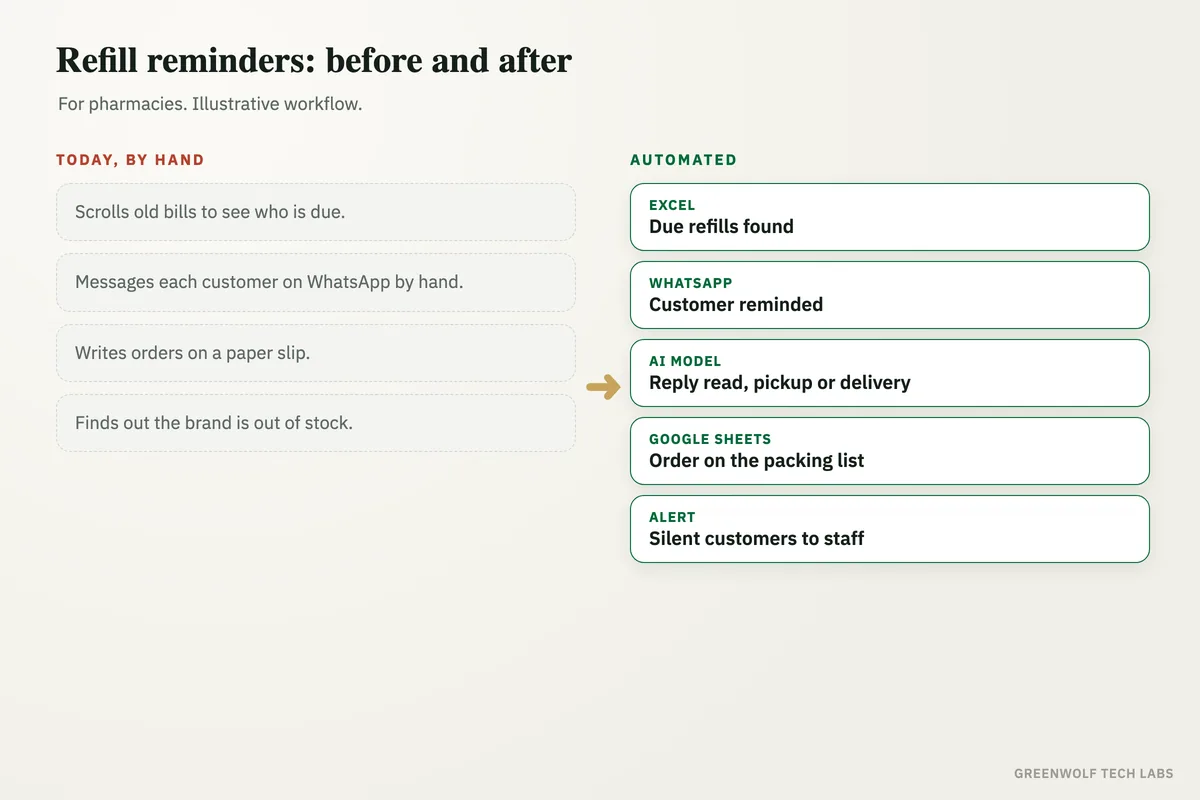
This workflow reads the day's due list from your billing records, works out whose medicine runs out in the next few days, sends each customer a WhatsApp reminder, reads the reply with an AI model, puts the confirmed order on the packing list for pickup or delivery, and hands silent customers to a staff member as a short call list. Your pharmacists talk to the customers who need a person. The routine reminding runs on its own.
What gets automated
Due refills found every morning
Each regular customer's last purchase, quantity and daily dose are read from your billing software export or a sheet, and the date the medicine runs out is worked out.
- Monthly medicines only
- Days left counted
- Overdue customers included
Customers reminded on WhatsApp
Each customer gets a short WhatsApp message a few days before they run out, naming the medicine and asking if they want it ready.
- Medicine named
- Pickup or delivery
- Polite repeat if silent
Replies read and orders made
Replies such as yes, deliver tomorrow or only the sugar tablets this time are read by an AI model and turned into an order line.
- Free text understood
- Changes picked out
- Order confirmed back
Packing list and stock check
Confirmed orders land on the day's packing list, and any medicine short in stock is flagged so it can be ordered before the customer arrives.
- One packing list
- Short stock flagged
- Delivery slots grouped
Silent customers sent to staff
Customers who do not reply after two reminders go on a short call list for a staff member, with the medicine and past messages ready.
- Short daily call list
- History in one place
- Wrong numbers flagged
Refills on one screen
Refills due, confirmed, collected and missed show on one dashboard for the owner, by day and by medicine.
- Due vs confirmed
- Missed refills
- Customers who stopped
How the workflow runs
Billing software: due refills found
Every morning the regular customers whose medicine runs out in the next few days are picked out of the billing export or the refill sheet.
WhatsApp: customer reminded
Each customer gets a message naming the medicine and asking whether to keep it ready or deliver it.
AI model: reply read
The reply is read and the choice, pickup or delivery, and any change to the order are picked out of it.
Google Sheets: order added to the packing list
Confirmed orders go on the day's packing list with the delivery address or pickup time, and short stock is flagged.
Alert: call list to staff
Customers who do not reply go to a staff member as a short call list with the details ready.
Dashboard: every refill on one screen
Due, confirmed, collected and missed refills show on one view for the owner.
Who it is for
What you need to start
You keep the tools you already use: the pharmacy billing software you run today, or the Excel and Google Sheets files your counter team keeps. Reminders go out from a WhatsApp Business number, the packing list lives in Google Sheets, and the workflow sits between them, built on tools such as n8n or Make with an AI model to read the replies.
The data is what you already have: each regular customer's name and mobile number, the medicines they buy every month, the quantity and how many tablets a day they take. Customers should agree to receive reminders, and the messages name the medicine only in a short, private chat. If the customer list has gaps, cleaning it is the first part of the build.
A first version that finds due refills, sends reminders and adds replies to the packing list for a pharmacist to check usually takes a couple of weeks. The staff call list and the dashboard follow once the team trusts the orders.
Questions about pharmacy refill reminders
How do pharmacies send refill reminders?
How does it know when a customer's medicine runs out?
Does it work with our pharmacy billing software?
Will customers need an app to reorder?
Is it safe to send medicine names on WhatsApp?
How many regular customers run out before they come back?
Book a digital audit. Tell us which billing software you use and how your team reminds customers today, and we will map what automated pharmacy refill reminders would look like for your store.
Part of our Sales and Marketing Automation hub. Start with our marketing automation services.